
The 10 KPIs Every Pharma E-Commerce Manager Must Track Daily and Monthly
The Essential Dashboard for Managing Your Digital Shelf on Amazon, CVS Pharmacy, and Walgreens
Introduction: Why Rigorous KPI Tracking Has Become Essential
E-commerce pharma in the United States is experiencing rapid transformation. While online sales still represent approximately 2% of the total pharmacy market, health and wellness products are recording annual growth of around 15%, driven by dietary supplements, wellness, personal care, and dermatology categories. Platforms like Amazon, CVS Pharmacy, and Walgreens are engaged in fierce competition, while consolidation led by major players is reshaping market dynamics.
In this environment, an e-commerce manager who operates without visibility loses ground every day. A product going out of stock, a product listing modified by a third-party seller, or a competitor launching an aggressive advertising campaign on your keywords: each event can shift your market share within hours.
The solution? A structured dashboard built around precise KPIs, with alert thresholds, clearly defined monitoring frequency, and a decision framework for each indicator. That's exactly what this article offers.
We'll review the 10 essential KPIs that every e-commerce manager in the consumer healthcare (CHC) sector must master, distinguishing what needs daily monitoring from monthly oversight. For each indicator, you'll find a definition, benchmarks adapted to the U.S. market, alert thresholds, and a concrete action framework.
Daily vs. Monthly Monitoring: An Operational Discipline
Before diving into KPIs, let's clarify the frequency logic.
Daily indicators: These are metrics that can evolve hourly and whose undetected degradation causes immediate losses. A search ranking drop, stock outage, or Buy Box loss requires same-day response.
Monthly indicators: These are trend metrics. They allow you to measure your brand's trajectory, evaluate investment effectiveness, and guide strategy. Search share, review velocity, or advertising ROAS should be read as curves, not isolated points.
A platform like Smile Analytics allows you to configure this dual frequency in a single dashboard. Each morning, teams open their daily view to check critical signals, then consult monthly reports to adjust strategy. This discipline transforms data into competitive advantage.
KPI #1: Search Ranking
Definition
Search ranking measures your products' position in search results for your strategic keywords on each platform (Amazon, CVS Pharmacy, Walgreens). It's the digital equivalent of shelf placement in a physical pharmacy.
Frequency: Daily
Why It's Critical
On Amazon, the top three organic results capture over 60% of clicks. Dropping from position 3 to position 8 can quarter your click-through rate. In categories like pain relief or vitamin D supplements, where competition is dense, every position counts.
Benchmarks and Alert Thresholds
- Target: Top 5 for brand keywords, Top 10 for category keywords
- Yellow alert: Drop of 3+ positions on a strategic keyword
- Red alert: Falling out of Top 20 on a priority keyword
Decision Framework
| Signal | Immediate Action |
|---|---|
| Sudden drop on brand keyword | Check: listing modifications, stock outage, competitive advertising activity |
| Gradual drop on category keyword | Audit product listing content (title, bullets, backend keywords) |
| Unexpected improvement | Identify cause and systematize |
With Smile Analytics, you can track each SKU's ranking for dozens of keywords across all U.S. platforms, with daily historical data. The alert system automatically notifies you of any significant drops, preventing you from discovering problems during monthly reviews.
KPI #2: Content Score
Definition
Content score evaluates the completeness and quality of your product listings: optimized title, number of bullet points, detailed description, number and quality of images, presence of enhanced content (A+ Content on Amazon), and platform standard compliance.
Frequency: Daily (monitoring), Monthly (optimization)
Why It's Critical
An incomplete product listing is a direct conversion barrier. In the CHC sector, where consumer trust is paramount, the absence of detailed ingredient images or usage instructions can be enough to swing the sale to a competitor. Additionally, all platform algorithms favor the most complete listings.
In the United States, FDA requirements for health claims add complexity: content must be both persuasive and compliant.
Benchmarks and Alert Thresholds
- Target: Score above 90% across the entire catalog
- Yellow alert: Listing falling below 80%
- Red alert: Listing below 60% (critical content missing)
Decision Framework
When score drops, first verify if a third-party seller modified the listing. On Amazon, content contributions from Marketplace sellers can degrade your listings without your knowledge. Then prioritize corrections based on revenue impact: start with the 20% of SKUs generating 80% of revenue.
Smile Analytics assigns a content score to each product in your portfolio and automatically compares it to category leaders. You can see at a glance which listings need priority optimization.
KPI #3: Product Availability Rate
Definition
Availability rate measures the percentage of time your products are in stock and purchasable on each platform. It's not just about having warehouse inventory: the product must appear available to the end consumer.
Frequency: Daily
Why It's Critical
A stock outage doesn't just lose immediate sales. On Amazon, it triggers a cascade of degradations: organic ranking drop, loss of Amazon's Choice badge, automatic advertising campaign suspension. Industry data shows it takes an average of two to four weeks of sustained sales to regain previous ranking after an outage.
For CHC brands selling through Vendor Central (1P) on Amazon, outages often stem from Amazon's own supply chain, making proactive monitoring even more important.
Benchmarks and Alert Thresholds
- Target: 98% availability on major platforms
- Yellow alert: Availability below 95%
- Red alert: Any complete outage on a Top 20 SKU
Decision Framework
Availability is a KPI where prevention is infinitely better than cure. Set up alerts on inventory trends (rapid inventory level decline) to act before outage. When outage is detected, immediately coordinate with supply chain and suspend advertising spend on the affected product.
Smile Analytics monitors your product availability on Amazon, CVS Pharmacy, Walgreens, and other platforms in real-time. Outage alerts are sent upon detection, potentially preventing significant ranking losses.
KPI #4: Buy Box Rate (Buy Box %)
Definition
Buy Box rate represents the percentage of time your offer (or that of an authorized reseller) is featured in the main purchase box on the product page on Amazon.
Frequency: Daily
Why It's Critical
On Amazon, over 80% of purchases are made through the Buy Box button. If an unauthorized third-party seller takes the Buy Box with a lower price, you lose not only the sale but also control of price and customer experience. In the pharmaceutical sector, where brand image and trust are essential, a Buy Box lost to a gray market seller can have disastrous consequences.
Benchmarks and Alert Thresholds
- Target: Over 95% Buy Box on strategic SKUs
- Yellow alert: Buy Box below 90%
- Red alert: Buy Box below 70% or total Buy Box loss
Decision Framework
| Identified Cause | Action |
|---|---|
| Lower price from third-party seller | Verify selective distribution policy, contact seller, adjust pricing strategy |
| Stock outage on your offer | Reactivate supply as priority |
| Unauthorized seller | Initiate unauthorized sales action |
Smile Analytics tracks your Buy Box rate evolution hour by hour, identifies third-party sellers taking the Buy Box, and correlates these changes with sales impact.
KPI #5: Average Rating and Review Count
Definition
Average rating (out of 5 stars) and total number of customer reviews for your products on each platform. These two metrics work in tandem: excellent rating with few reviews inspires less confidence than good rating with significant volume.
Frequency: Daily (monitoring), Monthly (analysis)
Why It's Critical
In the consumer health sector, reviews play a disproportionate role compared to other product categories. A consumer buying pain relief, dietary supplement, or dermatological care places major importance on other users' experience feedback. Industry data suggests dropping below 4.0 stars on Amazon can reduce conversion rate by 20-30% in CHC categories.
The FDA doesn't directly regulate reviews, but adverse event reporting obligations mean any adverse effect mention in a review must be detected and processed quickly.
Benchmarks and Alert Thresholds
- Target: Rating above 4.2 stars, minimum 50 reviews per major SKU on Amazon
- Yellow alert: Rating falling below 4.0 stars
- Red alert: Review mentioning safety issue or adverse effect
Decision Framework
When rating drops, analyze recent reviews to identify root cause (quality defect, packaging issue, product misunderstanding). A review mentioning side effects in the pharmaceutical sector must be reported to medical or regulatory team in compliance with pharmacovigilance obligations.
Smile Analytics continuously monitors ratings and reviews across all U.S. platforms, with automatic detection of critical reviews or safety-related mentions. This permanent surveillance is particularly valuable in a regulatory context where reactivity is mandatory.
KPI #6: Review Velocity
Definition
Review velocity measures the rate at which new reviews are published for your products over a given period (typically weekly or monthly). It's an indicator of customer engagement and commercial momentum.
Frequency: Monthly
Why It's Critical
A product with stagnant reviews sends negative signals to both algorithm and consumer. If your direct competitor gains 15 reviews monthly while you receive only 3, the credibility gap widens rapidly. On Amazon, review freshness is a ranking factor: a recent review counts more than an old one.
Benchmarks and Alert Thresholds
- Target: Maintain velocity at least equivalent to main competitors in the category
- Yellow alert: Velocity declining by more than 30% month-over-month
- Red alert: No new reviews for more than 30 days on a strategic SKU
Decision Framework
If velocity drops, first assess whether sales volume decreased (fewer sales mechanically equals fewer reviews). If sales are stable, consider review generation programs compliant with platform policies, like Amazon Vine for new products, or packaging inserts encouraging review submission. Caution: In the U.S., fake reviews are strictly prohibited by the FTC and subject to penalties.
Smile Analytics measures review velocity by product and category, enabling direct comparison with competitors. You can thus prioritize review generation programs on SKUs where the gap is most significant.
KPI #7: Share of Search
Definition
Share of search represents the percentage of visibility of your products in search results for a set of strategic keywords in your category. It's calculated as the proportion of positions occupied by your products relative to all displayed results.
Frequency: Monthly
Why It's Critical
Share of search is considered one of the best leading indicators of market share. If your share of search increases on your category's key terms, your market share will follow. Conversely, share of search erosion is an early warning signal of competitive ground loss.
In the U.S. market where online health and wellness is growing rapidly, positions are won and lost quickly. Private label brands (like Amazon Basic Care) are gaining ground in certain routine care categories, making share of search monitoring increasingly strategic.
Benchmarks and Alert Thresholds
- Target: Share of search greater than or equal to your offline market share
- Yellow alert: Loss of more than 2 share points in one month
- Red alert: Loss of more than 5 points or overtaking by new competitor
Decision Framework
A share of search decline should trigger multichannel analysis: is it a content problem (poorly optimized listings), advertising visibility (insufficient budgets), availability (stock outages), or competitive activity (new launch, aggressive campaign)? The appropriate response depends on the diagnosis.
Smile Analytics automatically calculates your share of search on Amazon, CVS Pharmacy, Walgreens, and other platforms. The competitive comparison view identifies precisely where you're losing ground and why.
KPI #8: Price Monitoring
Definition
Price monitoring compares your product prices on each platform both against your recommended price and against prices practiced by direct competitors (generics, private label brands, competing brands).
Frequency: Daily
Why It's Critical
Price is a determining factor for Buy Box on Amazon and a direct conversion lever. But in the CHC sector, price also plays a quality signal role: a price too low on a premium dietary supplement can erode brand perception. Conversely, too large a price gap with a generic mechanically reduces conversion rate.
Online sales of over-the-counter medications in the United States are regulated by the FDA, but pricing remains free for prescription and non-prescription health products.
Benchmarks and Alert Thresholds
- Target: Gap less than 5% from recommended price on authorized channels
- Yellow alert: Price more than 10% below recommended price (potential erosion)
- Red alert: Unauthorized seller price cutting, or price gap causing Buy Box loss
Decision Framework
An abnormal price gap should first be confirmed (input error? unauthorized promotion? parallel market seller?). If the problem comes from an unauthorized seller, activate your selective distribution strategy. If it's a competitor lowering prices, evaluate whether it's a temporary promotion or strategic repositioning before reacting.
Smile Analytics monitors prices for your portfolio and competitors across all platforms, with configurable alerts for significant deviations.
KPI #9: Advertising Performance (Ad Performance / ROAS)
Definition
This KPI groups your retail media campaign performance metrics: ROAS (Return On Ad Spend), ACoS (Advertising Cost of Sale), click-through rate (CTR), cost per click (CPC), and campaign conversion rate. On Amazon, it covers Sponsored Products, Sponsored Brands, and Sponsored Display.
Frequency: Daily (spend and budget), Monthly (strategic analysis)
Why It's Critical
Retail media is the fastest growth lever in U.S. pharma e-commerce. Amazon Advertising and retail media networks offer precise targeting opportunities. But without rigorous monitoring, advertising waste can reach 20-30% of budgets.
In the CHC sector, CPCs on category keywords (e.g., "vitamin D supplement" or "pain relief gel") are often higher than in traditional consumer categories, making optimization even more crucial. The FTC requires clear labeling of sponsored content, which can influence usable advertising formats.
Benchmarks and Alert Thresholds
- Target ROAS: Above 4x for brand campaigns, above 2x for category campaigns
- Target ACoS: Below 20% for brand campaigns, below 35% for conquest campaigns
- Yellow alert: ROAS declining by more than 20% in one week
- Red alert: ACoS exceeding 50% on significant campaign
Decision Framework
| Situation | Action |
|---|---|
| ROAS declining, stable CPC | Check product listing (problem is likely conversion, not traffic) |
| CPC sharply increasing | Analyze competitive pressure, adjust bids, explore long-tail keywords |
| Good advertising performance on poorly-rated product | Prioritize review generation to amplify advertising effect |
| Advertising spend on out-of-stock product | Immediately suspend campaign |
The integration between advertising metrics and digital shelf metrics is a fundamental advantage of Smile Analytics. The platform correlates advertising performance with content score, availability, and reviews. You can thus identify products not ready to receive advertising budget and reallocate investments to best-optimized SKUs.
KPI #10: Competitive Alerts
Definition
Competitive alerts group all change signals from your direct competitors: product listing modifications, price changes, new SKU launches, rating and review evolution, appearance of new advertising campaigns, or enhanced content modifications.
Frequency: Daily (alerts), Monthly (in-depth analysis)
Why It's Critical
Pharma e-commerce is a zero-sum game on many keywords. If a competitor launches an aggressive campaign on "probiotic gut health" or optimizes their product listing for "organic anti-aging cream," the impact on your visibility is immediate. Brands that react within hours protect their positions. Those that react within weeks suffer cumulative losses difficult to recover.
In the United States, e-pharmacy market consolidation involves frequent strategic movements. Platform expansion and increasing aggressiveness of private label brands in health and wellness generate constant change flow to monitor.
Benchmarks and Alert Thresholds
- High alert: New competitive product launch in strategic category
- Medium alert: Price change or enhanced content update by direct competitor
- Informational alert: Gradual evolution of competitive reviews
Decision Framework
Competitive alerts don't all require action. The key is having a prioritization framework:
- Direct threat to your sales (new product, aggressive campaign): team meeting within 24 hours to define response
- Tactical change (listing optimization, price adjustment): integration into your next weekly review
- Trend evolution (gradual competitive review improvement): integration into your monthly strategy
Smile Analytics excels in automated competitive surveillance. The platform detects competitor changes across all U.S. platforms and presents them by priority level. You never miss a strategic move while avoiding information overload.
Daily Workflow: From Data to Decision
Having the right KPIs isn't enough. The challenge is transforming them into quick, relevant decisions. Here's the daily workflow a high-performing e-commerce team should follow.
Morning Check-up (15 minutes)
- Open Smile Analytics dashboard and check overnight alerts
- Scan critical indicators: availability, Buy Box, search ranking, price alerts
- Identify urgent actions: stock outages, Buy Box losses, sudden ranking drops
- Delegate: assign each urgent action to a responsible person with resolution deadline
Weekly Review (30 minutes)
- Analyze weekly trends on content KPIs, reviews, and advertising performance
- Compare performance by platform (Amazon vs. CVS Pharmacy vs. Walgreens)
- Examine accumulated competitive alerts
- Adjust advertising bids and content priorities
Monthly Report (2 hours)
- Evaluate share of search and its evolution versus competitors
- Analyze review velocity and identify SKUs needing generation programs
- Measure ROAS over the period and identify campaigns to optimize or stop
- Prepare executive report with aggregated KPIs, actions taken, and next priorities
This structured cycle is exactly what Smile Analytics automates. The dashboard presents prioritized alerts each morning, generates weekly and monthly reports, and maintains history that measures each decision's impact.
How to Define Your Alert Thresholds: Three-Step Method
Most teams make the mistake of setting thresholds too wide (constant unnecessary alerts) or too narrow (serious problems detected too late). Here's the recommended method.
Step 1: Establish Your Baseline
For the first 30 days, collect your KPIs without setting alerts. Observe each indicator's natural volatility. On Amazon, search ranking can fluctuate 2-3 positions daily without significance.
Step 2: Define Thresholds Adapted to Volatility
Set alert thresholds beyond normal volatility. If your ranking naturally varies by plus/minus 3 positions, a 5-position drop alert will be more relevant than a 2-position alert that triggers too often.
Step 3: Refine Quarterly
Review thresholds quarterly based on market evolution. High seasonality periods (winter for cold/flu products, spring for antihistamines) require adapted thresholds.
In Smile Analytics, thresholds are fully configurable by product, category, and platform. The system learns from your historical data to suggest relevant alert levels and reduce false positives.
Summary Table of 10 KPIs
| # | KPI | Frequency | Main Objective | Critical Alert Threshold |
|---|---|---|---|---|
| 1 | Search Ranking | Daily | Top 5 brand keywords | Drop of more than 5 positions |
| 2 | Content Score | Daily/Monthly | Above 90% | Listing below 60% |
| 3 | Product Availability | Daily | Above 98% | Outage on Top 20 SKU |
| 4 | Buy Box Rate | Daily | Above 95% | Buy Box below 70% |
| 5 | Rating and Review Count | Daily/Monthly | Above 4.2 stars, 50+ reviews | Rating below 4.0 or safety alert |
| 6 | Review Velocity | Monthly | At least equal to competitors | No reviews in 30 days |
| 7 | Share of Search | Monthly | In line with offline market share | Loss of more than 5 points |
| 8 | Price Monitoring | Daily | Gap below 5% of recommended price | Price cutting by unauthorized seller |
| 9 | Advertising Performance | Daily/Monthly | ROAS above 4x (brand) | ACoS above 50% |
| 10 | Competitive Alerts | Daily/Monthly | Complete coverage | Direct competitive launch |
U.S. Market Specificities to Consider
Monitoring these KPIs in the United States occurs within a particular regulatory and competitive context worth noting.
Multiple regulatory framework. The FDA regulates medications, the FTC monitors health claims and deceptive commercial practices, while state boards regulate pharmacy operations. Your content KPIs must therefore integrate regulatory compliance dimensions.
Dense pharmacy network. With major chains like CVS Health (approximately 9,600 locations) and Walgreens (approximately 8,500 locations), plus independent pharmacies, the click-and-collect model is particularly strong in the United States. Your KPIs must cover online pharmacy platforms as much as general marketplaces.
Digital-first competition. The arrival of digital-native players like Capsule and HealthWarehouse introduces new competitors with significant budgets and data-driven approaches. Competitive alerts must monitor these players in addition to traditional competitors.
Smile Analytics: The Dashboard That Brings These 10 KPIs to Life
Throughout this article, each KPI has been illustrated with Smile Analytics features. This isn't coincidence: the platform was designed precisely to meet the needs of CHC e-commerce teams in the U.S. market.
In practice, here's what Smile Analytics brings to each stage:
- Unified multi-platform view: Amazon, CVS Pharmacy, Walgreens, and other retailers tracked in one dashboard
- Intelligent, customizable alerts: Configurable thresholds by product, category, and platform, with automatic prioritization
- Automated competitive benchmarking: Continuous competitor monitoring without manual effort
- Automatic reporting: Daily, weekly, and monthly reports generated and distributed to the right people
- KPI correlation: Ability to link advertising performance, content, availability, and reviews for informed decisions
- Regulatory compliance: Listing content monitoring to detect potential gaps with FDA and FTC requirements
From major pharmaceutical brands to health and wellness SMEs, Smile Analytics supports e-commerce teams wanting to move from reactive to proactive digital shelf management.
Conclusion: The Daily Discipline That Makes the Difference
In U.S. pharma e-commerce, the difference between brands gaining market share and those losing it often doesn't come down to product quality. It comes down to the e-commerce team's ability to detect weak signals, react quickly, and make the right decisions at the right time.
The 10 KPIs presented in this article aren't simple numbers to passively consult. They're action levers. Each is associated with a threshold, frequency, and decision framework that transforms raw data into competitive advantage.
The question is no longer whether you should track these KPIs. It's how quickly you can implement this discipline. With a tool like Smile Analytics, this implementation can happen in days, not months.
Ready to transform your e-commerce data into competitive decisions? Request a Smile Analytics demonstration and discover how your team can manage these 10 KPIs from a single dashboard.
This article was produced by Smile AI, leader in CHC e-commerce. Smile AI provides artificial intelligence, data, and consulting solutions that have generated over one billion dollars in e-commerce growth for clients over the past five years.
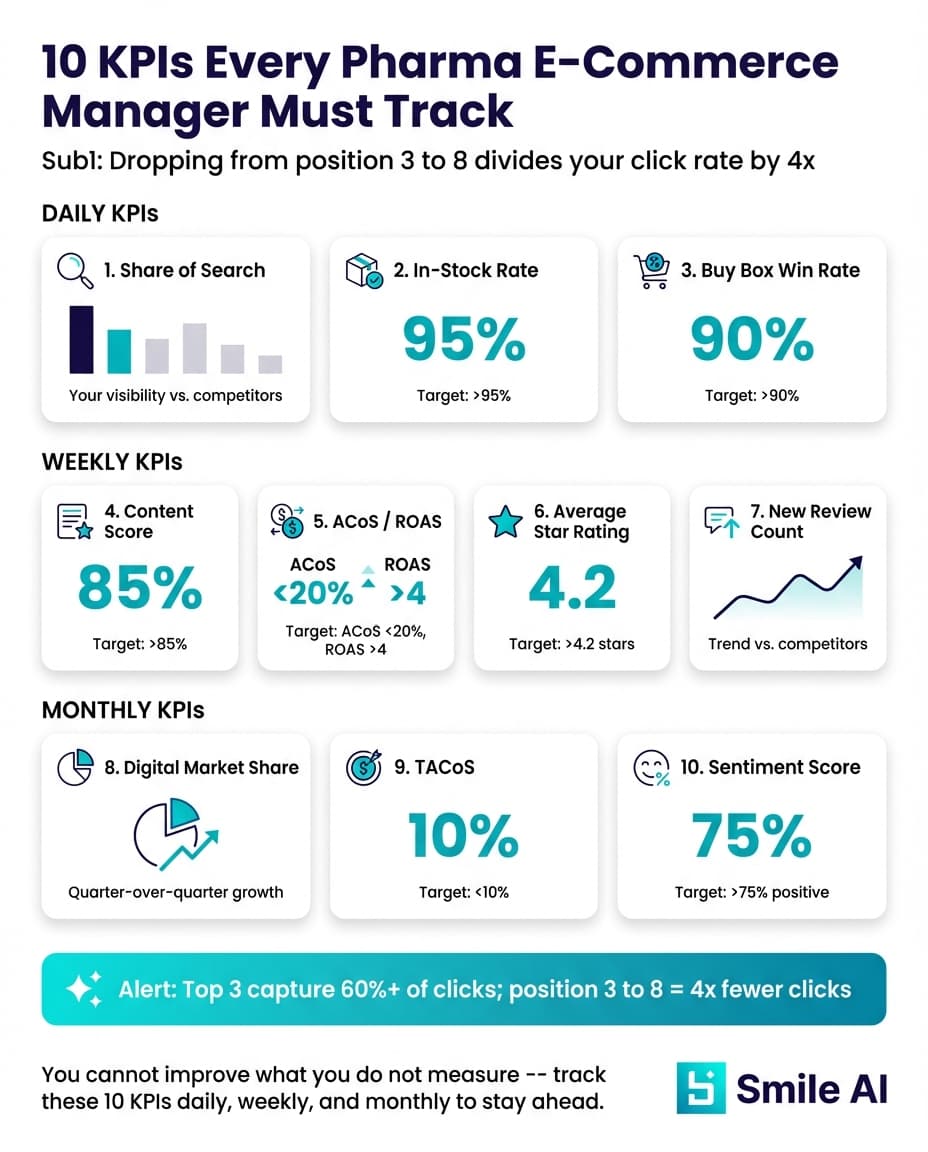
The essentials at a glance
Key takeaways from this article in one infographic.
© Smile AI 2026
Ready to dominate the Digital Shelf?
Discover how Smile Analytics helps Consumer Healthcare brands optimize their e-commerce performance across all platforms.
Related articles
The 2026 Pharma E-Commerce Playbook
How Consumer Healthcare Brands Dominate the Digital Shelf in the United States
Pharma Retail Media in the United States
The Complete Guide to Advertising on Amazon, CVS Pharmacy, and Walgreens