
Why Your CHC Product Isn't Ranking
10 Search Visibility Mistakes Killing Your Online Sales
Your product has been online for months, but it remains unfindable. Sales are stagnating. Your competitors dominate the top positions. The problem is probably not your product–it's how it's listed.
In the Consumer Healthcare (CHC) space in the United States, the battle for visibility is no longer fought solely in brick-and-mortar pharmacies. It plays out on Amazon.com, CVS Pharmacy online, Walgreens.com, and dozens of other e-commerce platforms. And in this digital arena, the rules are unforgiving: if your product listing isn't optimized, it simply doesn't exist.
The numbers tell the story. Thousands of health, wellness, and personal care products are published each year on US marketplaces. Yet the vast majority never make it past the third page of results. They accumulate a few views, even fewer clicks, and practically no conversions. This isn't inevitable–it's the direct result of recurring mistakes that marketing and e-commerce teams often don't know to look for.
This article examines the 10 most common errors that prevent your CHC products from ranking in search results. For each, we provide clear diagnostics and concrete action plans. Because the good news is that every one of these mistakes is fixable–provided you know where to look.
Mistake #1: Incomplete or Poorly Filled Backend Keywords
This is probably the most widespread and most underestimated mistake. On Amazon.com, backend keyword fields (also called search terms) represent a major SEO lever. These terms, invisible to shoppers but essential to the algorithm, allow your product to be indexed for queries that your title and bullet points don't cover.
Yet in the CHC sector, these fields are often left empty, partially filled, or populated with terms already present in the title. The result: your product misses out on hundreds of relevant queries.
Common mistakes:
- Leaving the search terms field empty when creating the listing.
- Repeating words already present in the title or product attributes (the algorithm already indexes them).
- Ignoring common spelling variations (e.g., "ibuprofen" vs. "Advil" vs. "pain reliever").
- Not including synonyms and everyday terms used by consumers ("headache" instead of "cephalgia").
- Exceeding the allowed character limit, resulting in silent non-indexation of the entire field.
What to do: Systematically fill your backend keywords with terms not covered by your other fields. Think like a consumer, not a healthcare professional. Use a diagnostic tool to verify the completeness of your indexation–platforms like Smile Analytics can identify keyword gaps across each listing in just a few clicks and prioritize corrections.
Mistake #2: A Title That Prioritizes Branding Over Search
We understand the attachment to brand identity. But on a marketplace, your product title isn't an advertising slogan–it's your first, and often your only, search visibility lever.
Too many CHC product listings in the US display titles like: "[Brand] - The Natural Solution For Your Well-Being - Exclusive Formula." This type of title, however appealing in marketing communications, is a disaster for SEO. Amazon's algorithm and other platforms primarily look for matches between user queries and title terms.
A strong e-commerce title should:
- Start with the brand name (Amazon requirement), followed by product type.
- Integrate primary keywords within the first 80 characters.
- Mention the dosage form (tablets, syrup, spray), dosage, and unit count.
- Include the primary indication in everyday language.
Concrete example:
- Weak: "VitaZen - Your Daily Health Partner - New Formula"
- Strong: "VitaZen Vitamin D3 1000 IU - 90 Tablets - Immune System & Bone Health Support Supplement - Adult"
The second title contains the keywords a consumer will actually search for. This pragmatic approach generates visibility. Smile Analytics lets you compare your title structure against the best-ranking products in your category and immediately identify missing search terms.
Mistake #3: A Low Content Score
Marketplaces evaluate your product listing quality based on specific criteria: field completeness, image presence, description richness, number of bullet points, and more. This "content score" directly influences your ranking.
In the CHC sector, product listings are often minimalist–a single image on a white background, three sparse bullet points, no detailed description. On Amazon.com, a listing with a low content score will be systematically disadvantaged compared to a competitor who has filled every available field.
Elements that build a strong content score:
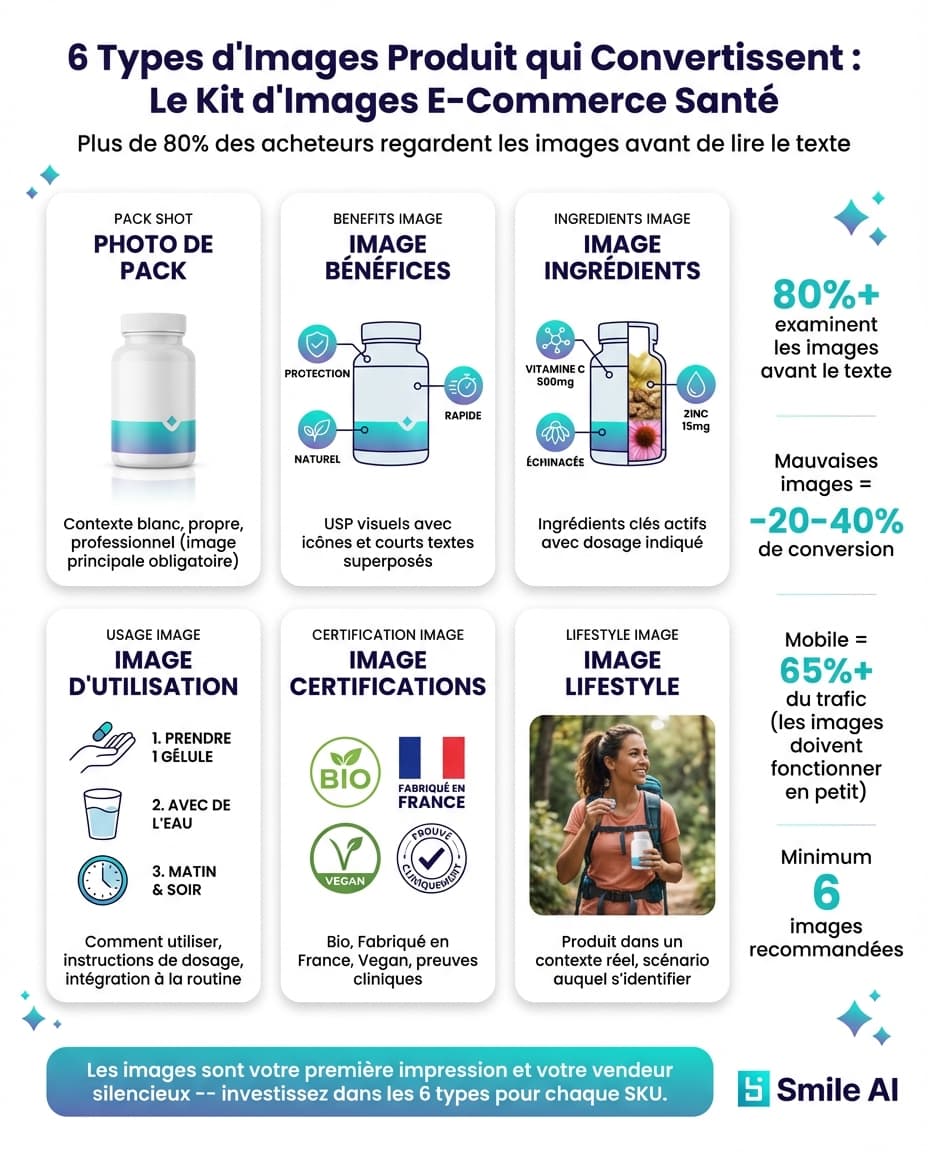
- At least 5 high-quality images (product, lifestyle, ingredients, usage instructions).
- 5 detailed bullet points integrating secondary keywords.
- A complete product description of at least 200 words.
- Correctly filled product attributes (category, subcategory, target audience, dosage form).
- Active and optimized A+ Content (Enhanced Brand Content).
Every empty field is a lost SEO opportunity. With Smile Analytics' diagnostic dashboard, you can evaluate the content score of each listing in real time and receive prioritized recommendations to reach the optimal threshold.
Mistake #4: Too Few Reviews–or a Declining Review Count
Customer reviews are a major ranking factor across all marketplaces. On Amazon.com, a product with fewer than 15 reviews will struggle to break through, even with a perfect title and keywords. The A9 algorithm (now evolved to A10 and beyond) favors products with strong social proof: review count, average rating, and review recency.
For CHC products, this issue is particularly acute. Shoppers of dietary supplements, medical devices, or health and beauty products need reassurance. A product without reviews–or with outdated reviews–inspires far less confidence than a competitor displaying dozens of recent testimonials.
Strategies to build your review base:
- Use the Amazon Vine program for new product launches.
- Enable automatic review requests via Seller Central.
- Include review reminders in your package inserts (in compliance with Amazon's terms of service).
- Respond to negative reviews consistently to demonstrate brand engagement.
- Monitor your review-to-sales ratio to detect anomalies.
Don't underestimate the value of rigorous monitoring. Smile Analytics integrates review trend tracking by product and platform, allowing you to directly correlate ranking performance with reputation dynamics.
Mistake #5: Ignoring Long-Tail and Symptom-Based Searches
This is one of the most costly strategic mistakes. Most CHC brands focus their optimization efforts on generic, ultra-competitive keywords: "vitamin C," "probiotic," "moisturizer." However, these queries are dominated by established players with large advertising budgets and significant sales history.
The real opportunity lies in long-tail and symptom-based searches. A consumer doesn't always type "probiotic"–they search for "bloating after meals natural solution" or "supplement to sleep better without dependency." These queries are less competitive but highly intentional, representing a source of qualified traffic.
How to capture long-tail traffic:
- Map symptom-based searches related to your products.
- Integrate these phrases into your bullet points, description, and backend keywords.
- Create content variants tailored to the most frequently asked questions.
- Analyze Amazon.com autocomplete suggestions to identify real consumer search patterns.
Smile Analytics lets you map long-tail queries where your competitors rank and you don't. Its keyword tracking module automatically surfaces unexploited opportunities across your catalog so you can close those gaps before your competitors do.
Mistake #6: Not Optimizing for Each Retailer's Specific Algorithm
Amazon.com is not CVS Pharmacy. CVS Pharmacy is not Walgreens. Each e-commerce platform has its own ranking algorithm, its own relevance criteria, and its own promotion rules.
Too many brands take a copy-paste approach: the same product listing duplicated identically across all platforms. But ranking factors differ significantly from one marketplace to another.
What changes by platform:
- Amazon.com: The algorithm prioritizes conversion rate, sales velocity, keyword relevance, and reviews. A+ Content plays an increasingly important role.
- CVS Pharmacy: Product categorization, completeness of pharmaceutical information, and regulatory compliance are paramount. The best-ranked listings include comprehensive product data.
- Walgreens: User experience and visual quality are particularly valued. Descriptions oriented toward pharmaceutical guidance tend to perform better.
The winning approach: Adapt each product listing to the target platform's specific requirements. This takes additional effort, but the return on investment is significant. Smile Analytics' dashboard offers a comparative view of your performance by platform, helping you identify where your listings are under-optimized and what specific adjustments to make for each retailer.
Mistake #7: Stock Outages That Destroy Your Ranking Momentum
Inventory management isn't just a logistics issue–it's an SEO issue. When a product goes out of stock on Amazon.com, the consequences for its ranking are immediate and lasting.
The algorithm penalizes unavailable products by removing them from search results. And when stock is restored, the product doesn't automatically regain its previous position. It must rebuild its visibility from scratch, which can take weeks or even months depending on the outage duration and category competition.
Impact in numbers: A 7-day stock outage can result in a ranking drop of 20 to 50 positions. Beyond 14 days, a product can remain virtually invisible for several weeks after restocking.
How to prevent this:
- Set up stock alerts with anticipated replenishment thresholds.
- Use sales forecasts to adjust FBA (Fulfillment by Amazon) shipments.
- Consider dual sourcing (FBA + FBM) to cover transition periods.
- Continuously monitor the availability of your listings across all platforms.
Smile Analytics' tracking features include correlation between product availability and ranking trends. When an outage is detected, the system alerts your team and projects the potential impact on visibility so you can act before the damage becomes irreparable.
Mistake #8: No A+ Content (Enhanced Brand Content)
A+ Content on Amazon.com is no longer a luxury–it's a competitive necessity. This enhanced format, available to brands enrolled in Brand Registry, lets you add visual modules, comparison tables, detailed imagery, and brand narratives directly to the product page.
For CHC products, A+ Content serves a dual function. It improves conversion rate by providing the additional information shoppers need to make a decision (usage instructions, ingredients, comparison with other products in the line). And it indirectly contributes to ranking by boosting the click-to-purchase ratio–a strong signal for the algorithm.
Elements of effective CHC A+ Content:
- A brand story module that reinforces credibility.
- Explanatory visuals of how the product works.
- A comparison table of products in the line (promotes cross-selling and reduces return rate).
- Icons and infographics summarizing key benefits.
- SEO-optimized text (A+ Content is now indexed by Amazon).
Did you know? Since Amazon's latest algorithm updates, text within A+ Content modules is indexed and contributes to organic SEO. Ignoring this lever means giving up additional real estate for your most strategic keywords.
Smile Analytics evaluates the presence and quality of your A+ Content relative to your direct competitors and identifies missing modules that could maximize your conversion rate and visibility.
Mistake #9: Cannibalizing Your Own Keywords
Keyword cannibalization is an insidious problem that particularly affects brands with large catalogs. The concept is straightforward: when several of your listings target exactly the same keywords, they compete against each other in search results.
In the CHC sector, this scenario is extremely common. A brand marketing three magnesium products (tablets, capsules, powder) often uses the same terms across all three listings. The algorithm then can't determine which listing to prioritize and, rather than surfacing one at the top, dilutes the visibility of all three.
How to detect cannibalization:
- Search your primary keywords and check whether multiple of your own products appear in results–and at what positions.
- Look for erratic ranking fluctuations–a product alternating between page 1 and page 3 is often a victim of cannibalization.
- Compare the target keywords of each listing in your catalog.
How to fix it:
- Assign a unique primary keyword to each listing.
- Differentiate titles and bullet points to reflect each product's specific attributes (dosage form, target audience, intended use).
- Use backend keywords to create clear semantic distinctions between listings.
- Structure your catalog around a "keyword pillar" framework where each product owns its own semantic territory.
Smile Analytics' catalog analysis module automatically detects cannibalization within your product portfolio. It maps keyword overlaps between your listings and proposes an optimal redistribution to maximize your brand's overall search coverage.
Mistake #10: Not Monitoring Ranking Changes
The final mistake–and perhaps the most fundamental–is the absence of ongoing monitoring. Rankings on marketplaces are dynamic. Positions shift daily based on competitor actions, algorithm updates, seasonality, and dozens of other variables.
Too many e-commerce teams check their rankings sporadically–during monthly meetings or quarterly reviews. At that frequency, problems are detected far too late. An undetected ranking drop over two weeks can translate into significant revenue loss, and climbing back to page one becomes even harder.
Indicators to monitor continuously:
- Organic position on your target keywords (daily).
- Share of voice within your category.
- Ranking changes after each listing modification.
- Competitor movements (new entrants, price changes, promotions).
- Correlation between advertising spend (Sponsored Products) and organic ranking.
The game-changing tool: Smile Analytics offers automated, daily tracking of your rankings across all targeted platforms. Its diagnostic dashboard consolidates all performance indicators in one place: position, trend, drop alerts, and prioritized recommendations. Instead of reacting after the fact, your teams can anticipate visibility drops and act before commercial impact materializes.
From Audit to Action: A Systematic Approach
These 10 mistakes don't operate independently. They form an ecosystem of interdependencies where each weakness amplifies the others. A poorly optimized title reduces your click-through rate. A low click-through rate decreases your conversion rate. A declining conversion rate signals to the algorithm that your product is less relevant. And your ranking falls.
This is why a fragmented approach–fixing a title here, adding a keyword there–rarely produces meaningful results. What's needed is a complete, structured audit capable of identifying all improvement levers and prioritizing them by potential impact.
This is exactly what Smile Analytics delivers. Its diagnostic dashboard analyzes each of your listings across the 10 dimensions covered in this article: keyword completeness, title structure, content score, review dynamics, long-tail coverage, platform-specific optimization, inventory management, A+ Content presence, cannibalization risk, and ranking monitoring.
For each product, the platform generates an overall health score and a prioritized list of recommendations. Your teams immediately know where to focus their efforts for the best return on investment–no more juggling multiple tools, spreadsheets, and manual reports. All intelligence is centralized in a single interface.
Conclusion: Visibility Isn't Discovered, It's Built
The US health e-commerce market is growing fast. More and more consumers are purchasing their CHC products online, and this trend will only accelerate. For brands, the question is no longer whether to be present on marketplaces, but how to be visible there.
The 10 mistakes detailed in this article are neither rare nor inevitable. They stem from practices inherited from physical retail, applied without adaptation to a digital environment that operates by entirely different rules. The good news is that every one of these mistakes can be corrected–often with measurable impact within weeks.
But you still need to know where to start. This is where the difference is made between brands that grow and those that stagnate. The former have diagnostic tools that let them instantly identify problems, prioritize actions, and measure results. The latter move blindly, correcting a detail here while a critical issue penalizes them elsewhere.
Smile Analytics was designed to turn this complexity into clarity. By offering a unified view of each listing's performance–on each platform, across each optimization dimension–the platform gives e-commerce teams and brand managers the means to make informed decisions, fast.
Your CHC product has the potential to reach page one. It may simply be missing the right diagnosis.
Want to identify the mistakes affecting your products' visibility? Request a Smile Analytics demo and get a personalized audit of your catalog in less than 48 hours.
The essentials at a glance
Key takeaways from this article in one infographic.
© Smile AI 2026
Ready to dominate the Digital Shelf?
Discover how Smile Analytics helps Consumer Healthcare brands optimize their e-commerce performance across all platforms.
Related articles
The 2026 Pharma E-Commerce Playbook
How Consumer Healthcare Brands Dominate the Digital Shelf in the United States
Pharma Retail Media in the United States
The Complete Guide to Advertising on Amazon, CVS Pharmacy, and Walgreens