
Does ChatGPT Recommend Your Product?
How AI Search is Reshaping Pharmaceutical E-commerce in the United States
Introduction: Consumers No Longer Search, They Ask
Picture this scenario. An American consumer experiences persistent joint pain. Five years ago, they would have typed "best joint pain relief" into Google, browsed ten links, compared product pages on Amazon or CVS Pharmacy, then made their decision. Today, they open ChatGPT and simply type: "What supplement is most effective for joint pain?"
In seconds, the AI assistant presents a structured response: three or four named products, selection criteria, and precautions. No ten pages of results to browse through. No ads to filter. A direct, evidence-based answer that resembles personalized pharmaceutical advice.
This scenario is no longer science fiction. It happens millions of times daily around the world, and the United States is leading this transformation. According to industry estimates, ChatGPT now surpasses 300 million weekly active users globally, with the US representing the largest adoption market. Perplexity AI, Google AI Overviews, Microsoft Copilot: conversational search interfaces are multiplying and fundamentally transforming how consumers discover, evaluate, and choose health products.
For consumer healthcare (CHC) brands in the US market, the question is no longer whether this change will affect them. The question is: does your product appear in the answers these AIs provide?
The Rise of AI Search in the Health Journey
A Paradigm Shift in Product Discovery
Traditional search relies on a well-known model: users enter keywords, the engine returns a list of links, and users navigate through results. This model is being fundamentally challenged by Large Language Models (LLMs).
AI assistants like ChatGPT, Perplexity, or Google Gemini don't return lists of web pages. They synthesize information, formulate direct answers, and increasingly recommend specific products. In April 2025, OpenAI launched integrated shopping features in ChatGPT, allowing users to search for products, compare prices, and get recommendations directly within the conversational interface–all without paid advertising initially, based solely on the model's perceived relevance.
This change has major implications for the healthcare sector:
- Fewer clicks, more implicit trust. When an AI recommends a product, consumers tend to accord that recommendation a level of trust comparable to expert advice. Studies conducted by digital strategy consulting firms indicate that AI-generated recommendations benefit from significantly higher trust rates than traditional advertising.
- Concentration of choices. While Google displays ten organic results per page, an LLM typically mentions only two to five products in its response. Being in this restricted selection becomes a decisive competitive advantage.
- "Zero-click" extends to e-commerce. Google AI Overviews already provides direct answers for many health queries, reducing traffic to retailers' product pages. LLMs amplify this phenomenon.
Why the Healthcare Sector is Particularly Affected
Pharmaceutical e-commerce in the United States has characteristics that make LLM visibility even more strategic than in other sectors:
1. High-involvement purchases
Health products aren't impulse buys. Consumers research, compare, and inform themselves. According to market data, purchase journeys for dietary supplements or OTC medications involve an average of 4 to 7 touchpoints before decision. AI assistants naturally insert themselves into this intensive research phase.
2. Increased need for trust
In healthcare, trust is the primary decision criterion. American consumers, accustomed to pharmacist consultation, seek perceived expertise. AI responses that cite studies, reviews, and scientific arguments meet this need in a way that advertising cannot match.
3. US regulatory complexity
The US regulatory framework–the FDA for medications, FTC for health claims, state boards for online medication sales–creates an environment where reliable information is particularly valued. AIs that rely on regulated sources and compliant content have a natural advantage, and brands whose content meets these standards are more likely to be recommended.
4. The rapidly accelerating US market
Online health product sales in the United States represent a substantial and growing portion of the $400+ billion pharmacy market, with e-pharmacy growing at approximately 20% annually. Platforms like CVS Pharmacy, Walgreens, Amazon Pharmacy, and specialized players like HealthWarehouse are driving this growth. In this expansion context, product discovery channels are rapidly diversifying–and LLMs are part of this.
How Do LLMs Decide to Recommend Your Product?
Understanding LLM recommendation mechanisms is essential for any AI visibility strategy. Unlike traditional search algorithms (like Amazon's A10 or Google's PageRank), LLMs operate on different principles.
Content Signals That Matter
Authority and Source Credibility
LLMs synthesize information from vast data corpora. They prioritize sources perceived as authoritative: institutional sites, scientific publications, specialized media, and product pages rich in factual information. For a CHC brand in the US, this means that the quality of content on your product pages (Amazon, CVS Pharmacy, Walgreens), your brand site, and media mentions directly influences your AI visibility.
Authority signals include:
- References to clinical studies or certifications
- Mentions by healthcare professionals
- Information consistency across sources
- Structured data presence (schema markup) on owned sites
- Mentions in recognized healthcare industry publications
Content Completeness and Depth
LLMs tend to recommend products for which they have rich, detailed information. A product page with a generic title, three vague bullet points, and no enhanced content has much lower chances of being cited than a complete page with:
- A descriptive title including brand, active ingredient, format, and dosage
- Bullet points detailing benefits, usage instructions, and specifications
- Enhanced content (A+ Content, Enhanced Brand Content)
- Information on ingredients, certifications, and regulatory warnings
Consumer Voice: Reviews and UGC
Customer reviews constitute a powerful signal for LLMs. Volume, average rating, recency, and review content influence how an AI perceives a product. A product with 2,000 reviews at 4.5 stars on Amazon will have much stronger digital footprint than a competing product with 50 reviews at 3.8 stars.
Review elements that weigh most:
- Total volume and velocity (rate of new reviews)
- Average rating and its stability over time
- Richness of textual review content (details on efficacy, usage)
- Brand responses to reviews, particularly negative ones
Technical Signals
Structured Data and Schema Markup
For owned sites (DTC) and retailers that implement them, structured data (schema.org) help AIs understand and categorize products. Healthcare-specific schemas–MedicalProduct, Drug, HealthTopicContent–are particularly important.
Cross-platform Consistency
LLMs cross-reference information from multiple sources. If your product displays contradictory information between Amazon, your brand site, and CVS Pharmacy listings, this reduces the model's trust in your data. Information consistency (price, ingredients, claims, dosage) across all digital touchpoints is a credibility factor.
Content Freshness
The most recent models, particularly those integrating real-time web search (like Perplexity or ChatGPT with browsing), favor recent information. Regularly updated content signals relevance and timeliness.
New Frontiers: ChatGPT Shopping, Google AI Overviews, and Perplexity
ChatGPT Shopping: Recommendation Without Advertising
ChatGPT's shopping features represent a turning point. The tool now allows users to search for products, see images, reviews, prices, and purchase links directly in the conversation. The crucial point: at this stage, these recommendations are not sponsored. They're based on what the model considers the most relevant products for the user's query.
For the CHC sector in the US, the implications are considerable:
- Brands best referenced in the digital ecosystem are favored. If your product has abundant reviews, complete listings, and editorial mentions, it's more likely to appear.
- Absence of paid advertising means organic content quality is the only lever. Impossible to buy your place in a ChatGPT recommendation (for now).
- Conversational format favors precise answers. "What's the best magnesium for stress?" calls for an answer with product names, not a list of categories.
Google AI Overviews: Healthcare Zero-Click
Google AI Overviews (formerly SGE) generates synthetic responses at the top of search results for many queries, including health queries. In the US, deployment is progressive but accelerating. For queries like "best probiotic for digestion" or "effective vitamin D supplement," Google can now provide direct answers that significantly reduce clicks to retailer sites.
What this changes for brands:
- Organic traffic to product pages may decrease if Google answers directly
- Brands cited in AI Overview gain considerable visibility
- Content cited by Google AI Overviews tends to come from sources perceived as highly reliable
Perplexity AI: Conversational Search Engine with Sources
Perplexity AI positions itself as a Google alternative by combining web search with AI-generated responses. Each answer comes with cited sources, making it particularly suitable for health queries where information traceability matters. US early adopters increasingly use it for in-depth health research.
Data and Trends: Measurable Impact on Healthcare E-commerce
AI Search Adoption in the US
AI assistant adoption figures in the US are significant and rapidly growing:
- Mass adoption: According to recent studies, a substantial and growing proportion of American internet users have used a generative AI assistant, with this figure progressing rapidly quarter over quarter. The 18-35 age group leads adoption, but usage extends across all age groups.
- Health queries: Health-related questions rank among the most popular categories on AI assistants. Queries cover symptoms, treatments, dietary supplements, and product comparisons.
- Purchase intent: A growing share of AI users report purchasing products following AI assistant recommendations. This behavior is particularly pronounced in categories where trust and information are central–like healthcare.
The Concentration Effect: Winners and Losers
Initial LLM visibility analyses in the healthcare category reveal concerning trends for brands that haven't anticipated this shift:
- Leaders consolidate their position. Brands with rich content, numerous reviews, and frequent editorial mentions are disproportionately recommended by LLMs. The gap with challengers widens.
- Private label brands are underrepresented. LLMs tend to recommend brands with strong identity and rich content history, favoring national brands over private label–at least at this stage.
- "Invisible" products online are invisible to AIs. If your product doesn't have substantial digital presence (detailed product pages, reviews, mentions), it simply doesn't exist in LLM reference systems.
- Traditional search rankings aren't directly correlated. Being first on Amazon for a keyword doesn't guarantee ChatGPT recommendation. LLMs evaluate relevance differently.
Key Sector Data
The US market context reinforces the urgency to act:
- The US online pharmacy market is experiencing sustained expansion, driven by players like CVS Pharmacy, which generates over $100 billion in annual revenue, and Amazon Pharmacy's growing presence in the healthcare category.
- The omnichannel model, very strong in the US with extensive pharmacy networks from CVS Health and Walgreens, creates a bridge between online research and physical purchase–a bridge where AI recommendations play an upstream prescriber role.
- Approximately 60% of US pharmacies are chain-operated, with strong digital capabilities. However, independent pharmacies often have limited online presence, opening considerable space for digitally savvy players.
Why Your Brand Cannot Afford to Ignore LLM Visibility
The Cost of Inaction
Not investing in LLM visibility carries concrete and growing risks:
1. Silent market share loss
Unlike an Amazon ranking drop (which you can detect in real-time), LLM visibility loss is invisible unless you measure it. Your competitor could be systematically recommended by ChatGPT for "best joint pain relief" without your knowledge. By the time you realize it, your target consumers' search habits have changed.
2. Brand prescription erosion
American consumers historically place great importance on pharmacist advice. AI assistants position themselves as a complement (or partial substitute) to this counsel. If your brand is absent from these recommendations, it loses a growing prescription channel.
3. First-mover advantage
Like early SEO, brands that invest early in LLM optimization build cumulative advantage. Model training data, accumulated quality signals, editorial mentions: all these elements reinforce each other over time.
US Regulatory Framework Specificity
The US regulatory framework adds complexity but also opportunity:
- FDA: Only licensed pharmacies can sell prescription medications online, with varying state regulations for OTC products. LLMs must (and tend to) respect this reality in their recommendations, favoring brands distributed through compliant channels.
- FTC: Health claims on supplements and OTC products are strictly regulated. Content complying with these regulations is perceived as more reliable by LLMs.
- State boards: Pharmacy practice regulations vary by state but generally emphasize information accuracy and patient safety–exactly the type of content LLMs prioritize.
Brands investing in rigorous, compliant, and detailed content benefit from dual advantage: they comply with regulations AND send authority signals that LLMs value.
Action Plan: How to Optimize Your LLM Visibility in the US
Step 1: Audit Your Current AI Visibility
Before optimizing, you must measure. Here are concrete actions:
- Query major LLMs (ChatGPT, Perplexity, Google Gemini, Microsoft Copilot, Claude) with queries your target consumers would use: "What's the best [product category]?", "What do you recommend for [symptom/need]?", "Compare [your brand] vs [competitor]"
- Document responses: note which products are recommended, what arguments are advanced, what sources are cited
- Compare with competitors: is your brand present? In what position? With what qualifiers?
- Repeat regularly: LLM responses evolve over time as models are updated and new data integrated
Step 2: Optimize Your Content for LLM Signals
Priority actions to improve your LLM visibility:
On e-commerce platforms (Amazon, CVS Pharmacy, Walgreens):
- Enrich product titles with key information: brand, active ingredient, dosage, format, primary benefit
- Write detailed, factual bullet points, not just marketing copy
- Invest in A+ Content/Enhanced Brand Content with scientific information and trust elements
- Generate and maintain substantial review volume with high ratings
- Respond to negative reviews professionally and informatively
On your brand site:
- Create in-depth content on your products, ingredients, and benefits
- Implement structured data (schema markup) appropriate for healthcare sector
- Publish quality editorial content (articles, guides, FAQs) positioning your brand as a reference
In the editorial ecosystem:
- Secure mentions in recognized US health media
- Collaborate with healthcare professionals for expert content
- Ensure information consistency across all sources
Step 3: Implement Continuous Monitoring
LLM optimization isn't a one-time project. It's an ongoing process requiring:
- Regular monitoring of your visibility across different LLMs
- Tracking recommendation changes after model updates
- Competitive intelligence on recommended products in your category
- Correlation between optimization actions and visibility results
Step 4: Integrate LLM Visibility into Your Global Strategy
LLM visibility shouldn't be treated in isolation. It's part of a broader Digital Shelf strategy:
- Search + LLM: good Amazon ranking indirectly reinforces your LLM visibility (LLMs analyze retailer result pages)
- Content + LLM: quality product content serves both product page conversion and AI visibility
- Reviews + LLM: abundant positive reviews signal quality for both search algorithms AND LLMs
- Compliance + LLM: content complying with US regulatory requirements (FDA, FTC) is also content LLMs consider reliable
How Smile Analytics Positions You at the Forefront
In this context of rapid transformation, CHC brands in the US need tools capable of measuring, tracking, and optimizing their visibility across new product discovery channels. This is exactly what Smile Analytics offers with its LLM visibility tracking functionality.
What Smile Analytics' LLM Tracking Enables
- Automated LLM visibility monitoring: Smile Analytics systematically queries major AI assistants (ChatGPT, Perplexity, Google Gemini, and others) with queries relevant to your category and products. No more manual work needed.
- Tracking over time: visualize your LLM visibility evolution week after week, detect trends, and measure your optimization actions' impact.
- Competitive benchmarking: compare your LLM presence to direct competitors. Identify queries where you're absent and competitors are recommended.
- Alerts and notifications: receive alerts when your LLM visibility changes significantly, for example after model updates or competitor content modifications.
- Digital Shelf KPI integration: LLM visibility is presented alongside your other key indicators (search ranking, content score, reviews, availability), for complete digital performance visibility.
Integrated Digital Shelf Vision
Smile Analytics isn't limited to LLM tracking. The platform offers complete visibility into your CHC products' e-commerce performance across major US retailers (Amazon, CVS Pharmacy, Walgreens, and many others), covering:
- Organic and paid search visibility
- Product content quality and completeness
- Review and reputation monitoring
- Competitive monitoring
- Retail media optimization
- And now, AI recommendation visibility
This integrated approach is essential because, as we've seen, the signals feeding LLM visibility are the same ones determining e-commerce platform success: quality content, positive reviews, coherent and compliant information.
Checklist: Actions to Launch Right Now
For digital strategy directors, CMOs, and innovation teams wanting to act without delay, here's a synthetic checklist:
Immediate (this week):
- Conduct LLM visibility audit: query ChatGPT, Perplexity, and Google Gemini with 10 queries corresponding to your key categories
- Document results: which products are recommended, which competitors appear, what arguments are highlighted
- Identify most critical gaps between desired visibility and actual visibility
Short term (30 days):
- Launch complete product content audit on your Amazon, CVS Pharmacy, and Walgreens listings
- Prioritize product page enhancement for strategic references (top 20% of revenue)
- Implement review generation program for underrepresented products
- Verify product information consistency across all platforms
Medium term (90 days):
- Implement editorial content strategy (blog, guides, FAQ) on your brand site to reinforce authority signals
- Deploy structured data (schema markup) on your owned site
- Set up regular (ideally automated) LLM visibility monitoring
- Integrate AI visibility metrics into monthly Digital Shelf performance reports
Long term (6-12 months):
- Build comprehensive GEO (Generative Engine Optimization) strategy
- Train content and e-commerce teams on LLM optimization specifics
- Establish partnerships with health media and KOLs to strengthen editorial footprint
- Evaluate and invest in LLM monitoring tools like Smile Analytics to industrialize tracking
Conclusion: The Time to Act is Now
AI search isn't a distant trend. It's already here, progressing rapidly, and redrawing the rules for pharmaceutical e-commerce in the United States. Consumers asking ChatGPT "which probiotic to choose" or Perplexity "best allergy treatment over the counter" expect concrete answers with product names. If your brand isn't included, it's leaving the field open to competitors.
The US market, with its rapid healthcare e-commerce growth, demanding regulatory framework, and extensive pharmacy networks in digital transition, presents both challenge and opportunity. Brands investing now in digital content quality, rich customer reviews, and coherent cross-platform presence will build lasting advantage–not only on traditional search engines and e-commerce platforms, but also in AI assistant recommendations that are becoming a prescription channel in their own right.
LLM visibility is the new frontier of the Digital Shelf. And like any frontier, the first arrivals are those who benefit most.
Want to measure and optimize your products' visibility in AI recommendations? Smile Analytics offers unique LLM tracking functionality that continuously monitors how AI assistants reference your products. Request a demo to discover how your brand positions in ChatGPT, Perplexity, and Google AI Overviews responses–and what you can do to improve your visibility.
Keywords: ChatGPT product recommendations, AI health search, LLM brand visibility US, AI shopping assistant, pharmaceutical e-commerce US, pharma GEO, generative engine optimization
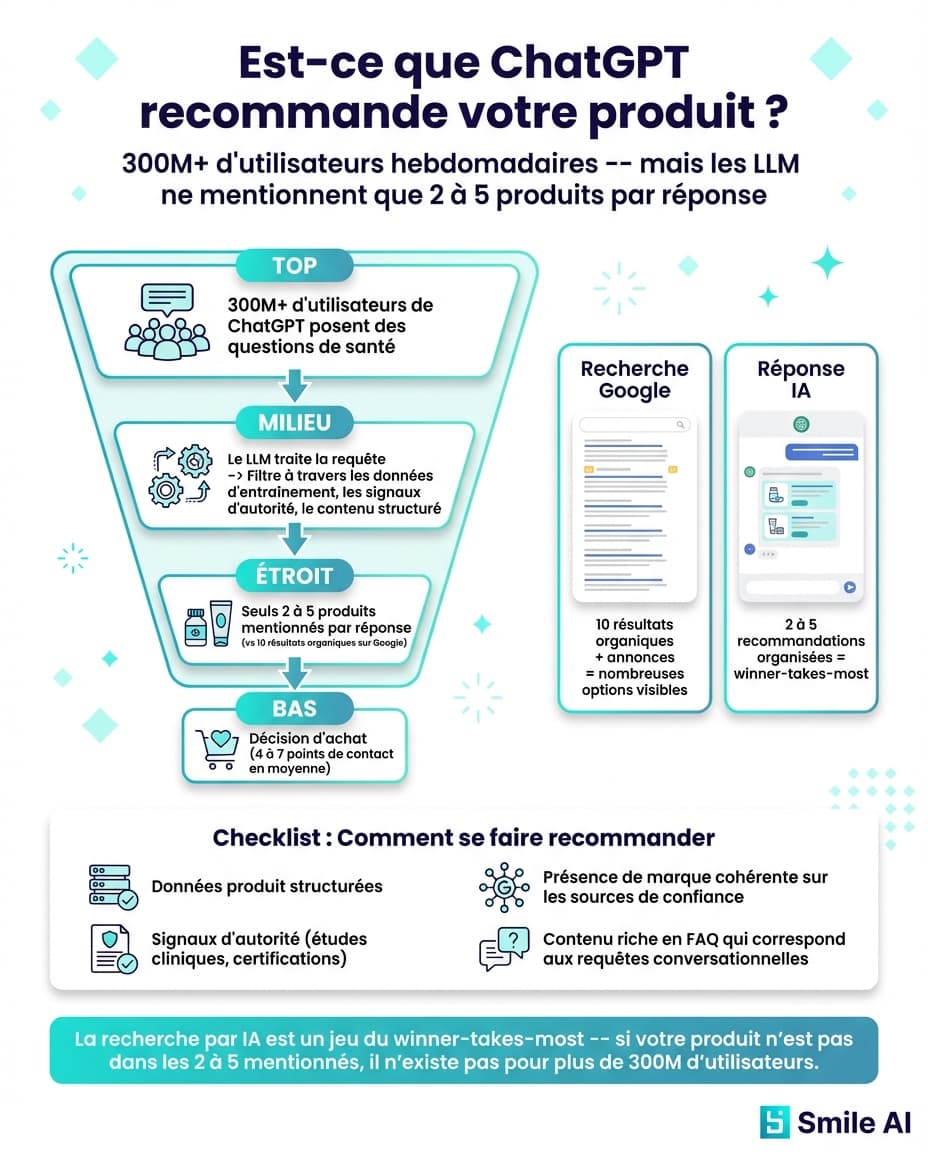
The essentials at a glance
Key takeaways from this article in one infographic.
© Smile AI 2026
Ready to dominate the Digital Shelf?
Discover how Smile Analytics helps Consumer Healthcare brands optimize their e-commerce performance across all platforms.
Related articles
The 2026 Pharma E-Commerce Playbook
How Consumer Healthcare Brands Dominate the Digital Shelf in the United States
Pharma Retail Media in the United States
The Complete Guide to Advertising on Amazon, CVS Pharmacy, and Walgreens