
How to Write Product Listings That Sell
The Definitive Guide for CHC Brands in the United States
Product content is your brand's silent salesperson. On Amazon, CVS Pharmacy, or Walgreens, your product listing must convince within seconds -- while complying with one of the strictest regulatory frameworks in the world. Here's how to achieve it.
Introduction: Why Your Product Listings Deserve Strategic Attention
In physical retail, a pharmacist can advise, explain, and reassure. They adapt their approach to each customer, respond to objections, and highlight the advantages of one product over another. Online, this human interaction disappears. Your product listing becomes your sole salesperson -- and it must accomplish all this work within seconds.
The U.S. online pharmacy market is experiencing robust growth of approximately 15% annually. However, online sales still represent less than 5% of total pharmacy revenue in the United States. This gap between channel growth and current market share represents a massive opportunity for Consumer Healthcare (CHC) brands that know how to optimize their digital presence.
But here's the paradox: on platforms like Amazon, CVS Pharmacy, or Walgreens, hundreds of products compete for consumer attention in every category. Dietary supplements, oral care, analgesics, dermatological products -- competition is fierce. And the first filter that determines whether your product will be seen, then purchased, is the quality of your product content.
This guide will teach you to:
- Understand the anatomy of a healthcare product listing that converts
- Write simultaneously for the algorithm and the human buyer
- Stay persuasive within the U.S. regulatory framework (FDA, FTC)
- Optimize every element: title, bullet points, description, enhanced content
- Apply concrete before/after examples from real healthcare categories
Part 1: The Anatomy of a Healthcare Product Listing That Converts
1.1 Key Components of a Product Listing
Whether you're on Amazon, CVS Pharmacy, or Walgreens, a high-performing product listing relies on the same fundamental pillars:
| Element | Primary Role | Impact on Conversion |
|---|---|---|
| Product Title | Search visibility + first impression | Very high -- determines the click |
| Bullet Points | Communicate key benefits quickly | High -- influences purchase decision |
| Product Description | Detail usage, ingredients, directions | Medium to high -- reassures hesitant buyers |
| Images | Show the product, benefits, usage | Very high -- first element seen |
| A+/Enhanced Content | Tell brand story, differentiate | Medium -- reinforces trust |
| Customer Reviews | Social proof | Very high -- #1 decision factor |
1.2 The Online Health Consumer's Decision Journey
To write content that converts, you must understand how American consumers buy health products online. Their journey is specific:
- Initial Search: The consumer types a query -- often a symptom or need ("sore throat lozenges", "magnesium for fatigue", "eczema cream face")
- Quick Scan: They browse results in 2-3 seconds per listing. Title and main image determine the click.
- Evaluation: On the product page, they read bullet points, check ratings and review count, look at secondary images.
- Reassurance: For a health product, they seek credibility proof: known brand, "Made in USA" mentions, certifications, detailed ingredients.
- Decision: They compare with 2-3 alternatives open in other tabs, then add to cart.
Key Point: At each stage, your content does the work. If any single element is weak, the consumer moves to a competitor.
1.3 What Differentiates Healthcare Content from General Consumer Content
Writing a product listing for a dietary supplement or medical device isn't the same as for a kitchen accessory. Healthcare sector specificities impose constraints -- but also unique opportunities:
Constraints:
- Strict regulatory framework (FDA, FTC)
- Inability to make certain therapeutic claims
- Required specific legal mentions
- Increased consumer sensitivity to unproven claims
Opportunities:
- Health consumers are willing to read more content (they actively seek information)
- Brand trust is a more powerful conversion lever than price
- Educational content creates a durable competitive advantage
- Well-explained technical terms reinforce credibility
Part 2: Writing for Two Audiences -- The Algorithm and the Human
2.1 Understanding E-Commerce Platform Algorithms
The best content in the world is useless if no one sees it. Before convincing a human, your product listing must convince an algorithm.
On Amazon, the search algorithm (A10) considers:
- Keyword relevance in title, bullet points, description, and backend search terms
- Conversion rate of the product listing (listings that convert well are rewarded)
- Sales velocity and performance history
- Content completeness (all fields filled get an advantage)
On online pharmacies (CVS Pharmacy, Walgreens, Amazon Pharmacy), mechanisms are similar but often less sophisticated. Direct correspondence between keywords and search queries plays an even more prominent role.
2.2 Healthcare Keyword Strategy
Healthcare keyword research has its own rules. American consumers use specific terms you need to know:
Common query types:
- By symptom: "headache", "bloating", "heavy legs", "stuffy nose"
- By ingredient/molecule: "magnesium bisglycinate", "vitamin D3", "hyaluronic acid"
- By brand + product: "Tylenol Extra Strength", "Advil Cold & Sinus", "Nature Made Vitamin D"
- By category: "sleep supplement", "sunscreen face SPF 50"
- By format/need: "vegetarian capsules", "lactose free", "organic", "made in USA"
Fundamental Principle: Naturally integrate your target keywords into every element of the listing. A keyword in the title carries more weight than in the description. A keyword in bullet points carries more weight than in enhanced content.
2.3 Writing in "Double Layer": SEO + Persuasion
The "double layer" technique consists of writing each sentence to simultaneously satisfy the algorithm and the human reader.
Example -- Magnesium dietary supplement:
Bad (too SEO-focused):
"Magnesium supplement capsules magnesium bisglycinate fatigue stress sleep 120 capsules magnesium."
Bad (too human-focused, no keywords):
"Rediscover your daily vitality with this innovative product that will change your life."
Optimal (double layer):
"Magnesium Bisglycinate Supplement -- 120 highly absorbable capsules to reduce fatigue and support normal nervous system function."
In this optimal example:
- Primary keywords are present ("magnesium supplement", "magnesium bisglycinate", "capsules", "fatigue")
- Consumer benefit is clear ("reduce fatigue")
- The claim complies with FDA regulations (authorized claim for magnesium)
- Format is specified ("120 capsules")
Part 3: Compliant Copywriting -- Persuading Within the U.S. Regulatory Framework
3.1 The Regulatory Landscape: Who Controls What
In the United States, online health product content is regulated by several agencies:
Food and Drug Administration (FDA)
- Regulates drug advertising, including OTC medications
- Prescription drugs cannot be advertised to the general public
- OTC drugs can be promoted under strict conditions with pre-approval requirements
Federal Trade Commission (FTC)
- Controls misleading claims on dietary supplements and health products
- Verifies compliance of health claims with federal regulations
- Sanctions deceptive commercial practices
FTC (Federal Trade Commission)
- Establishes deontological rules for advertising, including digital content
- Requires transparency on sponsored content
- Defines best practices for cosmetic and wellness claims
3.2 Golden Rules of Compliant Copywriting
Here are the principles to systematically apply to every product listing:
Rule 1: Use only authorized health claims
For dietary supplements, only claims authorized by the FDA and qualified health claims can be used.
| What you CAN write | What you CANNOT write |
|---|---|
| "Magnesium supports normal muscle function" | "Eliminates fatigue" |
| "Vitamin C supports immune system health" | "Prevents disease" |
| "Zinc supports healthy skin" | "Cures acne" |
| "Supports normal nervous system function" | "Treats anxiety and depression" |
Rule 2: Avoid medical vocabulary for non-drug products
For health and wellness products (cosmetics, dietary supplements, medical devices):
- Never use: "treats", "cures", "heals", "prescribed", "therapeutic"
- Prefer: "supports", "helps maintain", "contributes to normal function of", "aids"
Rule 3: Don't create confusion with a drug
The presentation of a dietary supplement or cosmetic must not suggest it's a drug. Avoid:
- References to specific pathologies
- Visuals evoking medical context (white coats, stethoscopes)
- Terms like "dosage", "treatment", "prescription"
Rule 4: Source and qualify evidence
When highlighting study results or figures:
- Cite the source ("Clinical study conducted on 120 subjects for 8 weeks")
- Use conditional formulations when necessary
- Clearly distinguish proven results from usage testimonials
3.3 Transforming Constraint into Competitive Advantage
The regulatory framework isn't a hindrance -- it's a quality filter. Brands that master compliant copywriting benefit from significant advantage:
- Enhanced credibility: Factual, measured content inspires more trust than aggressive advertising
- Reduced legal risk: No listing removal, no FTC fines, no negative publicity
- Differentiation: In a category where many competitors use questionable claims, clean, professional content stands out
- Sustainability: Compliant content doesn't need rewriting with every regulatory evolution
Practical tip: Build an internal library of claims approved by your regulatory team. Every product listing writer should have access to it. This accelerates content production while ensuring compliance.
Part 4: Element-by-Element Optimization Framework
4.1 Product Title: Your First (and Sometimes Only) Point of Contact
The title is your product listing's most strategic element. On Amazon, it's the #1 factor for search visibility. On online pharmacies, it determines the click from search results.
Recommended structure for a healthcare title:
[Brand] - [Product Name] - [Key Benefit/Ingredient] - [Format/Quantity] - [Key Differentiator] Title optimization rules:
- Ideal length: 80-150 characters on Amazon (titles too short lack keywords, titles too long are truncated on mobile)
- Brand first: Brand name at the beginning reinforces recognition and trust
- Priority keywords: Place the 2-3 most important keywords in the first 80 characters (visible portion on mobile)
- Format and quantity: Always specify (number of capsules, ml, mg, etc.)
- No excessive capitalization: Amazon penalizes all-caps titles
- No price or promotions: Prohibited in title on Amazon
Before/after examples:
| Before (suboptimal) | After (optimized) |
|---|---|
| "Marine Magnesium - Box of 60" | "Nature's Bounty -- Magnesium Bisglycinate B6 -- Dietary Supplement for Fatigue & Stress -- 60 Capsules -- High Absorption Formula" |
| "Nasal Spray" | "Ocean Saline -- Nasal Spray Hypertonic -- Natural Nasal Decongestant -- Sea Water -- Cold & Sinus -- 4.5 fl oz -- Ages 6+" |
| "Probiotics intestinal capsules" | "Garden of Life -- Dr. Formulated Probiotics -- Digestive Health Support -- 30 Capsules -- 50 Billion CFU -- Dietary Supplement" |
4.2 Bullet Points: Your Sales Arguments in 5 Seconds
Bullet points are the most-read element of the product listing after the title. On Amazon, you have 5 bullets. This is your opportunity to answer the buyer's key questions.
5-bullet framework for healthcare:
- Bullet 1 -- Primary benefit + claim: What is THE problem this product solves?
- Bullet 2 -- Composition/key ingredient: What makes this product effective?
- Bullet 3 -- Directions/format: How do you use it? How long does a bottle last?
- Bullet 4 -- Differentiation/quality: What distinguishes it from alternatives?
- Bullet 5 -- Guarantees/certifications: Why trust this brand?
Writing rules:
- Start each bullet with a capitalized benefit followed by a colon, then details. Example: "FATIGUE REDUCTION: Magnesium bisglycinate supports reduced fatigue..."
- Maximum 200 characters per bullet for optimal mobile readability
- One message per bullet -- don't overload
- Integrate keywords naturally but never sacrifice readability
- Use concrete numbers: "120 capsules = 2-month supply", "10 billion CFU per capsule"
Complete example -- Vitamin D3 dietary supplement:
Before (generic, non-optimized):
- Contains Vitamin D
- Good for health
- Easy to take
- Quality product
- American brand
After (optimized using framework):
- DAILY IMMUNE SUPPORT: Vitamin D3 supports normal immune system function. Optimal 1000 IU dosage per drop for supplementation adapted to daily needs.
- HIGH ABSORPTION FORMULA: Natural-source Vitamin D3 (cholecalciferol) in oil solution for optimal bioavailability. Most absorbable form by the body.
- EASY TO USE: 1 drop daily in water, juice, or directly under tongue. 20 ml dropper bottle = 600 drops, equivalent to 20 months of use.
- PREMIUM QUALITY: Made in USA in GMP-certified facility. Gluten-free, lactose-free, no artificial colors. Suitable for vegetarians.
- TRUSTED BRAND: American laboratory specializing in micronutrition for 25 years. Over 2 million bottles sold in the US. Formula validated by independent scientific committee.
4.3 Product Description: Convincing the Hesitant Buyer
The long description is your space to develop your argument. This is where you convert the hesitant buyer -- the one who read the bullet points but hasn't clicked "Add to Cart" yet.
Recommended structure:
- Empathetic hook (1-2 sentences): Identify consumer problem/need
- Solution presentation (2-3 sentences): How your product addresses this need
- Technical details (3-5 sentences): Composition, active ingredients, mechanism of action
- Detailed directions: Dosage, recommended duration, precautions
- Quality commitments: Certifications, manufacturing, controls
- Legal mentions: Required warnings, "not intended to diagnose, treat, cure, or prevent any disease", etc.
Writing tips:
- Write for scanning, not linear reading: Use short paragraphs, subheadings, lists
- Anticipate objections: If price is high, justify value proposition. If taste is a known barrier, highlight formulation efforts.
- Integrate secondary keywords: Description is excellent placement for long-tail search terms you couldn't fit in title or bullets
- End with implicit call-to-action: "Start your wellness journey today" (without being aggressive)
Example of empathetic hook for different categories:
- Analgesic: "Recurring headaches disrupt your daily routine and prevent you from fully enjoying your days. You need a fast, reliable solution."
- Probiotic: "Digestive discomfort, bloating, irregular bowel movements... Your gut may be sending signals it's time to act."
- Dermatological care: "Sensitive skin prone to redness and tightness requires special attention and care specifically formulated to respect its fragility."
4.4 Enhanced Content (A+ Content / Brand Content)
On Amazon, A+ Content (formerly Enhanced Brand Content) allows adding images, tables, comparisons, and formatted text below the standard description. On online pharmacies, similar options exist in various forms.
Most effective A+ modules for healthcare:
- Product range comparison table: Help consumers choose the right product within your range. This reduces bounce rate and increases average order value.
- Directions infographic: Step-by-step visual is more effective than text for usage instructions.
- Trust banner: Certifications, years of expertise, customer count, "Made in USA" -- credibility proof at a glance.
- Ingredient spotlight: Dedicated module for star ingredient with its origin, form, proven benefits.
- Visual FAQ: Answer the 3-4 most frequent questions directly in A+ content.
Important: A+ Content isn't indexed by Amazon's search engine for organic ranking. It serves conversion only, not visibility. Focus SEO efforts on title, bullet points, and backend search terms.
Part 5: Before/After -- Concrete Transformations by Category
5.1 Category: Dietary Supplements (Magnesium)
BEFORE:
Title: "Magnesium 60 capsules"
Bullet points:
- Magnesium
- 60 capsules
- Dietary supplement
- Take 2 daily
- Made in USA
Identified problems:
- Title too short, no secondary keywords
- Bullet points without consumer benefits
- No health claims
- No identifiable brand
- Zero differentiation
AFTER:
Title: "MagWell B6 -- Magnesium Bisglycinate with Vitamin B6 Dietary Supplement -- Fatigue & Stress Support -- 60 Tablets -- High Potency (300mg/tablet) -- Made in USA"
Bullet points:
- FATIGUE SUPPORT: Magnesium supports normal muscle and nerve function. MagWell B6 provides 300mg elemental magnesium per tablet, 71% Daily Value, to help you maintain your daily energy levels.
- SYNERGISTIC MAGNESIUM + B6 FORMULA: Vitamin B6 optimizes cellular magnesium absorption. This combination is the most scientifically documented for maximum effectiveness.
- SIMPLE & CONVENIENT: 2 tablets daily, preferably with meals and a full glass of water. One bottle of 60 tablets = 1 month complete supply.
- PHARMACEUTICAL QUALITY: Made in USA in GMP-certified facility. Quality controls at every manufacturing step. Gluten-free, lactose-free, suitable for vegetarians.
- TRUSTED BRAND: MagWell is the magnesium brand most recommended by healthcare professionals in America. Over 30 years of micronutrition expertise.
5.2 Category: Dermatological Care (Face Cream)
BEFORE:
Title: "Moisturizing face cream 1.7 fl oz"
Bullet points:
- Hydrates skin
- Light texture
- 1.7 fl oz
- For all skin types
- Dermatologist tested
AFTER:
Title: "CeraVe -- Daily Facial Moisturizing Lotion -- Sensitive Skin Hydrating Cream -- Ceramides & Hyaluronic Acid -- 1.75 fl oz -- Fragrance-Free, Non-Comedogenic"
Bullet points:
- 24-HOUR HYDRATION: Daily Facial Moisturizing Lotion provides intense hydration for 24 hours. Formula with essential ceramides and hyaluronic acid soothes and protects sensitive skin daily.
- ULTRA-LIGHT TEXTURE: Non-greasy finish, fast absorption. Ideal as makeup base. Perfect for normal to combination skin seeking comfort without shine.
- HIGH TOLERANCE FORMULA: Fragrance-free, non-comedogenic, paraben-free. Tested under dermatological control on sensitive skin. Minimizes risk of allergic reactions.
- STAR INGREDIENT -- CERAMIDES: Recognized for their skin barrier restoration properties. Essential lipids naturally found in healthy skin, clinically proven to improve skin barrier function.
- CERAVE QUALITY COMMITMENT: Brand recommended by over 25,000 dermatologists worldwide. Developed with dermatologists -- American skincare research since 2005.
5.3 Category: OTC Medication (Pain Reliever)
BEFORE:
Title: "Acetaminophen 500mg box of 24"
Bullet points:
- For pain relief
- 24 tablets
- Swallow with water
- Don't exceed 3g/day
- Read directions
AFTER:
Title: "Tylenol Extra Strength -- Acetaminophen 500mg -- Pain & Fever Relief -- 24 Caplets -- Fast-Acting Formula"
Bullet points:
- PAIN & FEVER RELIEF: Tylenol Extra Strength contains acetaminophen 500mg for temporary relief of minor aches, pains, and fever reduction. Starts working in 30-60 minutes.
- EXTRA STRENGTH DOSAGE: 500mg dosage allows flexible dosing based on pain intensity. For adults and children 12 years and over.
- DIRECTIONS FOR USE: Take 2 caplets every 6 hours as needed. Do not exceed 6 caplets in 24 hours unless directed by doctor. Swallow with water.
- AMERICA'S #1 PAIN RELIEVER: Tylenol is the most trusted pain relief brand in America. From Johnson & Johnson, a trusted healthcare company for over 125 years.
- DRUG FACTS: This product contains acetaminophen. Do not use with other products containing acetaminophen. If symptoms persist for more than 3 days, consult a healthcare professional.
Important regulatory note: For OTC medications sold online, product listings must contain required legal mentions per FDA regulations. The "Drug Facts" panel information and appropriate warnings are mandatory.
Part 6: Multi-Platform Optimization -- Adapting Your Content
6.1 Amazon: Key Specificities
Amazon has its own rules for "Health & Personal Care" category product listings:
- Backend search terms: You have 250 bytes to add keywords invisible to consumers but indexed by the algorithm. Use them for synonyms, common misspellings, and alternative terms.
- Category restrictions: Certain health subcategories require pre-approval to sell. OTC medications can only be sold by approved pharmacies.
- A+ Content: Available for brands registered in Brand Registry. Investing in quality A+ content can increase conversion rates by 5-10% in health categories.
- Image policy: Main image must be on pure white background (RGB 255,255,255), showing only the product, without overlaid text. Secondary images can include infographics.
6.2 CVS Pharmacy and Online Pharmacies
CVS Pharmacy, America's largest pharmacy chain with integrated healthcare services, has its own content standards:
- Detailed descriptions: Online pharmacies favor long, informative descriptions. Consumers shopping on pharmacy sites expect information level close to pharmaceutical counsel.
- Structured sections: Ingredients, directions, uses, warnings -- online pharmacies organize information in distinct sections.
- Professional guidance: Online pharmacies' advantage is healthcare professional presence. Your content should complement this guidance, not replace it.
- Google SEO: Unlike Amazon where SEO is internal to platform, online pharmacies depend heavily on Google for traffic. Your product content contributes to page's natural referencing on Google.
6.3 Walgreens and Other Platforms
Each platform has its particularities. The most common error is copy-pasting identical content everywhere. Here's why and how to adapt:
Copy-pasting hurts your performance:
- Google penalizes duplicate content (online pharmacy SEO)
- Each platform has different field length limits
- Each platform's audience has different expectations (Amazon buyer seeks convenience, pharmacy buyer seeks advice)
Recommended approach:
- Create comprehensive "master content" for each product
- Adapt it to each platform based on technical constraints and audience expectations
- Maintain central document ensuring consistency of key information (ingredients, dosages, claims) while allowing format variations
Part 7: Content Scoring -- Measuring Quality at Scale
7.1 Why You Need a Scoring System
You may manage 50, 200, or even 1,000 product references. How do you know which have optimal content and which need urgent intervention?
Manual audit is impossible at scale. An e-commerce manager can't review and evaluate every product listing monthly. Yet content quality degrades over time: competitors improve their listings, algorithms evolve, search trends change.
Signs of underperforming content:
- Conversion rate below category average
- Declining average position in search results
- Low click-through rate (CTR) from search results
- Stagnant review count (poor content doesn't convert, therefore doesn't generate reviews)
7.2 Healthcare Product Listing Evaluation Criteria
An effective scoring system evaluates each listing element according to objective criteria:
Title (score out of 25 points):
- Brand presence (5 pts)
- Main keyword presence (5 pts)
- Optimal length 80-150 characters (5 pts)
- Format/quantity mentioned (5 pts)
- Primary benefit included (5 pts)
Bullet points (score out of 25 points):
- 5 bullets completed (5 pts)
- Benefit + detail structure (5 pts)
- Natural keyword integration (5 pts)
- Optimal length per bullet (5 pts)
- Differentiation vs. competition (5 pts)
Description (score out of 25 points):
- Sufficient length (minimum 300 words) (5 pts)
- Scannable structure (short paragraphs, subheadings) (5 pts)
- Secondary keywords integrated (5 pts)
- Compliance information present (5 pts)
- Implicit call-to-action (5 pts)
Images and enhanced content (score out of 25 points):
- Sufficient image count (minimum 5) (5 pts)
- Main image compliant with standards (5 pts)
- Informative secondary images (benefits, directions) (5 pts)
- A+ content present and complete (5 pts)
- Visual consistency with brand (5 pts)
7.3 Automating Audit with Smile Analytics
Manually evaluating hundreds of product listings according to these criteria is time-consuming and subjective. This is precisely where a solution like Smile Analytics transforms your product content approach.
Smile Analytics content scoring enables you to:
-
Automatically scan your entire product portfolio on Amazon, CVS Pharmacy, Walgreens, and other platforms. In minutes, you get an overview of your content quality across every retailer.
-
Instantly identify underperforming listings through objective scoring based on industry best practices. Products with low scores are prioritized for rapid intervention.
-
Compare your content to competitors in each category. You see exactly where competitors outperform you -- and where you have the advantage.
-
Track quality evolution over time with dashboards measuring your content score progress week by week.
-
Detect regressions automatically: If a retailer modifies your content or an update fails, Smile Analytics alerts you immediately.
Concretely, instead of spending hours manually auditing your product listings, your content teams can focus on what they do best: creating quality content. Smile Analytics identifies priorities, your writers take action.
Concrete example: A dietary supplement brand with 150 references on Amazon used Smile Analytics content scoring to identify that 40% of their listings scored below 60/100. Within six weeks, after optimizing priority listings identified by the platform, these products' average conversion rate increased significantly.
Part 8: Operational Checklist -- Your Content Creation Process
8.1 Before Writing: Preparation Phase
- Keyword research: Identify 5-10 main search terms for your product on each target platform
- Competitive analysis: Study top 5 results for your target keywords. Note what they do well and where you can differentiate
- Regulatory validation: Verify authorized health claims for your ingredients/products. Consult your regulatory affairs team
- Product brief: Gather all technical information: composition, dosages, directions, certifications, clinical studies
8.2 During Writing: Control Points
- Title: Brand + main keyword + benefit + format + differentiator. 80-150 characters.
- Bullet points: 5 bullets structured per framework (primary benefit, composition, directions, differentiation, guarantee). Maximum 200 characters each.
- Description: Minimum 300 words. Empathetic hook + solution + technical details + directions + quality + legal mentions.
- Keywords: Primary terms appear in title. Secondary terms in bullet points and description. Synonyms and variants in backend terms.
- Compliance: No unauthorized claims. No medical terms for non-drugs. Legal mentions present.
8.3 After Publication: Continuous Monitoring
- Post-publication verification: Check content displays correctly on each platform (formatting, special characters, text cuts)
- Performance monitoring: Track conversion rate, search result position, CTR
- Iteration: Based on performance data, refine your content. Content optimization is continuous process, not one-time project
- Competitive surveillance: Regularly monitor competitor content evolution to stay competitive
Part 9: The 10 Most Common Mistakes (and How to Avoid Them)
Mistake 1: Copy-pasting from packaging Copying packaging text to online listing. Packaging is designed for physical context (limited space, quick reading in aisle). Digital demands richer, differently structured content.
Mistake 2: Absence of strategic keywords Writing "marketing" content without integrating terms consumers actually use in search. Result: product is invisible.
Mistake 3: Unexplained technical jargon Using terms like "liposomal", "chelated", "enteric-coated" without explanation. Average consumer doesn't understand these terms and disengages.
Mistake 4: Non-compliant claims Writing "cures", "treats", "eliminates" for dietary supplements or cosmetics. Risk: listing removal, FTC fines, credibility loss.
Mistake 5: Identical content across all platforms Copy-pasting same text from Amazon to CVS Pharmacy and Walgreens. Each platform has its constraints and audience. Adapt.
Mistake 6: Forgetting mobile Not checking smartphone display. In the US, over 60% of e-commerce consultations happen on mobile. A truncated title or overly long bullet points lose impact.
Mistake 7: Neglected images Settling for single packaging photo. Secondary images (benefits, directions, ingredients, lifestyle) are essential visual sales arguments.
Mistake 8: Absence of updates Publishing product listing and never returning to it. Market evolves, competitors optimize, algorithms change. Content that performed 12 months ago may be outdated today.
Mistake 9: Ignoring customer reviews in writing Not reading customer reviews (positive and negative) before writing. Reviews reveal questions, objections, and consumer vocabulary -- valuable information for your content.
Mistake 10: Working in silos Content team doesn't communicate with regulatory, marketing, and e-commerce teams. Result: content satisfying none of the parties. Cross-functional collaboration is key to performant, compliant content.
Conclusion: Product Content, Your Sustainable Competitive Advantage
In a market where online pharmacy in the United States experiences sustained growth, your product content quality is a first-tier strategic lever. This isn't an "operational" subject to delegate: it's a competitive advantage directly impacting your visibility, conversion rate, and revenue.
Consumer Healthcare brands that treat product content as strategic priority share common characteristics:
- They invest in keyword research specific to each platform and category
- They master the regulatory framework and make it a credibility advantage
- They structure content according to proven frameworks -- no improvisation
- They measure and iterate continuously -- product content is a living process
- They automate quality audits to focus on value creation
The U.S. online pharmacy market is still developing compared to other sectors. Positions are being built now. Brands investing today in excellent product content on Amazon, CVS Pharmacy, Walgreens, and other platforms position themselves to capture disproportionate share of future growth.
The first step? Audit your existing content. Identify your 10 products with highest online sales potential and apply this guide's framework to optimize them. Measure impact. Then extend to your entire portfolio.
And if you want to accelerate this process, Smile Analytics enables you to automatically score all your product listings, identify optimization priorities, and track your progress in real time. Because in healthcare e-commerce, every conversion point gained translates directly to additional sales.
Smile Analytics is the reference platform for Consumer Healthcare brands looking to optimize their e-commerce performance. Content scoring, competitive intelligence, digital shelf monitoring -- discover how our clients accelerate their online growth. Request a demo
Keywords: product description healthcare United States | health product listing e-commerce | optimize Amazon listing CHC | healthcare content optimization pharma USA | content scoring online pharmacy
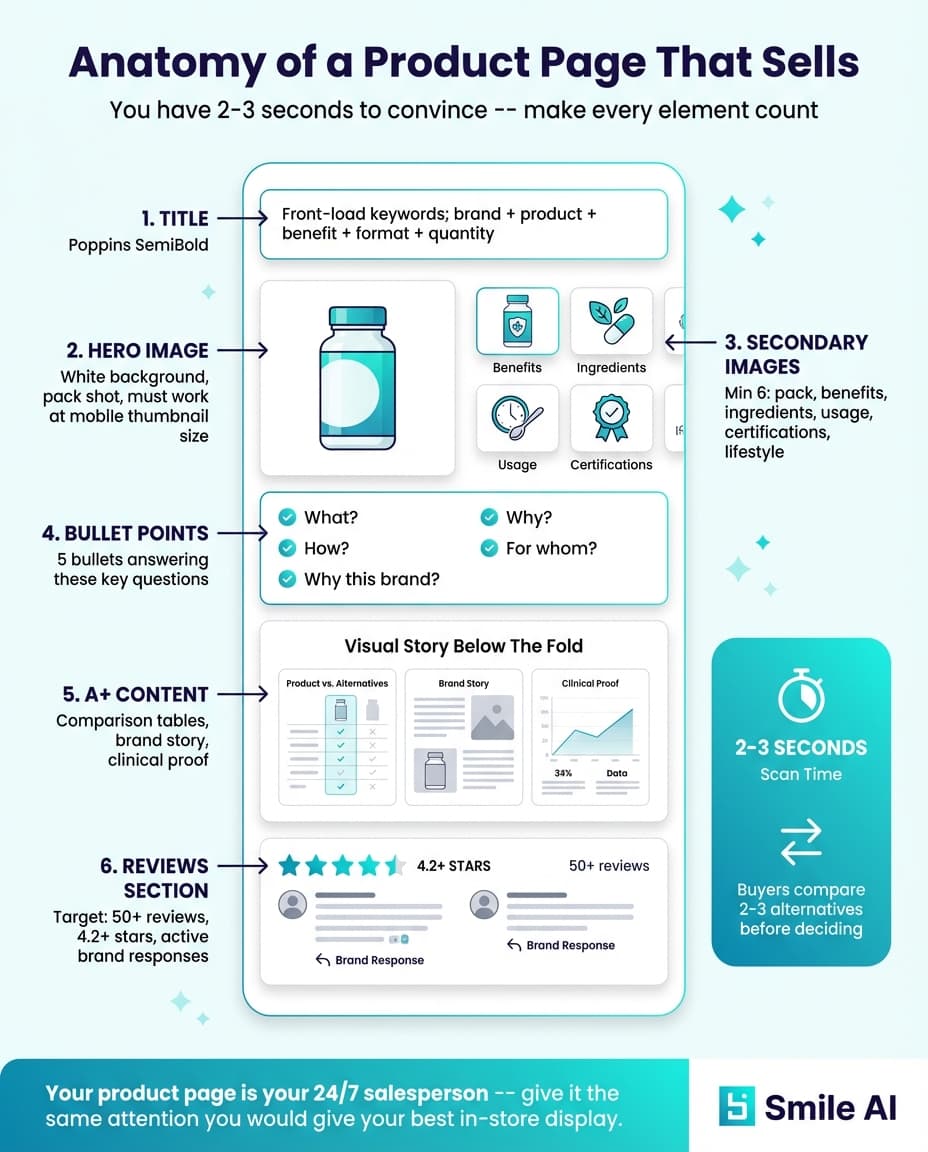
The essentials at a glance
Key takeaways from this article in one infographic.
© Smile AI 2026
Ready to dominate the Digital Shelf?
Discover how Smile Analytics helps Consumer Healthcare brands optimize their e-commerce performance across all platforms.
Related articles
The 2026 Pharma E-Commerce Playbook
How Consumer Healthcare Brands Dominate the Digital Shelf in the United States
Pharma Retail Media in the United States
The Complete Guide to Advertising on Amazon, CVS Pharmacy, and Walgreens