
The Complete Guide to Boosting Ratings and Reviews for Your Consumer Healthcare (CHC) Products in the United States
How to generate, manage, and leverage customer reviews to accelerate your sales on e-pharmacies and Amazon.com
Why Customer Reviews are E-Commerce Healthcare's Most Underestimated Lever
In the consumer healthcare (CHC) sector, trust is the currency that makes everything tip. Unlike buying fashion or electronics, the consumer who purchases an over-the-counter medication, dietary supplement, or health and wellness product makes a decision that directly impacts their physical well-being. This isn't just a purchase–it's an act of trust.
And this trust, online, is built primarily through customer reviews.
In the United States, the online health and wellness market grows approximately 15% annually, while OTC medication sales online still represent less than 5% of the total pharmacy market. The growth potential is immense, but the competition to capture consumer attention on digital platforms is fierce. On Amazon.com, CVS Pharmacy, Walgreens, or other major e-pharmacy platforms, customer reviews have become the number one differentiating factor between a product that stagnates and one that dominates its category.
This comprehensive guide is designed for Brand Managers and E-Commerce Managers who want to implement a structured strategy to generate more reviews, improve their ratings, and transform these reviews into a real growth engine. We'll cover legitimate strategies, platform-specific policies, and tools to drive this performance over time.
Part 1: Why Reviews Matter More in Healthcare Than Elsewhere
1.1 Trust as a Prerequisite for Healthcare Purchases
When an American consumer buys a healthcare product online, they ask three fundamental questions before clicking "Add to cart":
- Is this product effective? Consumers can't test a dietary supplement or pain reliever before buying it. They rely heavily on other users' experiences.
- Is this product safe? Concerns about side effects, drug interactions, or composition are very present. A detailed review mentioning the absence of adverse effects is extremely reassuring.
- Does this product deliver on its promises? In an environment where health claims are strictly regulated by the FDA, customer reviews play the role of informal validation that the brand cannot provide itself in its communications.
Sector studies consistently show that health and wellness products display significantly higher review consultation rates than the e-commerce average. For many consumers, the review section is the first area consulted on a healthcare product page, even before the product description or images.
1.2 The Measurable Impact on Conversion
The impact of reviews on conversion isn't theoretical. Here's what we observe concretely in the American market:
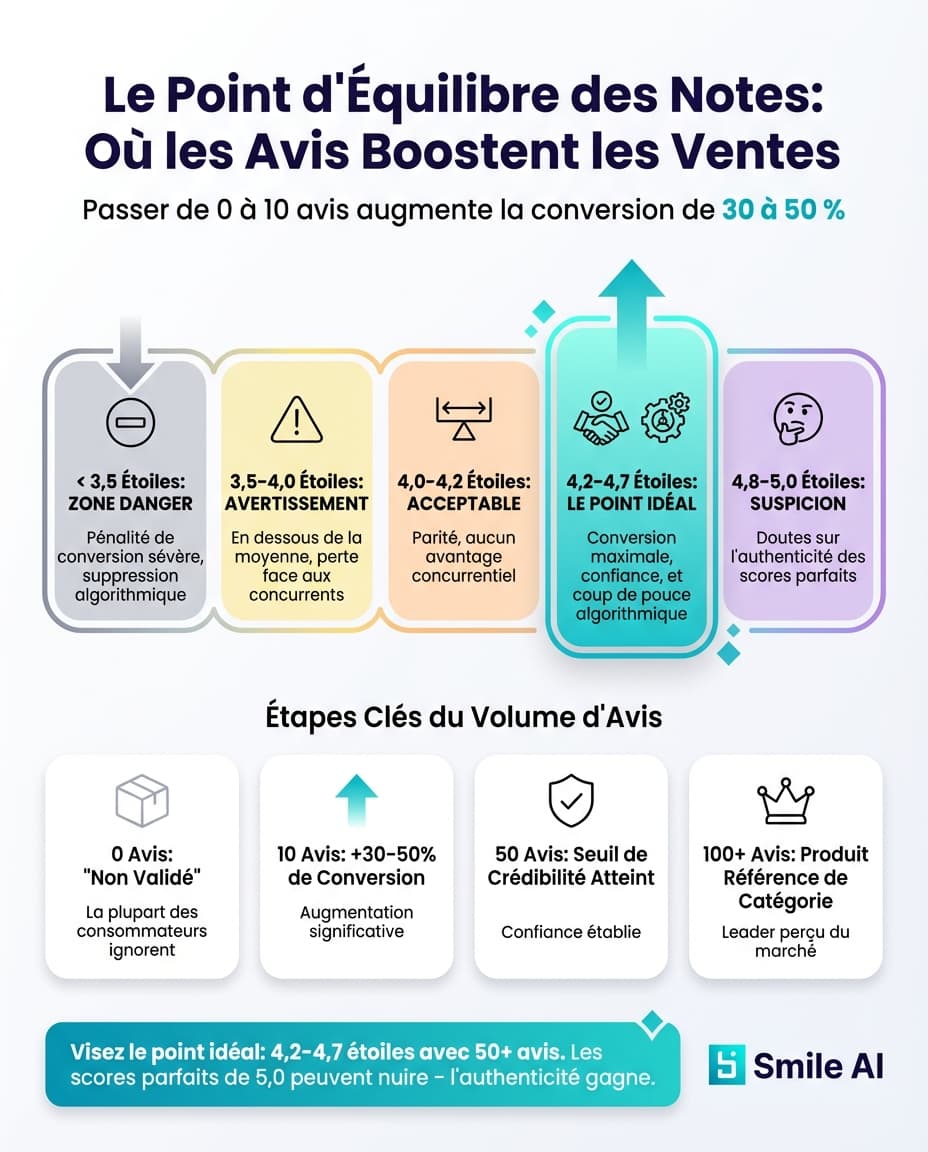
- The credibility threshold: A product with fewer than 10 reviews is perceived as "unvalidated" by most consumers. Beyond 50 reviews, perceived credibility increases significantly. From 100 reviews onward, the product is considered a reference.
- The minimum rating: In healthcare, consumers are more demanding. An average rating below 4.0/5 triggers warning signals. The "sweet spot" is between 4.2 and 4.7: high enough to reassure, but not to the point of seeming suspicious.
- Effect on conversion rate: Moving from 0 to 10 reviews on a product page can increase the conversion rate by 30 to 50%, depending on the category. Each additional batch of 10 reviews continues to generate gains, albeit in a diminishing manner.
- Effect on ranking: On Amazon.com, the number of reviews and average rating directly influence the A9/A10 algorithm. A well-rated product with a high review volume benefits from better organic ranking, which generates more visibility, more sales, and therefore... more reviews.
1.3 Reviews as Quality Signals for Algorithms
Beyond influencing the consumer, reviews constitute a key signal for e-commerce platform ranking algorithms:
- Amazon.com: The search algorithm takes into account average rating, total number of reviews, recency of reviews, and the ratio of verified reviews. A product with recent and positive reviews is systematically favored in search results.
- CVS Pharmacy: On the largest pharmacy chain's platform, reviews influence display order in categories and highlighting in personalized recommendations.
- Walgreens: Customer ratings contribute to product ranking within therapeutic categories and influence complementary product suggestions.
Key takeaway: Reviews aren't a "nice to have." In healthcare e-commerce, they're a structural performance factor that simultaneously impacts consumer trust, conversion rate, and algorithmic visibility.
Part 2: The Review Flywheel -- How Reviews Generate More Reviews
2.1 Understanding the Virtuous Circle
The "flywheel" concept applied to reviews is simple to understand but powerful in its effects:
- More reviews improve the average rating and displayed volume.
- A better rating increases the click-through rate (CTR) in search results.
- Better CTR generates more traffic to the product page.
- More traffic generates more sales.
- More sales mechanically generate more reviews.
- And the cycle begins again, with growing momentum.
This flywheel also works in reverse: a product with few reviews or a low rating enters a negative spiral where lack of social proof hinders sales, which hinders the accumulation of new reviews.
2.2 The Three Phases of the Flywheel
Phase 1: Priming (0 to 30 reviews)
This is the most critical and difficult phase. A product without reviews is almost invisible in search results, and consumers are reluctant to be the "first" to test. This is where priming programs (like Amazon Vine) and proactive solicitation strategies make all the difference.
Objective of this phase: reach the credibility threshold as quickly as possible, with authentic and detailed reviews.
Phase 2: Acceleration (30 to 100 reviews)
The product begins to benefit from the flywheel effect. Existing reviews attract buyers, who in turn generate new reviews. The challenge at this stage is to maintain a high average rating while increasing volume. Managing review quality becomes paramount.
Objective of this phase: maintain a regular pace of new reviews (the "review velocity") and monitor the average rating.
Phase 3: Maintenance and domination (100+ reviews)
The product has achieved reference status in its category. The flywheel runs by itself. The challenge is now to respond to negative reviews, exploit insights contained in reviews, and defend this position against competitors.
Objective of this phase: extract strategic value from reviews and maintain competitive advantage.
2.3 Review Velocity: The KPI to Monitor
"Review velocity" measures the rate at which a product receives new reviews over a given period. It's a more relevant indicator than total review volume because it reflects current dynamics.
Why is this important?
- Algorithmic freshness: Amazon.com and other platforms value recent reviews. A product with 500 reviews but none new for 6 months will be penalized compared to a competitor with 200 reviews including 30 received last month.
- Perceived relevance: Consumers often check review dates. Reviews from several years ago without recent reviews can raise doubts.
- Product health signal: Declining review velocity can signal a distribution problem, declining customer satisfaction, or increased competition.
With a tool like Smile Analytics, you can track the review velocity of each of your products across all your retailers, detect slowdowns, and compare your review acquisition rate to that of your direct competitors. This multi-platform visibility is essential for effectively managing your review strategy.
Part 3: Legitimate Strategies for Generating Reviews in the United States
3.1 The American Regulatory Framework
Before implementing any review generation strategy, it's imperative to understand the American regulatory framework. The United States has a comprehensive legal arsenal regarding online reviews:
- FTC Guidelines: The Federal Trade Commission (FTC) provides clear guidelines on endorsements and testimonials, including customer reviews. These guidelines ensure transparency and authenticity in online reviews.
- FTC Enforcement: The FTC actively monitors fake reviews and deceptive practices. Sanctions can be severe: fines reaching hundreds of thousands of dollars for companies and potential criminal charges for individuals.
- Consumer Protection Laws: Various state and federal laws impose obligations on platforms to communicate transparently about the conditions for publishing and processing reviews.
- FDA Regulations: For healthcare products, the FDA oversees health claims and marketing practices, which can impact how reviews are collected and used.
What is prohibited:
- Purchasing or writing fake reviews (or paying third parties to do so)
- Offering direct financial compensation in exchange for a positive review
- Selectively removing negative reviews
- Publishing reviews without the consumer having actually purchased or used the product
- Manipulating the date or display order of reviews to deceive the consumer
What is authorized:
- Soliciting a review from a verified buyer (without conditioning the content)
- Using official platform programs (Amazon Vine, for example)
- Sending post-purchase follow-up emails inviting customers to leave a review
- Offering a free sample within a supervised program, provided the review clearly mentions it's a product received for free
3.2 Strategies on Amazon.com
Amazon.com is the most important e-commerce channel for many CHC brands in the United States. Here are the specific strategies for this platform:
3.2.1 The Amazon Vine Program
Amazon Vine is Amazon's official program for generating first reviews on a product. Here's what you need to know:
- How it works: Amazon invites trusted reviewers (the "Vine Voices") to receive your product for free in exchange for an honest and detailed review. Vine reviews are clearly identified by a green badge.
- Eligibility: The product must have fewer than 30 reviews and be registered in Amazon Brand Registry.
- Cost: Registration fees apply per parent ASIN. It's a significant investment, but the return is measurable in terms of conversion.
- Limits: You can register up to 30 units per product. Reviews aren't guaranteed to be positive: Vine Voices are known for their honesty, which is precisely what makes these reviews credible.
Best practices for Vine:
- Register your new launches as soon as they're eligible to get ahead of the competition.
- Make sure your product page is optimized (images, title, A+ Content) BEFORE activating Vine. A poorly presented product will receive mixed reviews.
- Use Vine primarily for high-margin products or strategic products in your portfolio.
3.2.2 The "Request a Review" Button
Amazon provides sellers with a "Request a Review" button in Seller Central, usable between 5 and 30 days after order delivery:
- Advantage: It's an official channel compliant with Amazon policies. The email is sent by Amazon itself, which gives it additional credibility.
- Limitation: The message is standardized and cannot be personalized. You cannot guide the review content.
- Strategy: Activate this feature systematically for every order. For healthcare products, a delay of 14 to 21 days post-delivery is often optimal, as it allows the consumer time to test the product and notice its effects.
3.2.3 Product Inserts
Product inserts (cards or flyers slipped into packaging) are authorized by Amazon, but with strict rules:
What is authorized:
- Thanking the customer for their purchase
- Providing usage instructions or advice
- Inviting the customer to leave a review on Amazon (without guiding the content)
- Directing the customer to customer service in case of problems (to avoid a negative review)
What is prohibited:
- Offering a discount or gift in exchange for a review
- Specifically asking for a 5-star review or positive review
- Redirecting the customer to an external site to leave the review
- Asking the customer to contact the seller before leaving a negative review (prohibited "filtering" practice)
CHC Advice: For a healthcare product, a well-designed insert can include a usage guide with dosage advice, followed by a simple phrase: "Your experience helps us improve our products. Feel free to share your review on Amazon." This approach provides value to the consumer while naturally stimulating review generation.
3.2.4 Product Page Optimization as a Review Lever
This may seem counterintuitive, but the quality of your product page directly influences the quality and volume of your reviews:
- Clear and complete images reduce disappointments related to a gap between expectation and reality, which decreases negative reviews.
- Precise description of ingredients, dosage, and usage instructions helps the consumer use the product correctly, which increases satisfaction and therefore rating.
- Rich A+ Content reinforces the perception of brand quality and professionalism, which encourages satisfied customers to take time to leave a review.
3.3 Strategies on CVS Pharmacy
CVS Health is the largest pharmacy chain in the United States with a comprehensive online platform. The platform has its own review ecosystem.
3.3.1 The CVS Pharmacy Review System
- Verified reviews: CVS Pharmacy uses a verified review system linked to purchase. Only customers who have actually bought the product on the platform can leave a review.
- Follow-up emails: CVS Pharmacy automatically sends post-purchase emails inviting customers to leave a review. This system is managed by the platform itself.
- Moderation: Reviews are moderated in accordance with American legal obligations. Reviews containing unfounded medical claims or content contrary to platform rules may be rejected.
3.3.2 How to Maximize Reviews on CVS Pharmacy
- Optimize the product experience: On a pharmacy platform, precision of product information (composition, dosage, contraindications) is even more important than on Amazon. Complete and accurate information avoids unpleasant surprises and favors positive reviews.
- Collaborate with the CVS team: As a brand, you can work with your commercial contact at CVS to understand the mechanisms for highlighting well-rated products and additional visibility opportunities.
- Leverage health content: CVS offers health advice content associated with products. Quality educational content reinforces trust and can indirectly favor positive reviews by helping the consumer better use the product.
3.4 Strategies on Walgreens
Walgreens is another major e-pharmacy in the American market, recognized for its omnichannel presence and extensive OTC selection.
3.4.1 The Walgreens Review System
- Integrated customer reviews: Walgreens integrates a customer review system on its product pages, with 5-star ratings.
- Third-party trust: The platform may rely on certified third-party review collection solutions, which reinforces the credibility of displayed reviews.
- Ecosystem incentives: The platform's loyalty programs can indirectly encourage review submission by strengthening overall customer engagement.
3.4.2 How to Maximize Reviews on Walgreens
- Ensure constant availability: A product regularly out of stock cannot accumulate reviews. Stock management is a prerequisite for any review strategy.
- Take care of your visuals: On Walgreens, product image quality is an important differentiating factor. Professional visuals reinforce quality perception and favor post-purchase satisfaction.
- Respond to existing reviews: When the platform allows it, respond to reviews (positive and negative) professionally. This shows the brand is listening and encourages other customers to share their experience.
3.5 Cross-Platform Strategies (All Platforms)
Some strategies apply regardless of the sales channel:
3.5.1 Sampling Programs
Sampling (sample distribution) is a pharmaceutical industry tradition that naturally translates to digital:
- Samples via partner pharmacies: Work with pharmacy networks to distribute samples accompanied by an invitation to leave an online review.
- Ambassador programs: Identify your most satisfied customers and invite them to test your new references in preview. Ensure any ambassador relationship is transparent and compliant with FTC requirements.
- Partnerships with testing platforms: Platforms like BzzAgent or Influenster allow you to distribute products to consumer panels who commit to sharing their review online. Ensure published reviews clearly mention the product was received for free.
3.5.2 Proprietary Post-Purchase Email
If you sell direct-to-consumer (D2C) or via your own e-commerce site, the post-purchase email sequence is your best lever:
- Optimal timing: For an OTC medication, send the review request 10 to 14 days after delivery. For a dietary supplement, wait 3 to 4 weeks to allow time for the consumer to notice effects. For a health and wellness product (care, hygiene), 7 to 10 days is sufficient.
- Personalization: Personalize the email by recalling the product name and asking a specific question: "How do you feel after two weeks using [Product X]?" This invites a detailed response rather than just clicking on stars.
- Multi-channel: Invite the customer to leave their review on the platform where they bought the product, but also on Google (Google My Business listing), on Trustpilot, or on other relevant channels for your brand.
3.5.3 QR Codes on Packaging
A growing trend consists of integrating a QR code directly on the product packaging:
- The QR code redirects the customer to the product's review page on the platform of their choice.
- Accompany it with a brief message: "Your opinion matters. Scan to share your experience."
- This approach works particularly well for health and wellness products sold both in physical pharmacies and online, as it captures reviews from customers who bought in-store but can leave an online review.
Part 4: Managing Review Quality
4.1 Not All Reviews Are Equal
A 5-star review with only "Very good" as content has much less value than a detailed 4-star review that explains how the product was used, what results were obtained, and for what consumer profile it's recommended. Here's why review quality is as important as their quantity:
- Detailed reviews convert better: A review describing a concrete use case ("I've been using this magnesium for a month for my nighttime cramps and I've noticed a clear improvement") allows the reader to project themselves and make their decision.
- Detailed reviews are better ranked: Amazon and other platforms highlight reviews deemed "most helpful" by other users. Long and informative reviews receive more "helpful" votes.
- Detailed reviews feed algorithms: The textual content of reviews is indexed by platforms' internal search engines. A review mentioning relevant keywords ("joint pain", "sleep", "digestion") strengthens your product page's natural referencing.
4.2 Encouraging Detailed and Useful Reviews
How to encourage consumers to write complete reviews rather than a bare rating?
- Ask open questions: In your solicitation emails, ask specific questions: "How long have you been using the product?", "What effects have you noticed?", "Who would you recommend this product to?"
- Lead by example: If your platform allows it, highlight the most detailed and useful reviews at the top of the review section. This creates a quality standard other reviewers will want to match.
- Simplify the process: A review form that's too long or complex discourages participation. Ensure the review submission process is smooth, especially on mobile (more than 60% of online purchases in the United States are made from a smartphone).
4.3 Managing Negative Reviews
Negative reviews are inevitable and, contrary to what one might think, they're not necessarily harmful. A product with only 5-star reviews is perceived as suspicious. A few critical reviews reinforce the overall authenticity of the review profile.
That said, it's essential to manage negative reviews proactively:
- Respond quickly and professionally: On platforms that allow it, respond to each negative review within 24 to 48 hours. Show empathy, offer a solution, and invite the customer to contact your customer service.
- Analyze recurring patterns: If multiple reviews mention the same problem (defective packaging, inappropriate dosage, unpleasant taste), it's a warning signal for the product team. Negative reviews are a goldmine for continuous improvement.
- Distinguish real problems from false expectations: Some negative reviews result from poor product understanding (incorrect use, unrealistic expectations). Better product description or clearer instructions can prevent these situations.
- Report abusive reviews: If a review is manifestly fake, defamatory, or contradicts the platform's terms of use, report it through official channels. Never try to remove it through devious means.
4.4 The Special Case of Health Claims in Reviews
In the United States, the FDA closely monitors unauthorized health claims, including in customer reviews. While the brand isn't directly responsible for content written by consumers, it's recommended to:
- Avoid encouraging consumers to describe therapeutic effects in their reviews (even if these are real).
- Train your teams to identify reviews that could pose a regulatory problem and report them to the platform if necessary.
- Ensure your review solicitations contain no suggestion of health claims.
This point is particularly sensitive for dietary supplements and phytotherapy products, where the line between wellness and medicinal is sometimes blurry.
Part 5: Platform-Specific Policies and Programs
5.1 Amazon.com: Detailed Policies
Amazon.com applies the same community rules as all Amazon marketplaces, with some specificities related to the American market:
Key rules:
- Verified reviews: Reviews marked "Verified Purchase" are prioritized in display and weigh more in calculating the average rating.
- Compensation prohibition: Any form of compensation (discount, gift, free service) in exchange for a review is prohibited, except for the Vine program.
- Manipulation prohibition: "Gate-keeping" techniques (directing satisfied customers to the review page and dissatisfied customers to customer service) are explicitly prohibited.
- Reviews between linked accounts: Amazon detects and removes reviews from accounts linked to the seller (employees, family, business partners).
- Cross-marketplace reviews: On Amazon, reviews can be displayed cross-marketplace (a review left on Amazon.ca can appear on Amazon.com if translated). This can work in your favor for products sold across multiple markets.
Available programs:
| Program | Description | Cost | Max Reviews |
|---|---|---|---|
| Amazon Vine | Free products to certified reviewers | Fees per parent ASIN | 30 per ASIN |
| Request a Review | Button in Seller Central | Free | Unlimited |
| Early Reviewer Program | Program discontinued, replaced by Vine | - | - |
5.2 CVS Pharmacy: Detailed Policies
As a licensed pharmacy approved by state boards, CVS must comply with additional obligations related to online medication sales:
Key rules:
- Purchase verification: Reviews are linked to the customer account and purchase history. Only verified buyers can leave a review.
- Pharmaceutical moderation: Reviews mentioning serious side effects or drug interactions may be reviewed or supplemented by platform pharmacists.
- FDA Compliance: Reviews must not contain unauthorized therapeutic claims for health and wellness products.
- Trust standards: Review collection and display practices follow industry best practices, which reinforces consumer trust.
Opportunities for brands:
- Work with CVS on joint operations (promotions, featured placements) that generate sales volume and therefore mechanically more reviews.
- Provide comprehensive product content to reduce negative reviews related to lack of information.
- Explore possibilities for responding to reviews directly on the platform.
5.3 Walgreens: Detailed Policies
Key rules:
- Integrated rating system: Walgreens offers an integrated rating and review system on its product pages.
- Post-purchase collection: Automatic solicitations are sent to customers after receiving their order.
- Transparency: Reviews are displayed chronologically with publication date and verified buyer status indication.
Opportunities for brands:
- Optimize product pages to maximize customer satisfaction and therefore average rating.
- Monitor reviews regularly to identify trends and emerging issues.
- Use reviews as a source of insights for product and content improvement.
5.4 Other Relevant Platforms
Amazon Pharmacy:
- Verified review system with automatic solicitation emails.
- Reviews contribute indirectly to advertising campaign performance.
Rite Aid:
- Integrated review system with moderation compliant with American standards.
- Customer reviews are highlighted in category pages.
HealthWarehouse:
- Online pharmacy review system focused on prescription medications.
- The platform can serve as a relay for sampling and review generation.
Part 6: Managing Your Review Performance with the Right Tools
6.1 The Limitations of Manual Tracking
Manually tracking reviews of your products on Amazon.com, CVS Pharmacy, Walgreens, Rite Aid and other platforms quickly becomes unmanageable:
- Time: Checking reviews daily on 5 to 10 platforms for a portfolio of 50 products represents dozens of hours per week.
- Reliability: Manual tracking is subject to oversights, errors, and biases. A negative review can go unnoticed for weeks.
- Lack of context: Without an overview, it's impossible to compare your review performance to that of your competitors or detect category-wide trends.
- Absence of history: Without tools, you lose the ability to track the evolution of your ratings and review volumes over time.
6.2 How Smile Analytics Transforms Review Management
Smile Analytics offers a centralized platform to monitor, analyze, and optimize your customer review performance across the entire American CHC online market. Here's how:
Real-time multi-retailer monitoring:
- Track review volume, average rating, and review velocity for each of your products on Amazon.com, CVS Pharmacy, Walgreens, and other market retailers, all from a single dashboard.
- Receive automatic alerts when a product receives a negative review (1 or 2 stars) to react quickly.
- Detect products that need review support (low volume, declining rating, absence of recent reviews).
Sentiment analysis:
- Beyond star ratings, Smile Analytics analyzes review textual content to extract overall sentiment (positive, neutral, negative) and recurring themes.
- Quickly identify strengths perceived by consumers (effectiveness, value for money, ease of use) and weaknesses (taste, packaging, side effects).
- Use these insights to inform your product, marketing, and regulatory teams.
Competitive benchmarking:
- Compare your ratings and review volumes to those of your direct competitors on each platform.
- Identify categories where your competitors have a review advantage and focus your priming efforts on these segments.
- Track performance gap evolution over time to measure the impact of your actions.
Reporting and decision support:
- Generate automated reports on your review performance for your quarterly business reviews.
- Integrate review KPIs into your global digital shelf scorecard.
- Identify correlations between review evolution and sales trends to quantify the ROI of your review strategy.
6.3 Building a Review Dashboard
Here are the essential KPIs to integrate into your review dashboard, which you can configure in Smile Analytics:
| KPI | Description | Tracking Frequency |
|---|---|---|
| Average Rating | Star rating average per product and platform | Weekly |
| Total Review Volume | Total number of reviews per product and platform | Monthly |
| Review Velocity | Number of new reviews per week/month | Weekly |
| Positive/Negative Review Ratio | Proportion of 4-5 star vs. 1-2 star reviews | Monthly |
| Negative Review Response Rate | % of negative reviews that received a response | Weekly |
| Sentiment Themes | Top 5 positive and negative themes | Monthly |
| Competitor Benchmark | Average rating and volume gap vs. Top 3 competitors | Monthly |
| Review Coverage | % of your SKUs with more than 10 reviews | Quarterly |
Part 7: 90-Day Action Plan
To structure your approach, here's an operational 90-day action plan:
Days 1 to 30: Audit and Foundations
- Complete audit of your existing reviews: Map the number of reviews, average rating, and review velocity for each product on each platform. Use Smile Analytics to automate this audit and get a consolidated view.
- Priority identification: Classify your products into three categories:
- Critical products: Fewer than 10 reviews or rating below 3.5 -- urgent action required.
- Potential products: 10 to 50 reviews with rating above 4.0 -- acceleration possible.
- Champion products: More than 50 reviews with rating above 4.2 -- maintenance and exploitation.
- Monitoring configuration: Set up alerts and automated reports in Smile Analytics.
- Amazon Vine registration: For all eligible critical products, launch the Vine program immediately.
Days 31 to 60: Activation and Acceleration
- Product insert deployment: Design and integrate compliant inserts in the packaging of your best-selling products.
- "Request a Review" activation: Systematize the use of Amazon's review request button for every order, with optimized timing according to product category.
- Sampling campaign launch: For new launches or critical products, deploy sampling campaigns via testing platforms or partner pharmacy networks.
- Product page optimization: Correct product pages whose negative reviews reveal content problems (missing information, misleading images, imprecise descriptions).
- Team training: Train your e-commerce and customer service teams on managing negative reviews and response best practices.
Days 61 to 90: Measurement and Optimization
- First results analysis: Measure the evolution of your review KPIs since the beginning of the program. Evaluate the impact of the Vine program, inserts, and sampling.
- Competitive benchmark: Compare your progress to that of your competitors. Have you closed the gap? Where do opportunities remain?
- Timing optimization: Refine post-purchase solicitation timing based on collected data. What timing generates the best response rate and review quality for each product category?
- Insight extraction: Compile key learnings from review sentiment analysis and share them with product and marketing teams.
- Next quarter planning: Define review objectives for the next 90 days based on learnings from the first cycle.
Part 8: Common Mistakes to Avoid
Before concluding, let's review the most frequent errors we observe among CHC brands in the United States:
8.1 Strategic Errors
- Ignoring the review topic: Many brands invest heavily in retail media but completely neglect their review profile. It's like investing in a magnificent storefront with an empty store inside.
- Focusing only on Amazon: Amazon.com is important, but e-pharmacies (CVS, Walgreens, Amazon Pharmacy) are essential channels for CHC in the United States. A review strategy must be multi-platform.
- Treating reviews as a one-shot project: Review generation isn't a one-time campaign. It's a continuous process that requires regular attention and permanent adjustments.
8.2 Tactical Errors
- Soliciting too early: Asking for a review the day after delivery for a progressive-action dietary supplement is counterproductive. The customer hasn't yet been able to notice effects and risks leaving a neutral or negative review.
- Soliciting too aggressively: Sending three reminder emails in one week asking for a review irritates the customer and can generate reactive negative reviews.
- Not responding to negative reviews: A negative review without a brand response leaves an impression of indifference. Worse, it negatively influences potential buyers who read reviews.
- Buying fake reviews: Beyond legal risk (FTC fines), fake reviews are increasingly detectable by Amazon algorithms and savvy consumers. The reputational risk is enormous.
8.3 Regulatory Errors
- Ignoring FTC guidelines: If you manage a proprietary e-commerce site, ensure your review collection and display system complies with FTC guidelines.
- Conditioning an advantage on a positive review: Offering a discount "if you leave a 5-star review" is illegal in the United States. Solicitation must be neutral and unconditioned.
- Neglecting FTC implications: The FTC regularly conducts control campaigns on online reviews. Companies caught face significant financial sanctions and negative publicity.
Conclusion: Reviews, Your Sustainable Competitive Advantage
In the American healthcare e-commerce ecosystem, customer reviews aren't just a satisfaction indicator. They're a strategic asset that influences every step of the purchase journey: from visibility in search results to the buyer's final decision.
Brands that invest in a structured way in generating, managing, and exploiting their reviews build a sustainable competitive advantage. The review flywheel, once launched, creates a virtuous dynamic that's difficult for competitors to catch up with.
The keys to success are:
- Legitimacy: Use only strategies compliant with platform policies and American regulations. Shortcuts always end up costing more than they bring in.
- Consistency: Review generation is a marathon, not a sprint. Maintain constant effort and measure your progress month after month.
- Quality: Prioritize detailed and useful reviews over raw volume. One quality review is worth ten generic reviews.
- Management: Use tools like Smile Analytics to centralize tracking, automate alerts, and make data-based decisions rather than intuition.
- Cross-functionality: Integrate review insights into your product strategy, content, customer service, and retail media to maximize impact.
The American healthcare e-commerce market is still young and in full structuring. Brands that implement a robust and compliant review strategy now will be those who dominate digital shelves tomorrow. The best time to start was yesterday. The second-best time is now.
Want a complete, real-time view of your review performance across the entire American market? Smile Analytics gives you the tools to monitor, analyze, and optimize your customer ratings and reviews on Amazon.com, CVS Pharmacy, Walgreens, and all key retailers. Request a personalized demo and discover how to transform your reviews into a growth lever.
Smile AI is the European leader in CHC e-commerce. We support consumer healthcare brands with analytics, consulting, and AI solutions to gain visibility, optimize retail media investments, and accelerate online growth. Over one billion dollars in e-commerce growth generated for our clients.
The essentials at a glance
Key takeaways from this article in one infographic.
© Smile AI 2026
Ready to dominate the Digital Shelf?
Discover how Smile Analytics helps Consumer Healthcare brands optimize their e-commerce performance across all platforms.
Related articles
The 2026 Pharma E-Commerce Playbook
How Consumer Healthcare Brands Dominate the Digital Shelf in the United States
Pharma Retail Media in the United States
The Complete Guide to Advertising on Amazon, CVS Pharmacy, and Walgreens