
Share of Digital Shelf
How to Measure and Dominate Your Online Category
The complete guide for category managers and e-commerce leaders in pharmacy and health & wellness
Introduction: The Digital Shelf, the New Battlefield for Health Brands
In physical pharmacies, the concept of "shelf share" is crystal clear: how many centimeters of facing does your brand occupy compared to the competition? The more visible you are, the more you sell. This logic, decades old, hasn't disappeared with the rise of e-commerce. It has transformed.
In the United States, the online pharmacy market is a rapidly evolving channel. Online sales represent a growing portion of total pharmacy revenue, with exceptional growth: health and wellness e-commerce is growing by approximately 15% annually, and consolidation driven by players like CVS Health, Amazon Pharmacy, and Walgreens is accelerating the professionalization of the digital shelf. On Amazon, CVS Pharmacy, Walgreens, and other major retailers, the competition for online visibility has become as fierce as in physical aisles.
The problem? In-store, you can count your facings. Online, "shelf share" is a multidimensional, dynamic, and often opaque concept. Algorithms change, competitors optimize daily, and visibility fluctuates hour by hour.
This is where the concept of share of digital shelf comes into play–and where the highest-performing e-commerce teams make the difference.
This guide explains exactly what digital shelf share means in the context of health e-commerce in the United States, how to measure it systematically, and what strategies to deploy to dominate your online category. Whether you're managing a portfolio of pain relievers, vitamins, allergy products, or digestive solutions, you'll find concrete methodologies, category benchmarks, and immediate action levers.
1. What is Share of Digital Shelf?
Clear Definition
Share of digital shelf measures the proportion of visibility your brand or products occupy within a given category, across one or more online retailers. It answers a simple question: when a consumer searches for a product in your category, what's the probability they'll see your brand?
Unlike physical shelf space where visibility is static (a product is on the shelf or it isn't), the digital shelf is dynamic. Your visibility changes based on:
- The retailer's search algorithm
- Keywords typed by consumers
- The quality of your product content
- Your ratings and customer reviews
- Your inventory availability
- Your competitors' advertising activity (retail media)
Why It's a Strategic Indicator
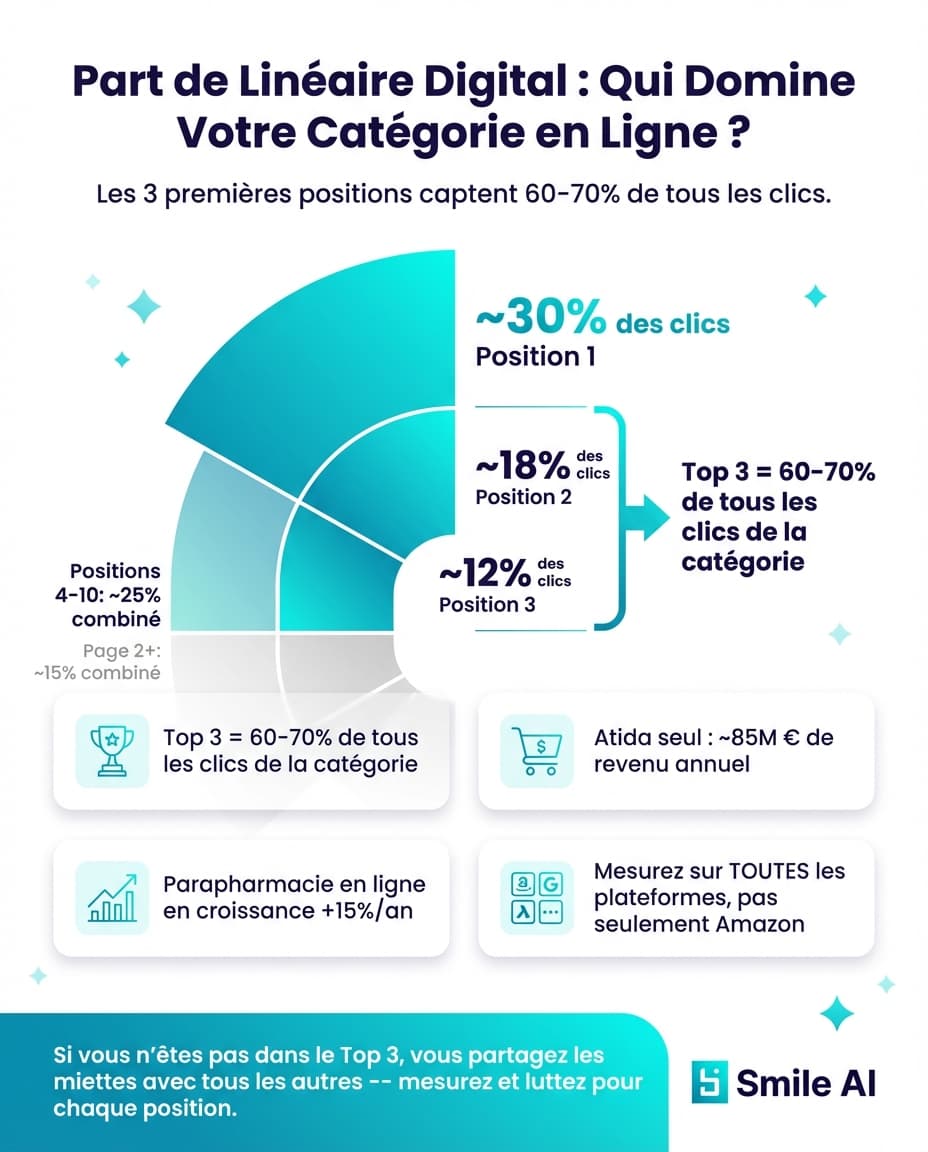
Digital shelf share is a leading indicator of market share. Studies conducted in the FMCG sector show a direct correlation between digital shelf visibility and sales volume. On average, brands that occupy the top three positions in search results capture between 60% and 70% of clicks–and therefore most conversions.
For category managers and e-commerce leaders in consumer health, tracking this KPI isn't a luxury: it's the foundation of a data-driven strategy.
The Parallel with Physical Shelf Space
| Dimension | Physical Shelf | Digital Shelf |
|---|---|---|
| Visibility | Number of facings, shelf position | Search result ranking, category page presence |
| Content | Packaging, labeling | Product listing, images, A+ Content, description |
| Reputation | Pharmacist recommendation | Ratings, reviews, number of reviews |
| Availability | Stock on shelf | Online availability, delivery time |
| Price | Shelf tag | Displayed price, automatic comparison |
2. The Four Components of Share of Digital Shelf
To measure your digital shelf share rigorously, you must break down the concept into four complementary pillars. Each contributes to overall visibility and each is measured differently.
2.1 Share of Search
Definition: The percentage of search results occupied by your brand for a set of strategic keywords in your category.
Share of search is probably the most decisive component. On Amazon, more than 70% of purchase journeys begin with the search bar. On e-pharmacies like CVS Pharmacy, Walgreens, and Amazon Pharmacy, search is also consumers' first reflex.
How to measure it:
- Define a basket of 20 to 50 keywords representative of your category (generic, by symptom, by ingredient, by brand)
- For each keyword, record the position of each of your products in the top 20 results (page 1 and beginning of page 2)
- Calculate the ratio: (number of positions occupied by your brand / total number of measured positions) x 100
- Repeat the exercise by retailer: Amazon, CVS Pharmacy, Walgreens, Amazon Pharmacy, HealthWarehouse
Concrete example: On the query "vitamin D3," if your brand occupies 3 positions out of the top 20, your share of search for this keyword is 15%. If your main competitor occupies 5, they're at 25%.
US Health Benchmarks:
| Category | Typical Leader (SoS) | Top 5 Average | Alert Threshold |
|---|---|---|---|
| Pain (analgesics) | 20-30% | 10-15% | < 5% |
| Allergies | 15-25% | 8-12% | < 4% |
| Vitamins and supplements | 10-20% | 5-10% | < 3% |
| Digestive | 15-25% | 8-14% | < 5% |
Categories with high brand concentration (like pain, dominated by a few historical players) have leaders with higher share of search. More fragmented categories (vitamins, supplements) offer more opportunities to gain ground.
2.2 Content Share
Definition: The relative quality and completeness of your product content compared to competition and category standards.
Content isn't just a conversion factor: it directly feeds search algorithms. A product with an incomplete listing, poor-quality images, or descriptions lacking relevant keywords will be systematically penalized in terms of visibility.
Elements to evaluate:
- Product title: Does it contain the brand, product, dosage, format, and key keywords?
- Images: Number of images (recommended minimum: 5-7), quality, compliance with retailer guidelines, presence of USP images (ingredients, usage instructions, comparatives)
- Bullet points: Complete, structured, integrating product benefits and search keywords
- Detailed description: Rich, informative, compliant with regulatory requirements (FDA for medications, FTC for health claims on supplements)
- A+ Content / Enhanced content: Present or absent, design quality, module relevance
- Product video: Presence and quality
Recommended scoring:
Assign a score of 0 to 100 to each product by weighting the above elements. Then compare your average score to that of your direct competitors and category best practices.
US Regulatory Specificity: In the United States, the FDA actively monitors health claims on dietary supplements and health & wellness products. The FTC requires clear labeling of sponsored content. Only FDA-approved online pharmacies can sell prescription medications online. These constraints make content quality even more critical: you must be both persuasive and perfectly compliant.
2.3 Ratings Share
Definition: Your brand's relative position in terms of average ratings and review volume compared to competitors in your category.
Customer reviews are a major conversion factor in the health sector. American consumers place particular importance on experience feedback before buying a health product online–the trust factor is central in this category.
Metrics to track:
- Average rating: Your rating compared to category average and leader
- Review volume: Total number of reviews. A product with 500 reviews and a 4.3 rating inspires more confidence than a product at 4.6 with only 12 reviews
- Review velocity: The rate at which new reviews are published (recent reviews count more)
- Positive/negative ratio: The percentage of 4-5 star reviews vs. 1-2 star reviews
- Qualitative sentiment: Recurring themes in reviews (effectiveness, taste, ease of use, value for money)
Benchmarks by category:
| Category | Category Average Rating | Median Volume (Amazon) | Recommended Minimum Threshold |
|---|---|---|---|
| Pain | 4.3 - 4.5 | 200-800 reviews | 50 reviews, rating > 4.0 |
| Allergies | 4.1 - 4.4 | 100-500 reviews | 30 reviews, rating > 4.0 |
| Vitamins | 4.2 - 4.5 | 150-1,000 reviews | 40 reviews, rating > 4.0 |
| Digestive | 4.0 - 4.4 | 80-400 reviews | 25 reviews, rating > 3.8 |
2.4 Availability Share
Definition: The percentage of time your products are available for purchase compared to the competition.
An out-of-stock product is an invisible product. On Amazon, an out-of-stock product not only loses the immediate sale but also its search ranking–and recovery can take weeks or even months. On US e-pharmacies, stockouts push consumers toward competitors, often permanently.
What to measure:
- Availability rate: Percentage of time the product is in stock and purchasable on each retailer
- Buy Box (Amazon): Percentage of time you hold the Buy Box (for products distributed by multiple sellers)
- Displayed delivery time: A "available" product with a 7-day delay is nearly invisible against a competitor delivered in 24-48 hours
- Retailer coverage: On how many platforms (Amazon, CVS Pharmacy, Walgreens, Amazon Pharmacy, HealthWarehouse) is your product actually available?
The quantified impact of stockouts:
Industry data shows that a product out of stock for 7 days on Amazon can lose between 20 and 40 positions in search results. Complete recovery generally takes 2 to 4 weeks after returning to stock–provided the competitor hasn't consolidated their position in the meantime.
3. How to Systematically Measure Share of Digital Shelf
3.1 Step 1: Define Your Category and Competitive Set
Before measuring anything, you must answer two fundamental questions:
What is your online category? Attention: your online category isn't necessarily the same as in physical retail. Online, categories are defined by consumer search behaviors, not pharmaceutical classification. A magnesium-based supplement can compete with anti-stress products, sleep aids, or general dietary supplements, depending on the keyword typed.
Who are your online competitors? Again, your digital competitive set may differ from physical retail. On Amazon, you're potentially competing with:
- Historical pharmaceutical brands
- Health & wellness and supplement brands
- Digitally native brands (DNVB)
- Private label brands (Amazon Basic Care, e-pharmacy private labels)
- Products imported from other markets
Concrete action: Identify 3 to 5 direct competitors and 2 to 3 indirect competitors per retailer. Build your reference framework before launching any measurement.
3.2 Step 2: Build Your Keyword Basket
The keyword basket is the backbone of digital shelf share measurement. It must be:
- Representative: Cover generic queries ("headache," "vitamin C"), symptom queries ("heartburn"), ingredient queries ("ibuprofen 400mg"), and brand queries
- Weighted: High search volume keywords should weigh more in the calculation
- Updated: Search behaviors evolve (seasonality effects, health trends, new formulations). Review your basket at least quarterly
Recommendation by category size:
| Category Size | Recommended Number of Keywords |
|---|---|
| Niche (< 50 products) | 15-25 keywords |
| Medium (50-200 products) | 25-50 keywords |
| Large (> 200 products) | 50-100 keywords |
3.3 Step 3: Define Measurement Frequency
Optimal frequency depends on your category's volatility:
- Daily: Search ranking tracking for priority keywords, stockout alerts
- Weekly: Share of search calculation, review tracking, content verification
- Monthly: Complete share of digital shelf analysis (all four components), competitive benchmarking, trend reporting
- Quarterly: Strategic review, keyword basket adjustment, competitive set redefinition
3.4 Step 4: Choose Between Manual and Automated Measurement
The manual approach: Technically possible for a small portfolio (5-10 SKUs on 1-2 retailers), manual measurement consists of typing each keyword, recording positions, checking content and reviews one by one. It's a pedagogical exercise the first time, but quickly becomes unsustainable:
- 50 keywords x 6 retailers x 20 results = 6,000 data points to collect. Manually.
- Content and prices change daily
- Search results vary by time of day and location
- Time spent on collection is time lost for analysis and action
The automated approach: This is where digital shelf analytics makes complete sense. An automated analytics platform collects data continuously, calculates indicators, detects anomalies, and generates alerts. It allows you to spend time on interpretation and action rather than data collection.
Smile Analytics was designed precisely for this mission. The platform offers automated digital shelf share tracking across all relevant US retailers–Amazon, CVS Pharmacy, Walgreens, Amazon Pharmacy, HealthWarehouse–with category views, integrated competitive benchmarking, and real-time alerts. Where a team would spend 20 hours or more per week manually collecting this data, Smile Analytics does it continuously and presents results in actionable dashboards.
3.5 Step 5: Calculate Composite Share of Digital Shelf
To obtain an overall score, combine the four components with weighting adapted to your strategy:
Recommended formula:
Share of Digital Shelf = (Share of Search x 40%) + (Content Share x 25%) + (Ratings Share x 20%) + (Availability Share x 15%) Why this weighting?
- Search share is the factor most directly linked to sales: no visibility = no sale. It deserves the strongest weight.
- Content share feeds both search and conversion. It's the most actionable lever.
- Ratings share influences conversion and, indirectly, algorithmic ranking.
- Availability share is a fundamental prerequisite but often outside direct e-commerce team control (it depends on supply chain).
Note that this weighting can be adjusted according to your context. A brand in launch phase will prioritize content share and ratings. An established brand in defense phase will focus on search share and availability.
4. Strategies to Increase Your Share of Digital Shelf
4.1 Winning Share of Search
Product title optimization: The title is the first element read by the algorithm. On Amazon, the optimal formula for health products generally follows this structure: Brand + Line + Main Ingredient/Active + Dosage + Format + Quantity + Main Benefit.
Example: "BrandName VitaPlus - Vitamin D3 2000 IU - 90 Vegetarian Capsules - Immune and Bone Support"
Backend keyword enrichment (Amazon): Keywords invisible to consumers but read by the algorithm are an underexploited lever. Include synonyms, common language terms (as opposed to medical terms), and queries related to symptoms.
Targeted retail media strategy: Sponsored Products campaigns on Amazon and advertising solutions on e-pharmacies allow immediate visibility gains on strategic keywords. Advertising investment must be coordinated with organic optimization: an ad that leads to a poor-quality product page burns your budget.
Seasonality and anticipation: In the United States, health categories follow marked seasonal cycles. Allergies explode from March to June. Cold and flu products are in high demand from November to February. Vitamins experience peaks in January (New Year's resolutions) and fall (winter preparation). Anticipate these cycles by optimizing your content and launching advertising campaigns 2 to 4 weeks before demand peaks.
4.2 Improving Your Content Share
Completeness audit: Review each product listing on each retailer. Requirements vary from platform to platform: Amazon has its own guidelines, CVS Pharmacy and Walgreens have theirs. Content optimized for Amazon won't necessarily be adapted for HealthWarehouse.
Investing in enhanced content: A+ Content on Amazon (formerly Enhanced Brand Content) is a major differentiation factor. In the health sector, it allows integration of comparison tables, ingredient infographics, visual usage instructions, and reassurance elements (US manufacturing, certifications, referenced clinical studies).
Professional quality product images: Aim for a minimum of 6 images per product: main photo on white background, packaging photo, ingredients/composition image, benefits infographic, lifestyle usage photo, size/comparison image. Products with a complete image set show conversion rates 20 to 30% higher on average than products with only 1-2 images.
Regulatory compliance as competitive advantage: Where many brands see regulatory compliance as a constraint, the best teams make it an advantage. Content perfectly compliant with FDA and FTC requirements won't be removed or modified, preserving your visibility over time. The FTC also requires that sponsored content be clearly identified–a point of vigilance for all retail media campaigns.
4.3 Strengthening Your Ratings Share
Review generation programs: On Amazon, the Amazon Vine program allows sending products to qualified testers in exchange for honest reviews. This is a particularly useful lever for new product launches or reformulations.
Encouraging post-purchase reviews: Follow-up emails, package inserts, and QR codes on packaging linking to the review page are proven tactics. The key is respecting each platform's policies: no direct incentives (discounts, gifts) in exchange for a positive review.
Managing negative reviews: In the health sector, a negative review mentioning an adverse effect or safety issue can have disproportionate impact. Set up a monitoring and rapid response process. In the United States, certain negative reviews may also trigger pharmacovigilance obligations–a point to coordinate with your regulatory teams.
Learning from reviews: Reviews are a goldmine of information on consumer expectations, competitor weaknesses, and product content improvement opportunities. Analyze recurring themes and use consumer vocabulary in your product descriptions and keywords.
4.4 Maximizing Your Availability Share
Supply chain / e-commerce coordination: The e-commerce team must have real-time visibility on stock levels by retailer and automatic alerts for stockout risk. On Amazon, losing the Buy Box due to stockout can have lasting consequences on ranking.
Multi-retailer strategy: Being present on a maximum of relevant platforms (Amazon, CVS Pharmacy, Walgreens, Amazon Pharmacy, HealthWarehouse) mechanically increases your availability share. But beware: each additional platform requires investment in content and operational management.
Continuous monitoring: Stockouts don't announce themselves. An automated alert system is essential to detect stockouts in real-time and measure their impact on ranking and sales. Smile Analytics offers precisely this capability: continuous availability monitoring across all retailers, with instant alerts and quantification of past stockout impact on performance.
5. Category Benchmarks: Where Do You Stand?
To give meaning to your measurements, you need reference points. Here are indicative benchmarks for four major consumer health categories in the US e-commerce market.
5.1 Pain (Analgesics, Anti-inflammatories)
Category characteristics:
- High brand concentration (a few historical players dominate)
- Strict regulation: only OTC medications sold by FDA-approved pharmacies
- Competition limited by regulation, but intense among authorized players
- Moderate seasonality (winter peak for cold-related pain)
Typical benchmarks:
| Indicator | Leader | Top 5 Average | Category Median |
|---|---|---|---|
| Share of Search | 25-30% | 12-18% | 5-8% |
| Content Score | 85-95/100 | 70-80/100 | 55-65/100 |
| Average Rating | 4.4-4.6 | 4.2-4.4 | 4.0-4.3 |
| Availability | > 97% | 92-96% | 85-92% |
Main lever: Search share is the key differentiation factor in this concentrated category. Content optimization and retail media strategy make the difference between leader and follower.
5.2 Allergies (Antihistamines, Nasal Sprays)
Category characteristics:
- Very strong seasonality (March to June in the US, with regional variations)
- Mix of OTC medications and medical devices (saline sprays, purifiers)
- Short but intense opportunity window
- Consumers often search by symptom rather than ingredient
Typical benchmarks:
| Indicator | Leader | Top 5 Average | Category Median |
|---|---|---|---|
| Share of Search (season) | 20-25% | 10-15% | 4-7% |
| Share of Search (off-season) | 15-20% | 8-12% | 3-5% |
| Content Score | 80-90/100 | 65-75/100 | 50-60/100 |
| Average Rating | 4.2-4.5 | 4.0-4.3 | 3.8-4.1 |
| Availability (season) | > 95% | 88-94% | 75-88% |
Main lever: Seasonal anticipation is critical. Brands that optimize their content and launch media campaigns 3-4 weeks before pollen season begins capture a disproportionate share of demand. In-season availability is a major logistical challenge–stockouts are devastating.
5.3 Vitamins and Dietary Supplements
Category characteristics:
- Most fragmented and competitive online category
- Low barrier to entry: many DNVB (digitally native brands) challenge historical players
- High search volume by ingredient (vitamin D, magnesium, omega-3, probiotics)
- Health claims closely monitored by the FTC
- Fastest growing segment in health & wellness e-commerce in the US
Typical benchmarks:
| Indicator | Leader | Top 5 Average | Category Median |
|---|---|---|---|
| Share of Search | 12-18% | 6-10% | 2-5% |
| Content Score | 80-92/100 | 65-78/100 | 45-60/100 |
| Average Rating | 4.3-4.6 | 4.1-4.4 | 3.9-4.2 |
| Review Volume (typical product) | 500-2,000 | 100-500 | 20-100 |
| Availability | > 96% | 90-95% | 82-90% |
Main lever: Content share is the number one differentiation factor. In a category where products can seem interchangeable, content quality (images, descriptions, A+ Content, reviews) makes the difference. Brands that invest in enhanced content and review programs gain a lasting advantage.
5.4 Digestive Health (Probiotics, Antacids, Laxatives)
Category characteristics:
- Mix of OTC medications and dietary supplements
- Search often triggered by symptoms ("bloating," "heartburn," "regularity")
- High sensitivity to reviews (consumers seek effectiveness testimonials)
- Moderate seasonality (slight post-holiday peak and spring)
Typical benchmarks:
| Indicator | Leader | Top 5 Average | Category Median |
|---|---|---|---|
| Share of Search | 18-25% | 9-14% | 4-7% |
| Content Score | 78-88/100 | 60-75/100 | 45-58/100 |
| Average Rating | 4.1-4.4 | 3.9-4.2 | 3.7-4.0 |
| Availability | > 95% | 89-94% | 80-90% |
Main lever: Ratings share is particularly influential in this category. Consumers actively seek experience feedback before buying a digestive product. Brands with higher review volume and detailed effectiveness testimonials convert significantly better.
6. Building Your Share of Digital Shelf Dashboard
6.1 Essential KPIs to Track
Your dashboard should be structured around the four components, with summary indicators and detailed indicators:
Overview:
- Composite Share of Digital Shelf score (calculated according to section 3.5 formula)
- Month-over-month evolution (trend)
- Relative position compared to category leader
By component:
| Component | Main KPI | Secondary KPI | Frequency |
|---|---|---|---|
| Search Share | % of top 20 positions | Weighted average rank | Daily / Weekly |
| Content Share | Average completeness score | % of "compliant" listings | Weekly / Monthly |
| Ratings Share | Average rating vs. category | Review volume and velocity | Weekly |
| Availability Share | Average availability rate | % Buy Box (Amazon) | Daily |
6.2 Internal Reporting and Communication
Weekly report (operational team):
- Alerts: stockouts, ranking drops, critical negative reviews
- Corrective actions underway
- Identified quick wins
Monthly report (management):
- Composite Share of Digital Shelf evolution
- Competitive benchmarking
- Correlation between investments (content, media) and visibility evolution
- Strategic recommendations
Quarterly review (leadership):
- Share of Digital Shelf vs. market share
- E-commerce investment ROI
- Trend analysis and forecasts
- Budget decisions
6.3 The Advantage of Automation with Smile Analytics
Building and maintaining such a dashboard manually is technically possible for a small portfolio, but the exercise quickly becomes unsustainable as the number of SKUs, retailers, and competitors increases. This is precisely Smile Analytics' reason for being.
The Smile Analytics platform is designed from the ground up for digital shelf share tracking in the health sector. It offers:
- Automated multi-retailer tracking: Amazon, CVS Pharmacy, Walgreens, Amazon Pharmacy, HealthWarehouse–all data in a single dashboard
- Category views: Define your categories, competitive sets, and keyword baskets. Smile Analytics automatically calculates your digital shelf share and that of your competitors
- Integrated competitive benchmarking: Compare your content, prices, reviews, and availability to those of your direct competitors at a glance
- Intelligent alerts: Receive real-time notifications for stockouts, ranking drops, critical negative reviews, or competitor strategy changes
- Automated reports: Generate weekly, monthly, and quarterly reports directly from the platform, in formats adapted to each audience
For category managers and e-commerce leaders managing dozens (even hundreds) of references across multiple platforms, Smile Analytics transforms hours of manual collection into minutes of strategic analysis.
7. Action Plan: From Measurement to Category Domination
7.1 Phase 1 - Diagnosis (Weeks 1-2)
- Define your online category and competitive set by retailer
- Build your keyword basket (20-50 priority terms)
- Conduct initial audit of your share of digital shelf (all four components)
- Identify your relative strengths and weaknesses compared to top 3-5 competitors
- Prioritize actions by potential impact and ease of implementation
7.2 Phase 2 - Fundamental Optimization (Weeks 3-8)
- Optimize titles and bullet points for the 20% of SKUs generating 80% of revenue
- Complete image sets (minimum 6 per product)
- Deploy or improve A+ Content on Amazon
- Launch review generation program (Amazon Vine, package inserts)
- Resolve availability issues identified during diagnosis
- Implement automated tracking with digital shelf analytics tool
7.3 Phase 3 - Acceleration (Weeks 9-16)
- Launch targeted retail media campaigns on high-potential keywords
- Optimize content for symptom and long-tail queries
- Expand retailer coverage (add under-exploited platforms)
- Intensify review strategy and user-generated content
- Analyze initial results and adjust strategy
7.4 Phase 4 - Domination and Defense (Ongoing)
- Weekly share of digital shelf tracking and response to competitive moves
- Continuous content optimization based on performance data
- Seasonal adaptation of keyword and retail media strategy
- Quarterly update of competitive set and keyword basket
- Regular management reporting with data-driven recommendations
8. Most Common Mistakes (and How to Avoid Them)
Mistake #1: Measuring Without Acting
Collecting digital shelf share data without translating it into concrete actions is a waste of time and budget. Every measurement must inform a decision.
Solution: Define alert thresholds and action playbooks for each KPI. If your share of search falls below a certain threshold, what's the immediate action? If a competitor surpasses you in content score, what's the response plan?
Mistake #2: Focusing on a Single Retailer
Amazon is unavoidable, but the US health e-commerce landscape is multi-retailer. Ignoring CVS Pharmacy, Walgreens, Amazon Pharmacy, or HealthWarehouse means leaving market share on the table.
Solution: Adopt a multi-retailer approach from the start, even if investment intensity varies by platform.
Mistake #3: Neglecting Seasonality
In health categories, seasonality isn't a detail: it's a structural factor. Brands that don't prepare their digital shelf before demand peaks lose most of the opportunity.
Solution: Create an annual calendar for your category with demand peaks, and plan your content optimizations and media campaigns 3 to 4 weeks in advance.
Mistake #4: Disconnecting Content and Advertising
Investing in retail media without having optimized your product listings is sending traffic to pages that don't convert. The best teams closely coordinate content and media teams.
Solution: Use a "readiness score": a product only receives advertising budget if its content score, rating, and availability exceed minimum thresholds.
Mistake #5: Using the Same KPIs Online and In-Store
Physical pharmacy market share and share of digital shelf aren't measured the same way and aren't always correlated. A leader in physical pharmacies can be invisible online.
Solution: Build an e-commerce-specific measurement framework, with its own KPIs, benchmarks, and objectives.
9. Regulatory Framework: A US Market-Specific Parameter
Measuring and optimizing digital shelf share in the United States operates within a specific regulatory framework that's essential to master:
- Food and Drug Administration (FDA): Regulates medications. OTC medication listings sold online must meet specific information requirements.
- Federal Trade Commission (FTC): Monitors health claims on dietary supplements and health & wellness products. Non-compliant claims can result in content removal, fines, and negative visibility impact.
- FTC Advertising Regulations: Require transparency in sponsored content–a point of vigilance for all retail media campaigns.
- State Pharmacy Boards: Issue licenses for online medication sales. Only licensed pharmacies can sell prescription medications online.
For e-commerce teams, compliance isn't just a legal issue: it's a factor in your visibility sustainability. Non-compliant content removed by a retailer or flagged by regulators destroys your digital shelf share instantly and durably.
Conclusion: Share of Digital Shelf, Your Strategic Compass
In a market where health e-commerce in the United States is accelerating rapidly, mastering share of digital shelf is no longer optional. It's the compass that guides investment decisions in content, retail media, supply chain, and competitive strategy.
Key takeaways from this guide:
-
Share of digital shelf is multidimensional. It's not just about search ranking: it integrates search, content, reviews, and availability.
-
Systematic measurement is a prerequisite. Without reliable, regular data, you're navigating blind in an environment where positions change daily.
-
Automation is an accelerator. Teams using digital shelf analytics tools like Smile Analytics spend their time on analysis and action, not data collection.
-
Category benchmarks provide meaning. Your digital shelf share only has value when compared to your competitors and category standards.
-
Action is what makes the difference. Measuring is necessary. Acting quickly and effectively based on these measurements is what separates leaders from followers.
The US health e-commerce market is still maturing compared to other sectors. This is an opportunity: brands that structure their digital shelf approach now will gain a lasting competitive advantage. Categories are forming, consumer habits are establishing, and leadership positions are being built today.
Ready to measure and optimize your share of digital shelf? Smile Analytics offers a complete view of your visibility across all health retailers in the United States, with integrated competitive benchmarking and actionable recommendations. Request a demo to discover how the platform can transform your online category strategy.
This guide was produced by Smile AI, the European leader in e-commerce solutions for the consumer health sector. Smile AI supports health brands in their online growth through the Smile Analytics platform and its team of specialized consultants.
The essentials at a glance
Key takeaways from this article in one infographic.
© Smile AI 2026
Ready to dominate the Digital Shelf?
Discover how Smile Analytics helps Consumer Healthcare brands optimize their e-commerce performance across all platforms.
Related articles
The 2026 Pharma E-Commerce Playbook
How Consumer Healthcare Brands Dominate the Digital Shelf in the United States
Pharma Retail Media in the United States
The Complete Guide to Advertising on Amazon, CVS Pharmacy, and Walgreens