
From Pharmacy Aisles to Digital Carts
The Shift Every CHC Brand Must Make by 2026
Trend Analysis | Thought Leadership Target Audience: CMOs, VP Marketing, Strategy Teams
Introduction: The Counter Alone Is No Longer Enough
For decades, the success of a Consumer Healthcare (CHC) brand in the United States was determined behind the pharmacy counter. Good retail relationships, an effective field team, a convinced pharmacist: that was the recipe that sold Tylenol, Voltaren, or Advil.
In 2026, this era isn't over. But it's no longer sufficient.
The U.S. market for self-medication and health and wellness products is undergoing a structural transformation. American consumers, long loyal to their local pharmacist's advice, are increasingly turning to digital channels to research, compare, and purchase their health products. COVID-19 was an accelerator. But the underlying movement was already there–and it's only intensifying.
For marketing directors and strategy teams at CHC laboratories, the question is no longer whether digital is relevant. The question is whether your brand will be visible where consumers will be tomorrow.
This article provides an in-depth analysis of the transformation of the U.S. CHC market: growth data, channel analysis, the reality of omnichannel in pharma, and the regulatory framework that makes this transition both complex and full of opportunities.
1. Current State: Where Are We with E-commerce Health in the U.S.?
A Market Still Growing, but with Constant Acceleration
Online commerce for health products in the United States represents approximately 8-12% of total pharmacy revenue. At first glance, this figure might seem modest compared to other retail categories. But it masks a much more powerful dynamic.
The U.S. health and wellness e-commerce market shows estimated annual growth of around 18-22%, driven by dietary supplements, personal care products, wellness, and dermocosmetics. In absolute value, e-commerce for health products (excluding prescription medications) now exceeds $15 billion in the United States, with projections placing this segment at over $25 billion by 2027.
CVS Pharmacy, the largest pharmacy chain with comprehensive online capabilities, generates billions in annual revenue across both prescription and OTC categories. Walgreens, Amazon Pharmacy, and specialized online pharmacies like HealthWarehouse complete an increasingly structured ecosystem.
Key Figures to Remember
| Indicator | Data |
|---|---|
| E-commerce share of total pharmacy sales | 8-12% |
| Annual growth of health and wellness online | ~18-22% |
| Number of pharmacies in the U.S. | ~60,000+ |
| Share of independent pharmacies | ~35% |
| CVS Health market share | ~25% |
| Walgreens market share | ~20% |
| Amazon Pharmacy penetration | Rapidly growing |
| Click-and-collect pharmacy adoption | Strong growth trajectory |
The COVID Legacy: A Lasting Change
The 2020 pandemic forced millions of Americans to turn to online pharmacies for the first time. What was supposed to be a crisis reflex became lasting behavior. Surveys conducted after the health crisis show that the majority of consumers who adopted online purchasing of health products continued to do so.
This behavioral change is particularly marked among three segments:
- Urban 25-44 year-olds, accustomed to e-commerce in other categories (fashion, food, electronics) and who find it natural to also purchase their dietary supplements or personal care products online.
- Parents of young children, for whom the convenience of home delivery or click-and-collect represents considerable time savings (baby care, vitamins, infant products).
- Dietary supplement and wellness product consumers, who tend to conduct thorough research before purchasing and actively compare prices online.
2. Channel Analysis: Where Are Americans Buying Their Health Products in 2026?
Physical Pharmacy: Still Dominant, but Evolving
With over 60,000 pharmacies distributed across the territory–though more consolidated than European markets–physical pharmacy remains the primary channel for CHC products in the U.S. The market is dominated by major chains like CVS Health (~25% market share) and Walgreens (~20% market share), with independent pharmacies representing approximately 35% of locations.
But even this stronghold is evolving. Major chains and pharmacy networks–CVS Health, Walgreens, Rite Aid–are investing massively in their digital capabilities: e-commerce sites, mobile applications, connected loyalty programs, and click-and-collect.
E-pharmacies: The Growth Engine
The e-pharmacy segment experiences the most dynamic growth. Several key players dominate the landscape:
CVS Pharmacy: Undisputed leader in the U.S. market with the most comprehensive online platform, integrating prescription services, OTC products, and health services. CVS embodies the convergence of physical and digital pharmacy with its omnichannel approach.
Walgreens: Major pharmacy retailer with strong digital capabilities, extensive OTC selection online, and growing digital health initiatives including telehealth services.
Amazon Pharmacy: The disruptive force that has transformed the landscape, offering competitive pricing, fast delivery, and integration with Prime benefits for prescription and OTC products.
HealthWarehouse: Pure-play online pharmacy specializing in prescription medications with competitive pricing and mail-order focus, particularly strong in the direct-to-consumer prescription market.
Capsule: Digital-first pharmacy with same-day delivery in major cities and modern user experience focused on prescription management and customer service.
Amazon.com: The Outsider That Increasingly Matters
Amazon.com occupies a unique position in the U.S. CHC ecosystem. Beyond Amazon Pharmacy for prescriptions, Amazon is a major channel for dietary supplements, Class I medical devices, personal care products, hygiene, and wellness products.
For many consumers, Amazon is the first search reflex–including for health products. CHC brands that ignore Amazon.com ignore the entry point of the purchase journey for a significant portion of their target audience.
Click-and-Collect: The American Adaptation
The click-and-collect model is particularly well-adapted to the American market for several reasons:
- The density of chain pharmacy networks makes pickup at pharmacies extremely convenient for the majority of the population, especially in suburban areas.
- Trust in pharmacy chains remains very high in the U.S. Click-and-collect allows combining digital convenience with the reassurance of professional pharmacy service.
- Major chains like CVS and Walgreens have specifically built their digital models around this principle, allowing customers to order online with store pickup while maintaining access to pharmacist consultation.
For CHC brands, click-and-collect represents a strategic bridge between physical and digital–a hybrid model that perfectly matches American consumer expectations.
Health and Wellness in Mass Retail: A Significant Complementary Channel
Target Pharmacy, Walmart Pharmacy, and the health sections of major retailers constitute a significant complementary channel. The rise of their e-commerce platforms and retail media offerings (including Walmart Connect and Target's Roundel) opens new opportunities for CHC brands.
Summary: The Channel Map in 2026
| Channel | Estimated Market Share (CHC excl. Rx) | Trend |
|---|---|---|
| Chain pharmacy physical | ~45% | Stable to slightly declining |
| Independent pharmacy physical | ~25% | Slightly declining |
| E-pharmacies (CVS, Walgreens, Amazon) | ~15-18% | Strong growth (~20%/year) |
| Amazon.com (health and wellness, supplements) | ~8-12% | Strong growth |
| Mass retail pharmacy (Walmart, Target) | ~8-10% | Stable |
| Click-and-collect pharmacy | Included in physical pharmacy | Strong growth |
3. What "Omnichannel" Really Means in Pharma–and Why Most Brands Get It Wrong
The Cosmetic Omnichannel Trap
The term "omnichannel" has become a buzzword in CHC laboratory strategic presentations. Everyone claims to be omnichannel. Few actually are.
For most brands, omnichannel boils down to: "We have a website, we sell on Amazon, and our products are in pharmacies." That's multichannel, not omnichannel.
True omnichannel is the ability to deliver a consistent, data-driven experience across all touchpoints–and to understand how these channels interact with each other.
The Three Most Common Mistakes
Mistake #1: Siloed Teams
In many CHC laboratories in the U.S., the team managing physical pharmacy (pharmaceutical representatives, pharmacy KAMs) and the e-commerce team are in different departments, with different KPIs and sometimes conflicting interests. The result: inconsistent pricing across channels, promotions that cannibalize each other, and a total absence of unified consumer vision.
Mistake #2: Heterogeneous Product Content
The product page on CVS Pharmacy doesn't resemble the one on Amazon.com, which doesn't correspond to the brand's website. Titles, descriptions, images, selling arguments vary from one channel to another without deliberate strategy. Consumers who move from one channel to another–and they all do–receive contradictory messages.
Mistake #3: No Cross-Channel Performance Measurement
How do you measure your brand's performance when data is scattered between Amazon Vendor Central reporting, CVS dashboards, field team feedback, and IMS/IQVIA panels? Most brands operate blindly, unable to answer fundamental questions like: "What is my share of search on key keywords across all online retailers?" or "How does my digital visibility impact my pharmacy sales?"
Authentic Omnichannel: Unified View, Coordinated Action
True omnichannel in pharma CHC rests on three pillars:
-
Unified Data: Aggregate digital performance metrics (search visibility, content quality, reviews, availability, pricing) across all online points of sale in a single dashboard.
-
Coordinated Content Strategy: Adapt content to the specificities of each platform while maintaining brand and message consistency. This requires centralized governance of product content.
-
Continuous Feedback Loop: Use digital data to inform pharmacy strategy, and vice versa. For example, the most used search terms online can reveal consumer expectation insights that enrich the pharmaceutical representative's discourse.
It's precisely in this context that platforms like Smile Analytics make complete sense. As an omnichannel command center, Smile Analytics allows CHC teams to track their product performance across all digital touchpoints–Amazon.com, CVS Pharmacy, Walgreens, Amazon Pharmacy, and beyond–from a single interface. Instead of navigating between five dashboards and three Excel files, teams have a consolidated view that reveals performance gaps, growth opportunities, and priority actions across all retailers.
4. The Regulatory Framework: Moving Fast Without Breaking Rules
A More Complex Environment Than Other Markets
The U.S. health e-commerce market operates within a significantly more complex regulatory framework than some international markets, with multiple federal and state-level oversight bodies. Understanding these constraints isn't a brake–it's a competitive advantage for brands that know how to navigate them.
The Four Key Regulators to Know
| Regulator | Scope | E-commerce Impact |
|---|---|---|
| Food and Drug Administration (FDA) | Medications, medical devices, dietary supplements | Strict oversight of online drug sales, health claim regulation, supplement labeling requirements |
| Federal Trade Commission (FTC) | Consumer protection, advertising | Surveillance of health claims on dietary supplements and health and wellness products, truth in advertising |
| State Boards of Pharmacy | Pharmacy licensing and operations | Individual state requirements for online pharmacy operations, varying by state |
| DEA (Drug Enforcement Administration) | Controlled substances | Strict requirements for online prescription sales, especially controlled medications |
What This Means Concretely for Brands
For OTC Medications: Only licensed pharmacies can sell OTC medications online, and requirements vary by state. This means your OTC medication distribution in e-commerce goes exclusively through authorized pharmacies–not through Amazon's general marketplace for medications (though Amazon Pharmacy is licensed). Channel mix strategy must account for these restrictions.
For Dietary Supplements and Health and Wellness Products: Health claims are strictly regulated by the FDA and FTC. Every claim presented in an online product description, enhanced content, or visual can be subject to regulatory review. Brands that directly transpose their content from other markets without adaptation risk FDA warning letters or FTC enforcement actions.
For Advertising and Retail Media: The FTC requires complete transparency on sponsored content. Retail media campaigns on Amazon.com or through other advertising networks must comply with these rules. Clear disclosure of advertising nature is not optional.
Turning Constraints into Advantages
Brands that master this regulatory framework have a considerable advantage:
- Barrier to Entry: U.S. regulatory complexity slows new entrants and protects established brands that invest in compliance.
- Consumer Trust: Product content compliant with U.S. standards strengthens brand credibility in a sector where trust is the primary decision factor.
- Execution Speed: Teams with established digital content validation processes–with the right monitoring tools–can update their product pages faster than competitors stuck in manual validation circuits.
It's in this challenge of speed and compliance that technology makes the difference. A platform like Smile Analytics enables real-time monitoring of product content quality and compliance across all retailers, generating automatic alerts when content is modified or potentially non-compliant. Instead of conducting quarterly manual audits, regulatory and marketing teams have continuous oversight.
5. Trends That Will Accelerate the Shift in 2026
Trend #1: Consolidation of Pharmacy and E-commerce Platforms
The aggressive expansion of major players like Amazon Pharmacy and the digital transformation of traditional chains like CVS Health and Walgreens is changing the game. These players bring technological capabilities, marketing budgets, and e-commerce expertise that independent pharmacies struggle to match.
For CHC brands, this consolidation means:
- New stakeholders with different requirements for product content and commercial terms.
- Increased pressure on online pricing.
- New retail media opportunities on growing platforms.
Trend #2: Generative AI Transforms the Health Shopping Journey
ChatGPT, Perplexity, Google AI Overviews: more and more consumers begin their health product research with an AI assistant query rather than a traditional Google search or pharmacy visit.
This evolution has profound implications for CHC brands:
- Visibility in LLMs becomes a strategic issue. If ChatGPT recommends a competitor when a consumer asks "what is the best magnesium supplement in the U.S.?", your brand loses an opportunity before the consumer even reaches a point of sale.
- Structured, information-rich product content is what feeds these recommendations. Brands with the most complete, accurate, and well-structured digital content will be most visible in these new discovery engines.
Trend #3: Retail Media Explodes in CHC
Retail media–advertising purchased directly on online sales platforms–is experiencing exponential growth. Amazon Advertising U.S. is already a major channel for CHC brands. But the ecosystem is expanding:
- Walmart Connect offers opportunities for health and wellness products distributed through these channels.
- Target's Roundel provides advertising capabilities for products sold through Target's pharmacy and health sections.
- CVS Media Exchange and similar programs from major pharmacy chains develop their own sponsored placement offerings.
For brands, the challenge is twofold: invest intelligently across these multiple channels, and measure return on investment reliably. Managing retail media without a consolidated view of performance is navigating without a compass.
Trend #4: Click-and-Collect as a Bridge to Digital-First
Click-and-collect, already well-established thanks to the density of chain pharmacy networks, is evolving toward more sophisticated models. Major chains like CVS and Walgreens no longer settle for simple order-with-pickup: they now integrate remote pharmaceutical consultation functionalities, prescription management, and digital loyalty programs.
For CHC brands, click-and-collect is strategic terrain because it combines digital conversion with physical pharmacy traffic–a model where online visibility directly translates into counter sales.
Trend #5: The Rise of Private Label and Niche Brands
Retailer private label brands from major chains and direct-to-consumer (DTC) niche brands are gaining market share in high-value segments: dietary supplements, probiotics, natural cosmetics. These players are often digital natives, agile in execution, and very effective in content and SEO.
Faced with this competition, major CHC laboratories must elevate their digital game. Brand prestige alone is no longer enough when Amazon's algorithm doesn't know your laboratory's historical reputation–it only sees the relevance of your product page, the quality of your reviews, and your conversion rate.
6. The Roadmap: How to Manage the Transition to Digital
Phase 1: Diagnosis (Months 1-2)
Before defining a strategy, you need to understand where you stand. This involves:
- Auditing your current digital presence across all online retailers: Amazon.com, CVS Pharmacy, Walgreens, Amazon Pharmacy, HealthWarehouse. What are your product pages? Are they complete? Consistent? Compliant?
- Measuring your search visibility: for strategic keywords in your category, where do you appear in search results on each platform?
- Evaluating your competitive position: how do your products compare to competitors in terms of content, reviews, pricing, availability?
A platform like Smile Analytics enables this diagnosis in days rather than weeks, by automatically aggregating data from all retailers in a single dashboard.
Phase 2: Foundations (Months 2-4)
Based on the diagnosis, priorities are generally:
-
Optimize product content: titles, descriptions, images, enhanced content (A+ on Amazon, detailed pages on e-pharmacies). Each page must be optimized for the platform's organic search while respecting U.S. regulatory constraints.
-
Structure monitoring: implement continuous tracking of key KPIs–search rank, content quality, reviews, availability, pricing–across all channels.
-
Align teams: create a collaboration framework between the e-commerce team, pharmacy team, marketing, and regulatory. Omnichannel only works if teams speak the same language and share the same data.
Phase 3: Acceleration (Months 4-8)
With foundations in place:
- Launch or optimize retail media campaigns on Amazon.com and pharmacies that offer advertising formats. Target both brand keywords (defense) and category keywords (conquest).
- Develop a review strategy: actively encourage reviews on key platforms, respond to negative reviews, and use consumer feedback to enrich product content.
- Integrate click-and-collect into digital strategy, working with pharmacy networks to maximize your product visibility in their online ordering journeys.
Phase 4: Leadership (Months 8-12+)
The most advanced brands go beyond tactical optimization:
- AI Visibility: monitor and optimize your brand's presence in AI assistant recommendations (ChatGPT, Perplexity, Google AI Overviews).
- Advanced retail media: use digital shelf data to inform retail media decisions, only sponsoring products whose content and reviews are at the level required to convert.
- Continuous competitive intelligence: monitor competitor launches, price changes, and content evolutions in real-time to react in hours rather than weeks.
7. The Management Challenge: Why Cross-Channel Data Is the Heart of the Matter
The fundamental challenge of digital transformation in CHC isn't technological–it's a visibility and management challenge. The data exists, but it's fragmented: one dashboard at Amazon, another at CVS, field reports for pharmacy, IQVIA panels for market view.
Teams that succeed are those with a single source of truth, capable of instantly answering questions like:
- "What is our share of search on the keyword 'probiotic' across Amazon.com, CVS Pharmacy, and Walgreens this week?"
- "Which products in our portfolio have incomplete or non-compliant content on at least one retailer?"
- "A competitor just changed their prices on three retailers simultaneously–how should we respond?"
- "Do our retail media campaigns on Amazon generate better ROAS than those on pharmacy chains?"
This is exactly the role that Smile Analytics fulfills as an omnichannel command center. The platform aggregates digital performance data–search visibility, content quality, reviews, pricing, availability, retail media–across all online retailers, in a single dashboard. Teams spend less time collecting data and more time making decisions that generate growth.
For CHC brands managing dozens, even hundreds of references across five, six, or seven online retailers, this centralized management capability isn't a luxury–it's a prerequisite.
8. Conclusion: The Time to Act Is Now
The U.S. CHC market is at an inflection point. The signals are clear:
- Growth is online. With double-digit annual growth, health e-commerce is the most dynamic segment of the U.S. CHC market.
- Consumers have changed. COVID accelerated adoption, but habits are now entrenched. American consumers are omnichannel–even if your brand isn't yet.
- Competition is intensifying. Digital-native brands, DTC companies, private labels: all are investing heavily in their online presence. Standing still equals moving backward.
- Regulation is an advantage, not a brake. Brands that master the FDA/FTC framework and have compliance monitoring tools have a lasting advantage over less rigorous competitors.
The shift from pharmacy aisle to digital cart isn't a question of "if"–it's a question of "how fast." CHC brands that invest now in their digital infrastructure–content, visibility, retail media, analytics–will be those that capture tomorrow's growth.
And those that wait? They'll find their digital shelves occupied by competitors who acted sooner.
Smile Analytics accompanies leading CHC brands in the United States through this transition, providing the omnichannel management platform that transforms fragmented data into strategic decisions. From search visibility to retail media, from content monitoring to competitive intelligence, Smile Analytics gives e-commerce teams the unified vision they need to win on the digital shelf.
To discover how Smile Analytics can help your brand manage its digital transformation, request a personalized demo.
Keywords: CHC e-commerce trends 2026 USA | pharma digital transformation United States | healthcare online shopping growth | omnichannel pharma USA | e-pharmacy USA growth | Smile Analytics
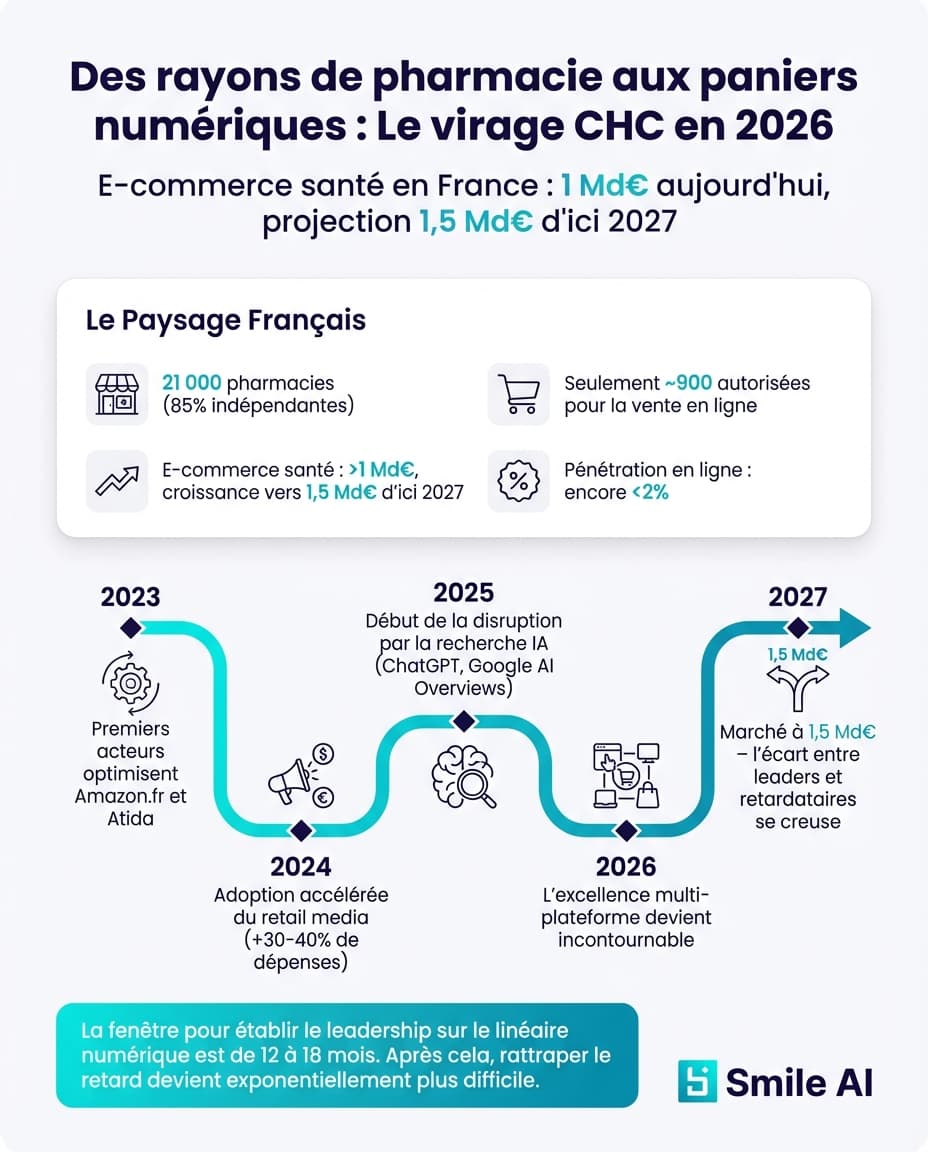
The essentials at a glance
Key takeaways from this article in one infographic.
© Smile AI 2026
Ready to dominate the Digital Shelf?
Discover how Smile Analytics helps Consumer Healthcare brands optimize their e-commerce performance across all platforms.
Related articles
The 2026 Pharma E-Commerce Playbook
How Consumer Healthcare Brands Dominate the Digital Shelf in the United States
Pharma Retail Media in the United States
The Complete Guide to Advertising on Amazon, CVS Pharmacy, and Walgreens