
The Pharma E-Commerce Playbook 2026
How Consumer Healthcare Brands Dominate the Digital Shelf in the UK
Complete strategic guide for VP E-Commerce, Digital Directors and CMOs in the CHC sector
Introduction: UK pharmaceutical e-commerce, a market at an inflection point
The UK pharmaceutical market is the second largest in Europe, with pharmacy turnover exceeding £36 billion. Yet online sales still represent less than 2% of total pharmacy sales. This figure, often cited as a weakness, is actually a colossal opportunity.
Whilst other retail sectors have already shifted to digital (fashion, electronics, food), UK online pharmacy remains an under-exploited territory. The reasons are multiple: a strict regulatory framework, a dense territorial network of independent pharmacies, and a culture of pharmacy consultation deeply ingrained among British consumers.
But the landscape is shifting. And it's shifting fast.
The signals are clear:
- The online health and beauty segment (food supplements, body care, beauty, wellness) is growing by approximately 15% per year, driven by increasing demand for prevention and responsible self-medication.
- Pan-European consolidation of e-pharmacies is accelerating: Redcare Pharmacy (formerly Shop Apotheke), Atida, and DocMorris are investing heavily in the UK market.
- Amazon.co.uk is progressively extending its health and beauty and food supplement offering, with increasingly bold ambitions in consumer health.
- Click-and-collect, a hybrid model perfectly adapted to the UK's dense pharmacy network, is transforming the purchasing journey.
For Consumer Healthcare (CHC) brands -- whether vitamins and supplements, OTC care, dermocosmeceuticals or wellness products -- the question is no longer "should we invest in e-commerce?" but "how do we structure a strategy that wins on the digital shelf?".
This guide is designed to answer that question. It proposes a complete framework, structured around five fundamental pillars, with concrete benchmarks, examples from the UK market, and actionable maturity stages. This is your CHC e-commerce playbook UK for 2026.
The UK pharma e-commerce landscape: where are we now?
A still-emerging market, but accelerating
Online commerce for health products in the UK weighs approximately £700 million, a figure that includes OTC medicine sales by MHRA-approved pharmacies and, importantly, health and beauty. Whilst this amount seems modest compared to the overall pharmaceutical market, the growth dynamic is remarkable.
Key benchmarks:
- Approximately 900 pharmacies have MHRA authorisation for online sales of over-the-counter medicines, out of a total of around 11,500 pharmacies.
- Boots is the undisputed leader in UK online pharmacy, with estimated annual turnover of approximately £850 million across all channels.
- Superdrug, LloydsPharmacy, and Pharmacy2U complete the podium of major players.
- Amazon.co.uk has become a major channel for food supplements and health and beauty, without however selling OTC medicines (as it lacks MHRA licensing).
- The average online basket for health and beauty sits between £45 and £65, significantly higher than the average in-store basket for the same categories.
UK market specificities
For any brand wishing to deploy an effective pharma e-commerce strategy UK, it's essential to understand local particularities:
1. The regulatory framework is among the strictest in Europe
- The Medicines and Healthcare products Regulatory Agency (MHRA) regulates online medicine sales.
- Only pharmacies with authorisation from the MHRA can sell OTC medicines online.
- The Competition and Markets Authority (CMA) oversees compliance with rules on health claims for food supplements and health and beauty. Non-compliant claims under European regulation (EC) No 1924/2006 are systematically sanctioned.
- The Advertising Standards Authority (ASA) imposes strict rules for sponsored content and health product advertising.
2. The network of independent pharmacies is an asset, not an obstacle
With 85% of UK pharmacies being independent (rather than chains), the landscape is fragmented. However, buying groups and cooperatives like Well Pharmacy, Rowlands Pharmacy, and various independent networks offer opportunities for coordinated online distribution and large-scale click-and-collect.
3. UK consumers expect advice and trust
The British consumer places great importance on pharmaceutical advice. They are more sceptical than their American counterpart towards general marketplaces for health products. This means product content must be more rigorous, more informative and more compliant with regulatory expectations.
Key consumer healthcare digital shelf platforms
| Platform | Type | Strengths | Key Categories |
|---|---|---|---|
| Amazon.co.uk | General marketplace | Massive traffic, Amazon Advertising, A+ Content | Food supplements, body care, beauty, wellness |
| Boots | Pharmacy chain | Market leader, health expertise, strong conversion | OTC, health and beauty, dermocosmeceuticals, supplements |
| Superdrug | Health & beauty retailer | Strong online platform, GP services, competitive pricing | Health and beauty, OTC, supplements |
| LloydsPharmacy | Pharmacy chain | NHS prescription services, click-and-collect | Full pharmacy range, health products |
| Pharmacy2U | Online-first pharmacy | Specialised NHS delivery, repeat prescriptions | Prescription management, OTC expansion |
| Well Pharmacy | Community pharmacy chain | Online services, health consultations | Prescription management, OTC, wellness |
Mastering this multi-channel landscape is the first step of any successful consumer healthcare digital shelf strategy.
The five pillars of pharma e-commerce success
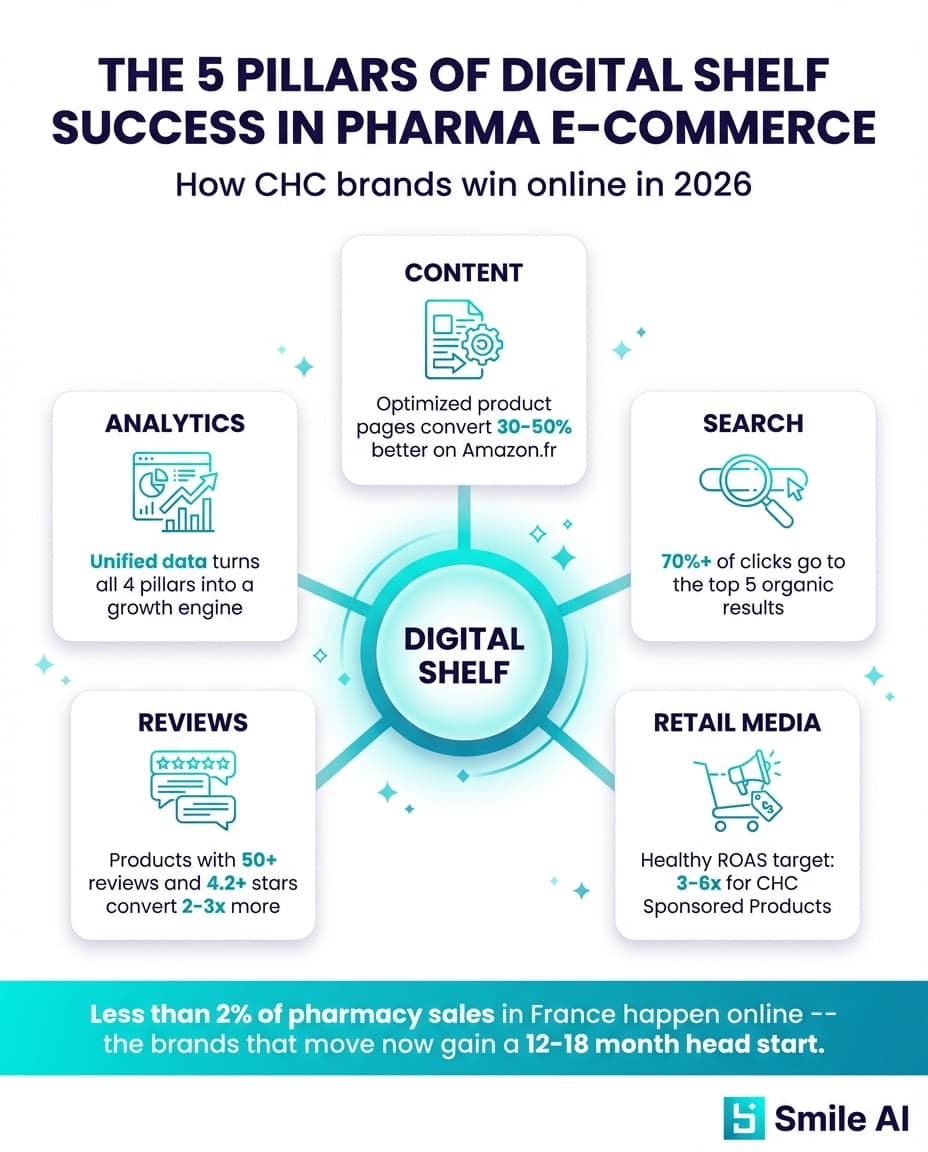
After supporting hundreds of CHC brands in their digital transformation, a clear framework emerges. Success on the digital shelf rests on five interdependent pillars: content, search, retail media, reviews, and analytics.
None of these pillars works in isolation. It's their strategic alignment that makes the difference between a passive online presence and a high-performing growth engine.
Pillar 1: Content -- The Foundation of the Digital Shelf
Why product content is your primary conversion lever
On the digital shelf, there's no shop assistant, no pharmacist behind the counter. Your product listing IS your salesperson, your adviser, your packaging and your point-of-sale display combined in a single screen. In pharma e-commerce, content quality has a direct and measurable impact on conversion rate.
The data is unequivocal: optimised product listings on Amazon.co.uk show on average a 30 to 50% higher conversion rate than those that are incomplete or generic. On Boots or Superdrug, a well-structured product description with quality images can double the click-through rate from category pages.
Components of high-performing product content
Product title: your first and sometimes only chance
On Amazon.co.uk, the title is the number one factor for visibility and clicks. For health products, an effective title must combine:
- Brand name
- Product name
- Primary benefit or key ingredient
- Format/dosage
- Quantity
Concrete example: "Vitabiotics Wellwoman Original - 30 Tablets - Multivitamin for Women - Food Supplement" performs significantly better than a generic title "Vitabiotics Wellwoman 30 tablets".
Images: the most underestimated element
- Minimum 5 images per listing, including at least one pack shot (white background), one benefits image (visual USPs), one ingredients/composition image, and one usage instructions image.
- On Amazon.co.uk, brands with 6 or more images see their conversion rate increase by 20 to 30% compared to those with only 1-2 images.
- On UK e-pharmacies, where listing format is often more constrained, the quality of the first 2-3 images is even more critical.
Bullet points and descriptions: inform to convert
The British consumer seeks precise information: composition, usage instructions, possible contraindications, certifications (organic, Made in UK, vegan). Bullet points must answer the 5 questions buyers ask:
- What does this product do?
- What are the active ingredients?
- How do I use it?
- Who is it suitable for?
- Why choose this brand/product?
Enhanced content (A+ Content / Enhanced Brand Content)
On Amazon.co.uk, A+ Content is a powerful lever for brands registered with Brand Registry. It allows integration of visual modules, comparison tables, and brand stories directly into the product listing. In the CHC sector, brands using A+ Content see on average a 5 to 10% increase in conversion rate.
On e-pharmacies like Boots or Superdrug, enhanced content possibilities are more limited, but optimising available fields (long description, usage advice, precautions) remains a major competitive advantage.
Regulatory compliance: a non-negotiable imperative
In the UK, product content in pharma e-commerce is subject to strict regulatory oversight:
- Health claims: Only claims authorised by European regulation can be used on food supplements. The CMA conducts regular online checks.
- OTC medicine advertising: Subject to prior approval from the MHRA. All promotional communication must comply with UK medicines legislation.
- Mandatory mentions: Food supplements must include the mention "food supplement", recommended daily allowances, and regulatory warnings.
Practical advice: Create a compliance matrix by product category and platform. What's authorised on Amazon.co.uk (non-pharmaceutical marketplace) may differ from what's acceptable on an MHRA-approved e-pharmacy.
How to measure your content "health"
Essential content KPIs include:
- Content Score: a composite index measuring listing completeness (title, images, bullet points, description, enhanced content). Target: over 85% on each platform.
- Image Count & Quality: number of images and compliance with each platform's guidelines.
- Title Compliance Rate: percentage of titles compliant with your naming charter.
- Rich Content Adoption: percentage of SKUs with A+ or enhanced content.
Smile Analytics in action: Smile Analytics' Content Health module automatically scans all your product listings on Amazon.co.uk, Boots, Superdrug and other retailers. It assigns a Content Score to each SKU, identifies gaps (missing images, incomplete descriptions, non-compliance) and generates priority alerts. E-commerce teams can thus focus their efforts on the highest-impact listings, instead of spending hours manually auditing hundreds of references.
Pillar 2: Search -- Being Visible Where Consumers Search
Search on the digital shelf: a radically different challenge from classic SEO
Search visibility on e-commerce platforms follows fundamentally different rules from Google SEO. On Amazon.co.uk, the A9 algorithm (and its A10 evolution) ranks products based on a combination of textual relevance, commercial performance (sales, conversion rate, sales velocity), availability, and competitive pricing.
On e-pharmacies like Boots or Superdrug, search algorithms are less sophisticated but equally determining: position in internal search results directly conditions traffic to the product listing.
Search mechanisms on each platform
Amazon.co.uk:
- The algorithm favours products that convert well. The more a product sells, the better it ranks. It's a virtuous (or vicious) circle.
- Backend keywords (search terms invisible to consumers) are a lever often under-exploited by CHC brands.
- Click-through rate from results pages (CTR) is a strong signal: title, main image and price must be optimised to maximise clicks.
Boots:
- The internal search engine prioritises exact term matching. Using molecule names, indications and common patient search terms is essential.
- Default ranking often includes a "popularity" factor that favours best-rated and best-selling products.
Superdrug:
- Category navigation is as important as direct search. Ensuring products are correctly categorised is an often-neglected prerequisite.
Keyword strategy for UK pharma e-commerce
Health keyword research is specific. British consumers use a mix of:
- Generic terms: "probiotics", "vitamin D", "organic sun cream"
- Symptom terms: "sore throat", "difficult digestion", "chronic fatigue"
- Brand names: "Vitabiotics", "Solgar", "Biocyte", "Nuxe"
- Molecule terms: "magnesium bisglycinate", "curcumin", "hyaluronic acid"
An effective keyword strategy covers these four axes and deploys them specifically on each platform.
Share of Search: the strategic KPI par excellence
Share of Search measures your brand's visibility share in search results for a set of strategic keywords. It's the digital equivalent of shelf facing.
Example: If a consumer types "probiotic" on Amazon.co.uk and your product appears in 3rd position out of 48 results displayed on the first page, your visibility is significant. If it appears on page 3, it's practically invisible -- over 70% of clicks concentrate on the first 5 organic results.
Smile Analytics in action: Smile Analytics' Search Rank Tracking module daily tracks the position of your products and those of your competitors for hundreds of keywords on Amazon.co.uk, Boots, Superdrug and other retailers. The Share of Search dashboard provides real-time visualisation of your visibility share evolution by category, by keyword and by platform, and immediately detects any position loss.
Pillar 3: Retail Media -- Amplify Visibility, Accelerate Conversion
The explosion of retail media in UK CHC
Retail media has become the third pillar of digital advertising, after search and social. In the UK, the retail media market has exceeded £1.2 billion, with annual growth of over 25%. For consumer healthcare brands, it's an essential lever to gain visibility on increasingly crowded digital shelves.
Retail media options by platform
Amazon Advertising UK
Amazon Advertising is by far the most mature and powerful retail media platform in the UK for CHC products. Available formats include:
- Sponsored Products: Ads integrated into search results and product pages. This is the fundamental format, representing approximately 75% of CHC brand retail media spend on Amazon.co.uk.
- Sponsored Brands: Banner at the top of search results, ideal for brand awareness and traffic to Brand Store.
- Sponsored Display: Audience targeting on and off Amazon, useful for retargeting and conquest.
- Amazon DSP: Programmatic platform for large-scale display and video campaigns.
Criteo Commerce Media (retailers, partner platforms)
Criteo increasingly powers retail media offerings from UK e-pharmacies and health retailers. CHC brands can thus reach qualified audiences directly on sites where consumers are in health purchase mode.
Boots Media Network and Superdrug advertising
For health and beauty brands present on these major UK platforms, their retail media offerings provide an interesting complement, though less developed than Amazon Advertising for the health sector.
Golden rules of retail media in pharma e-commerce
1. No retail media without optimised content
Investing in retail media to drive traffic to a poor-quality product listing is wasting your budget. Before each advertising activation, verify that the listing has an optimised title, quality images, complete bullet points, and sufficient positive reviews (ideally more than 15 reviews with a rating above 4 stars).
2. Structure your campaigns by objective
- Defence: Protect brand keywords against competitor campaigns (conquesting). Budget: 20-30% of total retail media.
- Conquest: Target generic keywords and symptom terms to capture new customers. Budget: 40-50%.
- Expansion: Test new keywords, new audiences, new formats. Budget: 20-30%.
3. Set clear KPIs and measure ROAS
ROAS (Return on Advertising Spend) is the central KPI. In CHC on Amazon.co.uk, a healthy ROAS generally sits between 3 and 6 for Sponsored Products, depending on category and competition level. A ROAS below 2 should trigger immediate strategy review.
- Target ACoS (Advertising Cost of Sale): 15-25% for most CHC categories. Leading brands can target an ACoS below 15%.
- TACoS (Total Advertising Cost of Sale): a more comprehensive indicator that relates advertising spend to total revenue (organic + paid). Target: maintain TACoS below 10%.
4. Respect advertising regulatory framework
The ASA requires that all sponsored content be clearly identified as such. For health products, MHRA advertising restrictions also apply to retail media formats. Unauthorised health claims are just as prohibited in a Sponsored Brand as in a product listing.
Smile Analytics in action: Smile Analytics' Retail Media Intelligence module offers a unified view of your advertising campaigns on Amazon.co.uk and other platforms. It allows real-time tracking of ROAS, ACoS and TACoS, detecting underperforming campaigns, and crucially crossing advertising data with content quality and organic positions. It's this transversal vision that optimises budget allocation and avoids the classic trap: paying in advertising for what better-quality product listings could generate organically.
Pillar 4: Reviews -- The Trust Capital of the Digital Shelf
The quantified impact of reviews on pharma e-commerce sales
In the health sector, trust is the number one purchase factor. And on the digital shelf, customer reviews are the primary vector of trust. UK market data confirms this reality:
- A CHC product with more than 50 reviews and a rating above 4.2 stars converts on average 2 to 3 times better than an equivalent product with fewer than 10 reviews.
- The average rating of products on the first page of results on Amazon.co.uk in health categories is 4.3 stars. Below 4.0 stars, the probability of appearing on the first page drops dramatically.
- On e-pharmacies like Boots or Superdrug, reviews play a less dominant role in ranking algorithms, but remain a major conversion factor: British consumers consult reviews in 72% of cases before buying a health product online.
Building a sustainable review strategy
Generating review volume: authorised levers
- Amazon Vine: Programme allowing free products to be sent to certified testers in exchange for honest reviews. It's the most effective lever for new product launches on Amazon.co.uk.
- Sampling programmes: Sending samples with an insert inviting review submission (without conditioning on a positive review, which is prohibited).
- Post-purchase emails: On Amazon.co.uk, the "Request a Review" programme allows automated and CGU-compliant review solicitation.
- QR codes on packaging: Direct consumers to the product page to leave a review after use.
Managing negative reviews: an obligation, not an option
Negative reviews are inevitable and, well managed, can even strengthen trust. The response strategy must be:
- Quick: Respond within 24-48 hours.
- Empathetic: Acknowledge the consumer's problem.
- Factual: Provide concrete elements (usage instructions, dosage, customer service).
- Compliant: Never make therapeutic claims in a review response.
Sentiment analysis: transform reviews into product insights
Customer reviews are a goldmine of information on product perception, friction points, and unmet expectations. Systematic analysis of reviews -- positive and negative -- by theme (efficacy, taste, format, price, packaging) identifies product improvement and marketing positioning opportunities.
Smile Analytics in action: Smile Analytics' Review Analytics module automatically collects and analyses reviews of your products and those of your competitors across all platforms. Sentiment analysis by theme identifies strengths and weaknesses perceived by consumers. Real-time alerts signal any rating drops or spikes in negative reviews, enabling rapid intervention. Marketing and R&D teams thus have a continuous flow of consumer insights directly from the digital field.
Pillar 5: Analytics -- Drive Performance with Data, Not Intuitions
Why analytics is the pillar that multiplies the impact of the other four
The four preceding pillars -- content, search, retail media, reviews -- each generate masses of data. But without transversal analytics capability, this data remains inert silos. It's analytics that transforms data into decisions, decisions into actions, and actions into growth.
In a high-performing CHC e-commerce playbook UK, analytics plays three roles:
- Diagnosis: Where are we? What are our content scores, our search positions, our ROAS, our average review rating?
- Comparison: How do we position ourselves compared to our competitors and category benchmarks?
- Action: Which priority actions will generate the most impact on sales?
Pharma e-commerce KPIs that every manager must track
Daily KPIs:
| KPI | Definition | UK CHC Benchmark |
|---|---|---|
| Share of Search (SoS) | Visibility share in search results | Varies by category -- track trend |
| Stock availability rate (In-Stock Rate) | Percentage of SKUs available for purchase | > 95% |
| Buy Box Win Rate (Amazon.co.uk) | Percentage of time your offer is featured | > 90% for brands selling direct |
Weekly KPIs:
| KPI | Definition | UK CHC Benchmark |
|---|---|---|
| Average Content Score | Product listing completeness | > 85% |
| ACoS / ROAS retail media | Advertising campaign effectiveness | ACoS < 20%; ROAS > 4 |
| Average review rating | Aggregated customer evaluation | > 4.2 stars |
| Number of new reviews | Review generation velocity | Variable -- track trend vs. competitors |
Monthly / quarterly KPIs:
| KPI | Definition | UK CHC Benchmark |
|---|---|---|
| Digital market share | Sales share in category | Positive quarterly growth |
| TACoS | Advertising cost / total revenue | < 10% |
| Category ranking evolution | Position in best-seller rankings | Top 20 in target subcategories |
| Digital NPS / Sentiment analysis | Brand perception in reviews | Positive sentiment > 75% |
Competitive benchmarking: a necessity, not a luxury
On the digital shelf, performance is always relative. Having a Content Score of 80% is mediocre if your three main competitors are at 95%. Having a ROAS of 4 is excellent if the category average is 2.5, but insufficient if your competitors reach 6.
Competitive benchmarking must cover:
- Content: Number of images, title quality, enhanced content presence, listing completeness.
- Search: Organic positions on strategic keywords, evolution over time.
- Retail media: Advertising share of voice, competitor spend estimation.
- Reviews: Volume, average rating, recurring themes, generation velocity.
- Pricing: Relative price positioning, competitor promotion detection.
Smile Analytics in action: It's precisely in this transversal steering role that Smile Analytics brings the most value. The platform consolidates all data from the five pillars -- content, search, retail media, reviews and pricing -- in a unified dashboard. Dashboards by category, by brand and by SKU enable moving from diagnosis to action in just a few clicks. Automated competitive benchmarking continuously compares your performance to that of your competitors on each dimension, each platform, each KPI. E-commerce teams, trade marketing and commercial management thus have a single source of truth to make informed and rapid decisions.
The three maturity stages of pharma e-commerce
Each CHC brand sits at a different stage of its digital journey. This maturity model identifies where you are and what the next priority steps are.
Stage 1: Foundation (0-12 months)
Characteristics:
- Existing but non-optimised online presence
- Incomplete or generic product listings
- No structured keyword strategy
- Low or non-existent retail media investment
- Reactive or absent review management
- Manual or non-existent performance tracking
Priority actions:
- Audit all product listings on Amazon.co.uk and key e-pharmacies
- Define a content charter (titles, images, descriptions) by platform
- Build a strategic keyword base (50-100 key terms)
- Launch first Sponsored Products campaigns on Amazon.co.uk
- Implement review tracking and response process
- Deploy analytics tool to establish baseline metrics
End-of-stage objectives:
- Content Score > 70% on main platforms
- Presence in top 30 search results for priority keywords
- First ROAS data available
- Review response process in place
Stage 2: Optimisation (12-24 months)
Characteristics:
- Largely optimised product listings
- Active search strategy with regular tracking
- Structured retail media investment with ROAS objectives
- Review generation programme in place
- Monthly reporting with defined KPIs
Priority actions:
- Deploy A+ / enhanced content across entire catalogue
- Refine keyword strategy with long-tail and seasonality analyses
- Structure retail media campaigns by objective (defence, conquest, expansion)
- Launch review generation initiatives (Vine, sampling, QR codes)
- Implement systematic competitive benchmarking
- Integrate review insights into marketing and R&D plans
End-of-stage objectives:
- Content Score > 85% on all platforms
- Top 10 for 50% of priority keywords
- ROAS > 4 on Sponsored Products campaigns
- Average rating > 4.2 stars with growing review volume
- Digital market share in progression
Stage 3: Leadership (24+ months)
Characteristics:
- Operational excellence on content and search
- Sophisticated retail media strategy (full-funnel, DSP, cross-platform)
- Proactive online reputation management
- Advanced analytics with real-time benchmarking
- Complete integration between e-commerce, trade marketing, medical and R&D teams
Priority actions:
- Automate monitoring and alerts across the five pillars
- Deploy full-funnel retail media strategies (Sponsored Display, DSP, video)
- Industrialise sentiment analysis to feed product innovation
- Optimise for new discovery channels (AI search, Google AI Overviews)
- Build reporting dashboards for senior management
- Develop multi-market approach (UK + Europe)
End-of-stage objectives:
- Content Score > 95% with enhanced content on 100% of catalogue
- Top 3 for strategic keywords on priority platforms
- TACoS < 8% with optimised organic/paid mix
- Average rating > 4.4 stars with over 100 reviews per key SKU
- Digital market share leadership in target categories
Concrete examples by category
Food supplements and vitamins
The UK food supplements market weighs over £2.6 billion, and the online channel is one of the most dynamic with double-digit annual growth. Brands like Vitabiotics, Solgar, Healthspan, and Seven Seas are engaged in fierce battle for digital visibility.
Key success factors:
- Optimise for benefit search terms ("immunity", "sleep", "digestion") rather than product name alone
- Highlight certifications (organic, Made in UK, vegan, gluten-free) from title and images
- Use A+ Content to explain mechanisms of action and differentiate formulas
- Detailed reviews with usage testimonials are particularly influential in this category
- Strong seasonality: adapt content and retail media to peaks (immunity in autumn/winter, slimming in spring, sun protection in summer)
Dermocosmeceuticals and skincare
Dermocosmeceutical brands (La Roche-Posay, Avène, Bioderma, CeraVe, The Ordinary) are historically strong in the UK pharmacy network. Their transition to the digital shelf is a major strategic challenge.
Key success factors:
- High-quality images showing textures, before/after results (in compliance with ASA rules)
- Enhanced content focused on skincare routine (natural cross-selling)
- Keyword strategy covering skin concerns ("adult acne", "dry skin", "pigmentation marks")
- Reviews with photos are particularly impactful
- Dermatological advice must be reproduced in digital content
OTC and self-medication
OTC medicine sales online in the UK are among the most regulated in Europe. Only MHRA-authorised pharmacies can sell these products online, limiting available channels to Boots, Superdrug, LloydsPharmacy and authorised pharmacy websites.
Key success factors:
- Absolute compliance with MHRA requirements on online medicine content
- Product listings systematically including patient information leaflet, contraindications and precautions
- Trust is the primary purchase criterion: reviews and online pharmacy reputation are decisive
- Retail media is less developed on e-pharmacies for medicines, but organic search is all the more critical
The technology ecosystem: the cement that holds everything together
Why a unified tool makes the difference
Managing the five pillars of pharma e-commerce generates considerable operational complexity. Each platform has its own administration tools, its own data formats, its own metrics. Without a centralised tool, teams spend more time collecting and consolidating data than analysing and acting on it.
The symptoms of inadequate tooling are familiar:
- Multiple Excel files to track search positions, review ratings, content scores
- Monthly reports compiled manually, obsolete before they're even presented
- Inability to rapidly detect problems (stock-out, rating drop, position loss)
- Competitive benchmarking at best quarterly, often sporadic
- Decisions based on impressions rather than data
The integrated platform: a structural competitive advantage
The CHC brands that perform best on the digital shelf are those with a unified, real-time vision covering all pillars and platforms. This vision enables:
- Proactive alerting: Automatic detection of anomalies (stock-out, ranking drop, critical negative review) with immediate notification of relevant teams.
- Cross-optimisation: Understanding, for example, that ROAS drop on a campaign is linked to Content Score degradation of the targeted listing, not a bidding problem.
- Automated reporting: Dashboards shareable with management, continuously updated, eliminating hours of manual compilation.
- Permanent benchmarking: Continuous comparison with competitors on each dimension, each platform, each KPI.
Smile Analytics: It's exactly this unified vision that Smile Analytics was designed to deliver. As a unique platform dedicated to pharma e-commerce, Smile Analytics covers the five pillars -- content, search, retail media, reviews, and competitive benchmarking -- across all UK market platforms (Amazon.co.uk, Boots, Superdrug, LloydsPharmacy, Pharmacy2U, and many others). The intuitive interface allows teams to move from global diagnosis to SKU-by-SKU action, whilst automated alerts ensure no critical problem goes unnoticed.
For VP E-Commerce and CMOs, Smile Analytics becomes the strategic dashboard of the digital shelf, offering the clarity needed to arbitrate investments, prioritise actions, and drive growth with confidence.
Action plan: the first 90 days
For CHC brands ready to structure their digital shelf approach in the UK, here's a concrete action plan for the first 90 days:
Days 1-30: Diagnosis and foundations
- Conduct complete audit of product listings on Amazon.co.uk, Boots and Superdrug
- Establish baseline metrics: Content Score, search positions, review ratings, availability
- Identify the 20 priority SKUs (top sales + high potential)
- Map 50-100 strategic keywords by category
- Analyse competition: identify 3-5 key competitors and their strengths/weaknesses on the digital shelf
- Implement analytics and monitoring tool
Days 31-60: Content optimisation and search activation
- Optimise product listings for 20 priority SKUs (titles, images, bullet points, descriptions)
- Deploy A+ Content on Amazon.co.uk for priority products
- Launch first Sponsored Products campaigns on strategic keywords
- Implement review response process (templates, workflow, timelines)
- Define reporting KPIs and review frequency
Days 61-90: Scale-up and first results
- Extend content optimisation to rest of catalogue
- Analyse first retail media results and adjust bids/budgets
- Launch review generation programme (Vine on Amazon.co.uk, sampling)
- Produce first complete performance report with competitive benchmarks
- Present results and phase 2 plan to management
2026 trends that will reshape UK pharma e-commerce
1. Generative AI transforms product discovery
Google's AI Overviews, ChatGPT Shopping, and retailer AI assistants are revolutionising the product discovery journey. For CHC brands, this means a new optimisation dimension: Generative Engine Optimization (GEO). Product listings must be structured to be understood and cited by language models, not just classic search algorithms.
2. Pan-European consolidation accelerates
Redcare Pharmacy, Atida, and DocMorris are investing heavily to build pan-European e-pharmacies. For UK CHC brands, this opens multi-market deployment opportunities, but also requires content management and performance capability at European scale.
3. Social commerce enters health
TikTok Shop and Instagram Shopping are beginning to touch health and wellness categories. Whilst UK regulation remains strict on health product promotion on social media, social commerce is an emerging channel to monitor, particularly for food supplements and dermocosmeceutical beauty products.
4. Click-and-collect becomes even more digital
The UK's dense pharmacy network makes click-and-collect a unique competitive advantage compared to European pure players. Evolution towards hybrid purchase journeys (online discovery, pharmacy collection with advice) will continue to develop in 2026.
5. First-party data becomes strategic
With the progressive end of third-party cookies, first-party data from pharmacy loyalty programmes, online interactions, and customer reviews becomes a strategic asset for advertising targeting and personalisation.
Conclusion: The digital shelf won't wait
The UK pharma e-commerce market is at an inflection point. With less than 2% of pharmacy sales conducted online, the growth potential is immense. But this growth won't be evenly distributed. It will benefit brands that invest now in a structured strategy, covering the five digital shelf pillars: content, search, retail media, reviews and analytics.
The consumer healthcare brands that will dominate the digital shelf in 2026 and beyond will be those that:
- Consider the digital shelf as a strategic asset, not just a complementary distribution channel.
- Invest in content with the same rigour they invest in physical packaging.
- Master search on each platform, with a keyword strategy adapted to British consumer vocabulary.
- Deploy retail media intelligently, ensuring every pound invested builds on an optimised product listing.
- Cultivate trust through proactive customer review management.
- Drive by data, with tools offering unified, real-time, and comparative performance vision.
The CHC e-commerce playbook UK we've presented in this guide isn't a theoretical document. It's an action framework, tested and proven by hundreds of brands across Europe. The question is no longer whether to act, but how quickly you can execute.
Brands that start today will have a 12 to 18-month advantage over those that wait. On the digital shelf, time is the most precious resource -- and the one you can't catch up.
Smile Analytics is the leading platform for driving pharma e-commerce performance. To discover how Smile Analytics can help you master the five digital shelf pillars in the UK market, request a personalised demonstration at smileanalytics.com.
Keywords: pharma e-commerce strategy UK | consumer healthcare digital shelf | CHC e-commerce playbook UK
The essentials at a glance
Key takeaways from this article in one infographic.
© Smile AI 2026
Ready to dominate the Digital Shelf?
Discover how Smile Analytics helps Consumer Healthcare brands optimize their e-commerce performance across all platforms.