
Price Monitoring in Pharma E-Commerce
Protecting Brand Value Whilst Remaining Competitive in the UK Market
Format: Strategic article | Audience: Pricing Managers, Commercial Directors, E-Commerce Managers | Keywords: price monitoring e-commerce pharma UK, pricing policy enforcement online, competitive pricing healthcare UK
Introduction: Price, the Hidden Nerve of the Digital Shelf War
In UK health e-commerce, price is a constant paradox. Too high, and you lose the Buy Box and disappear from top search positions. Too low, and you erode your margins, devalue your brand in the consumer's eyes, and trigger a price war that nobody wins. Unlike other retail sectors, pricing in Consumer Healthcare (CHC) is governed by regulatory, ethical, and strategic constraints that make each pricing decision more consequential.
The UK online pharmacy market is worth approximately £700 million and experiences sustained annual growth. Yet online sales still represent less than 2% of total pharmacy sales. This figure is telling: the digital channel is a territory to conquer where positions are being decided now. In this battle, price is often the first differentiation criterion visible to consumers.
According to sector data, price consistently ranks among the top three purchase decision factors for over-the-counter and food supplement products online. On Amazon.co.uk, price is a determining parameter of the Buy Box algorithm. On e-pharmacies like Boots and Superdrug, integrated price comparators directly pit offers from dozens of sellers for the same product.
This article provides a comprehensive strategic framework for pricing managers, commercial directors, and e-commerce managers in the CHC sector. You'll find an analysis of pricing challenges specific to the UK market, the concrete impact of price on digital performance, and an actionable methodology for building a price monitoring and response strategy that protects your brand equity whilst maintaining competitiveness.
1. The Pricing Challenge for Pharma Brands in the UK: A Delicate Balance
1.1 A Fragmented and Difficult-to-Control Pricing Ecosystem
The UK CHC online distribution landscape is structurally fragmented. Your products can be sold simultaneously on:
- Amazon.co.uk – general marketplace with high traffic, where third-party sellers (3P) freely set their prices.
- Boots – leading UK pharmacy chain with aggressive online pricing and estimated e-commerce revenue of approximately £200 million.
- Superdrug, LloydsPharmacy, Well Pharmacy – major pharmacy chains with online services and varied pricing strategies.
- Pharmacy2U, UK Meds – pure-play online pharmacies with competitive positioning.
- Tesco Pharmacy, Sainsbury's, ASDA – supermarket chains with online pharmacy sections and discount positioning.
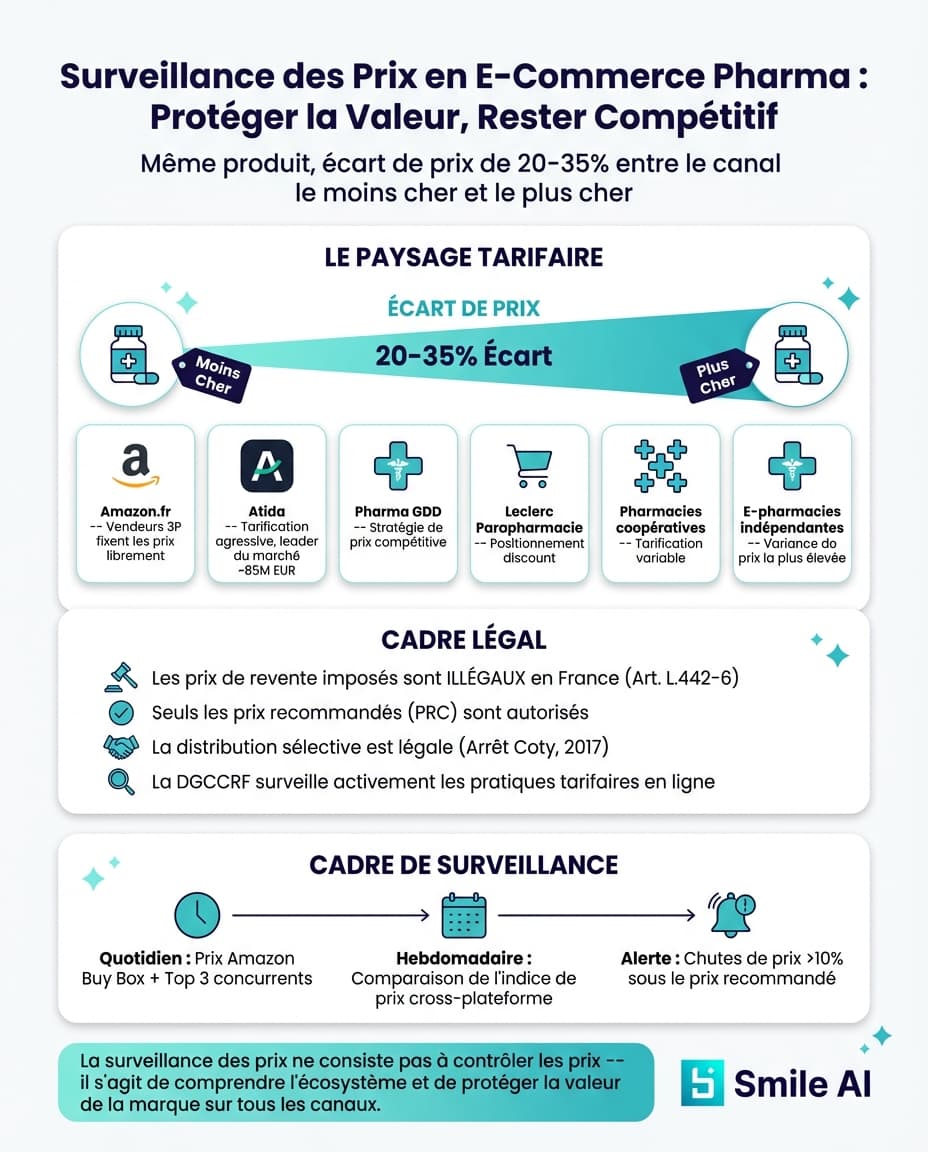
Each channel applies its own pricing logic. An independent pharmacist selling on their own MHRA-approved e-pharmacy can set a significantly different price from a third-party seller on Amazon.co.uk, which itself differs from Boots' displayed price. Result: for the same product, online price gaps can reach 20 to 35% between the most expensive and cheapest channels.
For brands, this dispersion creates a dual problem. On one hand, it makes price-image control virtually impossible without dedicated monitoring tools. On the other hand, it generates tensions with distributors who feel unfairly competed against by cheaper channels.
1.2 Pricing Policies: Between Recommendation and Prohibition
In the UK, the legal framework is clear on one essential point: imposed resale price maintenance is illegal. Competition law, reinforced by retained EU competition provisions post-Brexit, prohibits manufacturers from imposing resale prices on their distributors. Only "recommended" retail prices (RRP) are permitted.
However, brands have legitimate levers:
- Recommended Retail Price (RRP) policy: communicating a recommended price to distributors whilst knowing it remains indicative.
- Selective distribution policy: reserving the sale of certain products to distributors meeting objective quality criteria. The EU Court of Justice (Coty judgment, 2017) confirmed the legality of selective distribution for luxury products and, by extension, for certain health and cosmetic product categories.
- Minimum Advertised Price (MAP) monitoring: though more common in Anglo-Saxon markets, equivalent mechanisms exist in the UK within brands' commercial policy framework.
- Terms and conditions of sale: defining resale conditions that include commitments regarding product presentation and associated services.
The Competition and Markets Authority (CMA) actively monitors pricing practices in the health sector. In 2023 and 2024, several warnings were issued regarding misleading pricing practices on online pharmacy sites, particularly concerning the display of fictitious promotions (crossed-out prices not corresponding to previously practised prices).
1.3 The "Price Breaker" Phenomenon: When an Actor Destabilises the Market
Every CHC sector pricing manager knows this scenario: a third-party seller on Amazon.co.uk or an online pharmacy pure-player slashes the price of a flagship product by 15 to 25% below the recommended price. Consequences follow quickly:
- Domino effect on other distributors: e-pharmacies adjust their prices downward to remain competitive.
- Erosion of value perception: consumers become accustomed to a lower price and perceive the normal price as "too expensive".
- Tension with physical pharmacy channel: high street pharmacists, who don't have the same cost structure, find themselves at a visible disadvantage.
- Margin degradation across the entire chain: manufacturer, distributors, and pharmacists all see their margins compressed.
This phenomenon is particularly sensitive in the UK where a dense network of approximately 14,000 community pharmacies coexists with a rapidly expanding online channel. Community pharmacists regularly express concerns about price competition from digital pure-players, an issue that frequently reaches the General Pharmaceutical Council (GPhC) and professional associations.
1.4 Promotions: Growth Lever or Margin Trap?
Promotional pressure in online pharmacy is intense. According to market data, the average promotion rate on food supplement and dermocosmeceutical categories in e-commerce frequently exceeds 25% of selling time. Certain key periods amplify the phenomenon:
- January: detox ranges, probiotics, weight management (New Year resolutions).
- March-April: sun care, antihistamines, hair care (pre-summer).
- October-November: vitamins, immunity, essential oils (pre-winter).
- Black Friday / Cyber Monday: widespread promotions across all categories.
The problem arises when promotions are no longer a one-off event but become the permanent market state. When a product is on promotion 40% of the time, the promotional price becomes the reference price in consumers' minds. The brand then loses its ability to sell at normal price, and promotion ceases to generate incremental uplift.
2. The Direct Impact of Price on Digital Shelf Performance
2.1 Price and Buy Box: The Amazon.co.uk Mechanism
On Amazon.co.uk, the Buy Box (the "Add to Basket" button displayed prominently) generates approximately 80 to 85% of a product's sales. Winning the Buy Box isn't optional: it's a condition for commercial survival.
The Buy Box attribution algorithm considers several factors, including:
- Total price (product + delivery): this is the most heavily weighted criterion. All else being equal, the seller offering the lowest price has a significantly higher probability of winning the Buy Box.
- Seller performance metrics: order defect rate, late shipment rate, cancellation rate.
- Fulfilment method: offers managed by Amazon (FBA – Fulfilled by Amazon) have a structural advantage.
- Stock availability: an out-of-stock offer automatically loses the Buy Box.
For CHC brands, this mechanism poses a concrete dilemma. If an unauthorised third-party seller slashes your product's price, they can win the Buy Box from you – or from your authorised distributor. Your product is then sold at the wrong price, potentially by a seller who doesn't respect your quality standards, and your efforts in A+ Content and Amazon Advertising generate revenue for this seller rather than for you.
Data shows that a price difference of just 2 to 3% can be enough to tip the Buy Box from one seller to another. On a £15 product, that represents less than 50 pence. Monitoring granularity must therefore be extreme.
2.2 Price and Search Ranking: The Virtuous (or Vicious) Circle
Price directly influences ranking in search results, both on Amazon.co.uk and on e-pharmacies. The mechanism works as follows:
- A competitive price improves conversion rate: consumers are more inclined to buy when they perceive good value for money.
- Better conversion rate improves BSR (Best Sellers Rank): the algorithm rewards products that sell well.
- Better BSR improves organic ranking: the product rises in search results.
- Better ranking generates more visibility and therefore more sales: the virtuous circle reinforces itself.
Conversely, an uncompetitive price triggers the vicious circle: poor conversion, BSR decline, visibility loss, sales drop. And most pernicious: this decline can be rapid (a few days) but slow to recover (several weeks).
On e-pharmacies, the logic is comparable. Boots and Superdrug integrate price competitiveness parameters into their product promotion algorithms. A product consistently more expensive than its direct competitors will tend to be less prominently featured, even with optimised product pages and good customer reviews.
2.3 Price and Value Perception: The British Health Consumer
The British consumer of online health products presents a specific profile. They are both price-sensitive and attached to perceived quality. Purchase behaviour studies show that:
- Price is the primary choice criterion for recurring purchases (food supplements in courses, daily care), where consumers have already validated product efficacy and seek the best price.
- Brand and pharmaceutical advice remain determining factors for first purchases, particularly in OTC and dermocosmeceutical categories, where trust is a prerequisite.
- Abnormally low prices arouse suspicion in the health sector: a food supplement displayed at a much lower price than competitors may be perceived as lower quality, or worse, as potentially counterfeit.
This last observation is crucial. In healthcare, unlike electronics or fashion, the race to the lowest price isn't always synonymous with performance. There exists a "perceptual price floor" below which price reduction harms conversion rather than improving it.
3. Building a Price Monitoring Strategy: Methodology and Tools
3.1 The Four Pillars of an Effective Monitoring Strategy
A mature price monitoring strategy in pharma e-commerce rests on four interdependent pillars:
Pillar 1: Coverage – Where to Monitor?
The first step consists of defining the surveillance perimeter. For the UK CHC market, minimum coverage must include:
| Priority | Channels | Justification |
|---|---|---|
| Critical | Amazon.co.uk (1P and 3P) | Traffic volume, Buy Box mechanism, uncontrolled third-party sellers |
| Critical | Boots / Superdrug | Leading UK pharmacies, health pricing references |
| High | LloydsPharmacy / Well Pharmacy | Major pharmacy chains with growing online presence |
| High | Tesco Pharmacy / Sainsbury's | Supermarket chains with aggressive price positioning |
| Medium | Pharmacy2U / UK Meds | Pure-play online pharmacies with competitive positioning |
| Watch | Google Shopping / price comparison sites | Contact point where consumers compare offers before purchase |
Pillar 2: Frequency – At What Pace to Monitor?
Monitoring frequency must be calibrated according to price volatility in your category:
- Daily monitoring: essential for highly competitive products on Amazon.co.uk and seasonal categories during peak periods (immunity in autumn, sun care in spring).
- Weekly monitoring: sufficient for stable-price products sold primarily on e-pharmacies.
- Real-time alerts: necessary for pricing policy violations (prices below a defined threshold) and Buy Box losses.
Sector data shows that food supplement prices on Amazon.co.uk can change up to 3 to 5 times per week for the most competitive references. Without daily monitoring, you're operating blind.
Pillar 3: Metrics – What to Measure?
Beyond simple price recording, effective monitoring must track:
- Displayed selling price: the price visible to consumers, including any promotions.
- Total price (product + delivery): this is the real price perceived by buyers and considered by the Buy Box algorithm.
- Gap vs. recommended price (RRP): measure each distributor's deviation from your recommended price.
- Gap vs. direct competitors: position your price relative to competing products in the same category.
- Promotion rate: frequency and depth of promotions by distributor and channel.
- Unit price (per capsule, per ml, per dose): price per gram or dose is often the most relevant comparison criterion for food supplement consumers.
- Price history: identify trends, seasonalities, and distributor pricing behaviour patterns.
Pillar 4: Action – How to React?
Monitoring without reaction capability is an academic exercise. Each alert must trigger a clearly defined response workflow (detailed in the next section).
3.2 Smile Analytics' Pricing Intelligence: A 360-Degree View
Manually monitoring prices of dozens of references across a dozen channels, several times per week, is an impossible mission for a human team. This is the raison d'être of pricing intelligence tools.
Smile Analytics offers a complete pricing intelligence suite specifically designed for CHC brands operating on the UK and European digital shelf. The platform allows you to:
- Track your prices and those of your competitors in real-time across all relevant retailers and marketplaces. Amazon.co.uk, Boots, Superdrug, Tesco, Google Shopping – all price points are consolidated in a single dashboard.
- Automatically detect pricing policy violations: as soon as a distributor drops below a defined price threshold, an alert is triggered. You can differentiate alerts by severity (slight deviation vs. significant price breaking) and by channel.
- Analyse the impact of price changes on performance: correlation between price variations and key indicators (Buy Box share, search ranking, conversion rate, revenue) is made visible and measurable. You no longer guess: you quantify.
- Benchmark your competitive positioning: compare your prices with direct competitors, category by category, channel by channel, with histories allowing identification of each actor's pricing strategies.
- Manage promotional periods: measure promotional depth by channel, identify distributors over-exposing your products in promotion, and evaluate the real ROI of each promotional operation.
The advantage of a platform like Smile Analytics is transforming price monitoring from a reactive activity ("we discover a price problem") into a proactive strategic capability ("we anticipate price movements and act before they impact our performance").
3.3 The Response Workflow: From Alert to Action
A good monitoring system only has value if coupled with a structured response workflow. Here's a four-level framework:
Level 1 – Minor Deviation (1 to 5% gap vs. RRP)
- Action: Monitor and document. No immediate intervention.
- Responsible: Pricing / e-commerce team.
- Timeframe: Weekly review.
- Objective: Ensure deviation doesn't generalise and stay informed of market micro-adjustments.
Level 2 – Significant Deviation (5 to 15% gap vs. RRP)
- Action: Contact affected distributor. Remind of commercial conditions and recommended price. Analyse cause (input error, uncoordinated promotional action, competitor alignment).
- Responsible: Key Account Manager / Commercial Director.
- Timeframe: Within 48 hours.
- Objective: Correct deviation before it triggers a domino effect with other distributors.
Level 3 – Price Breaking (gap exceeding 15% vs. RRP)
- Action: Immediate escalation. Direct contact at commercial management level. Analyse stock origin (parallel sale? destocking? unauthorised seller?). Evaluate impact on Buy Box and ranking.
- Responsible: Commercial Director + E-Commerce Director.
- Timeframe: Within 24 hours.
- Objective: Stop the haemorrhage before other channels align downward.
Level 4 – Systematic Violation / Unauthorised Seller
- Action: Activate selective distribution policy. Request offer removal (Brand Registry on Amazon, direct platform contact). If necessary, legal intervention. Analyse unauthorised seller's supply network.
- Responsible: Legal Department + Commercial Department.
- Timeframe: Formal procedure within 72 hours.
- Objective: Eliminate the source of the problem, not just the symptom.
4. Balancing Brand Equity and Competitiveness: Healthcare Pricing Strategy
4.1 Price as a Quality Signal
In Consumer Healthcare, price isn't just a number: it's a signal. A premium food supplement based on patented curcumin cannot be sold at the same price as a generic product. Price communicates a level of quality, research, and trust.
Leading UK market brands have understood this well. In dermocosmeceuticals, brands like La Roche-Posay, Avène, or CeraVe maintain price levels above category average whilst dominating online sales. Their strategy rests on three pillars:
- Evidence-based justification: clinical studies, patents, expert opinions referenced in product pages.
- Multi-channel consistency: online price aligns with high street pharmacy price, avoiding cognitive dissonance in consumers.
- Distribution control: rigorous selective distribution limiting the number of authorised online resellers.
4.2 The Price-Value Matrix: A Decision Tool
For each reference in your portfolio, build a matrix crossing two axes:
- Horizontal axis: consumer price sensitivity (low to high).
- Vertical axis: product differentiation (low to high).
This gives you four strategic quadrants:
| Price sensitivity LOW | Price sensitivity HIGH | |
|---|---|---|
| Differentiation HIGH | Defensible premium: Maintain prices. Invest in content and reviews to justify premium. | Innovation under pressure: Innovate on value for money (formats, packaging) without lowering unit price. |
| Differentiation LOW | Cash cow to protect: Monitor Buy Box. Automate price adjustments within defined range. | Price war: Accept price competitiveness or differentiate through service (bundles, subscription, advice). |
This matrix isn't static. A product can migrate from one quadrant to another based on new competitor arrival, regulatory evolution, or changes in consumer expectations. Quarterly review of this matrix is good practice.
4.3 Five Concrete Strategies to Protect Value Without Sacrificing Competitiveness
Strategy 1: The "Price Corridor" – Define an Acceptable Price Range
Rather than setting a single recommended price, define a price corridor with upper and lower bounds. For example, for a product with an RRP of £19.90, the acceptable corridor could be £17.90 to £21.90. Any offer outside this corridor triggers an alert and response workflow.
The price corridor advantage is twofold: it leaves commercial freedom to distributors (compliant with competition law) whilst defining clear limits that protect brand value.
Strategy 2: Differentiation Through Format and Packaging
Rather than competing on price for the same product, create channel-specific references:
- A 30-capsule format for e-pharmacies (first purchase, discovery).
- A 90-capsule format exclusive to Amazon.co.uk (better value for money for recurring purchases).
- A duo or trio pack exclusive to pharmacy cooperatives (volume incentive).
This strategy makes direct price comparison impossible and allows each channel to find its own value proposition without cannibalisation.
Strategy 3: Subscription as a Retention and Price Stabilisation Lever
Amazon.co.uk offers the "Subscribe & Save" programme allowing consumers to regularly receive a product with a 5 to 15% discount. For CHC brands selling course products (vitamins, probiotics, long-term supplements), subscription is a powerful tool:
- It stabilises the price perceived by consumers (subscription price becomes reference).
- It improves volume predictability.
- It reduces sensitivity to competitors' one-off promotions.
Strategy 4: Planned Promotional Coordination
Instead of letting each distributor decide their promotions alone, establish a coordinated promotional calendar:
- Define promotion periods (maximum 4 to 6 highlights per year per reference).
- Communicate recommended promotional mechanics (percentage discount, multi-buy offer, free gift with purchase).
- Avoid simultaneous promotions on all channels – favour sequential activations that always maintain one channel at standard price.
Strategy 5: Content Investment to Justify Price
Quality content is the best defender of premium pricing. On Amazon.co.uk, products with complete A+ Content (enhanced images, comparison tables, FAQ, certifications) show conversion rates 5 to 10% higher than those without, even at equivalent or slightly higher prices.
On e-pharmacies, detailed product pages including clinical studies, expert opinions, and usage protocols create value perception that justifies higher pricing.
5. Practical Cases: UK Market Pricing Scenarios
5.1 Scenario: Third-Party Seller Breaks Price on Amazon.co.uk
Situation: Your premium food supplement is sold at £24.90 by your authorised distributor on Amazon.co.uk. An unknown third-party seller appears with the same product at £18.50 and wins the Buy Box.
Diagnosis with Smile Analytics: The platform immediately detects the anomaly – a new seller outside your authorised network offers a 25% gap from RRP. Level 3 alert is automatically triggered.
Action Plan:
- Hour 0 to 4: Identify seller via Amazon Brand Registry. Verify stock legitimacy (batch number, origin). File report if seller is unauthorised.
- Hour 4 to 24: Contact seller directly via Amazon requesting removal or price adjustment. In parallel, use Amazon's brand protection mechanisms (Report a Violation).
- Day 2 to 5: If situation persists, activate selective distribution clauses. Involve legal service if necessary. Document entire case for potential formal action.
- Follow-up: Monitor via Smile Analytics that seller doesn't reappear under another shop name.
5.2 Scenario: Promotional War on Probiotics in Autumn
Situation: In October, three major e-pharmacies simultaneously launch promotions of -20% to -30% on your probiotic range. Prices drop below acceptable threshold and your pharmacy partners complain they can no longer compete.
Diagnosis with Smile Analytics: Historical analysis shows this phenomenon recurs annually at the same period. Promotional depth has increased by 5 points compared to previous year. Margin impact is quantified: each additional promotion point represents X% erosion on category gross margin.
Action Plan:
- Preventive (from September): Communicate recommended promotional calendar to all distributors. Propose alternative promotional mechanics (multi-buy offers, free samples, exclusive content) maintaining better margin levels.
- Reactive: Contact distributors in significant gap. Remind commercial conditions. Negotiate return to normal price according to defined schedule.
- Structural: For next season, introduce exclusive format or SKU for each major channel to make direct comparison impossible.
5.3 Scenario: Price Gap Between Physical and Digital Channels
Situation: Your dermocosmeceutical cream is sold at £14.90 in physical pharmacies but only £11.50 on Boots online and £12.20 on Amazon.co.uk. Community pharmacists refuse to promote the product.
Diagnosis with Smile Analytics: Multi-channel tracking shows the gap has gradually widened over 6 months. Identified cause: an intermediate distributor offers increasing volume discounts to e-pharmacies without these conditions being reflected in conditions granted to physical pharmacies.
Action Plan:
- Short term: Harmonise commercial conditions between online and offline channels to reduce structural gap.
- Medium term: Introduce loyalty programme or value-added services for physical pharmacies (training, merchandising, POS) justifying slightly higher price without creating friction.
- Long term: Rethink range architecture by channel (different formats, exclusive references) to eliminate direct comparability.
6. Key Indicators to Track: Your Pricing Dashboard
To effectively manage your pricing strategy, here are KPIs to integrate into your monthly reporting:
| KPI | Definition | Indicative Target |
|---|---|---|
| RRP Compliance Rate | % of distributors whose price is in acceptable corridor | > 85% |
| Buy Box Win Rate | % of time your offer (or authorised distributor's) holds Buy Box | > 70% |
| Average Price Gap vs. Competitors | Average price difference vs. 3 main competitors | +/- 5% depending on positioning |
| Promotion Rate | % of time product is on promotion (all platforms) | < 25% |
| Average Promotional Depth | Average discount practised during promotions | < 20% |
| Number of Pricing Violations | Cases where price exits acceptable corridor | Downward trend |
| Average Resolution Time | Time between violation detection and correction | < 72 hours |
| Price Impact on Conversion | Measured correlation between price changes and conversion rate | Measured via Smile Analytics |
Rigorous tracking of these indicators, facilitated by Smile Analytics dashboards, transforms pricing from a cost centre into a genuine commercial performance lever.
7. Mistakes to Avoid: Classic Pharma E-Commerce Pricing Pitfalls
Mistake #1: Reacting Purely Reactively
Systematically lowering your prices at every competitor move is a losing strategy medium-term. Before adjusting, analyse: is this a one-off promotion or lasting repositioning? Is the impact on your Buy Box and conversion real or marginal? Smile Analytics gives you data to make this decision intelligently rather than emotionally.
Mistake #2: Ignoring Third-Party Sellers
On Amazon.co.uk, third-party sellers represent a significant portion of offers in health categories. Ignoring them means letting uncontrolled actors define your brand's price image. Proactive monitoring of 3P offers is essential.
Mistake #3: Dissociating Pricing from Content
Price and content are inseparable. Premium pricing without premium content is indefensible. Conversely, high-quality content without coherent pricing is under-exploited investment. Both must evolve together.
Mistake #4: Not Coordinating Internal Teams
Pricing touches commercial, marketing, legal, and digital. Without coordination, pricing decisions are inconsistent between channels and periods. Institute a monthly pricing committee bringing together all stakeholders.
Mistake #5: Forgetting the Regulatory Dimension
The Competition and Markets Authority actively monitors online pricing practices in the health sector. Fictitious reference prices, misleading promotions, and unfounded reduction claims are sanctioned. Ensure your promotional strategy respects Consumer Rights Act provisions, particularly regarding consumer price information.
Conclusion: Price, a Strategic Asset to Manage, Not Endure
Price is the most visible and impactful parameter of your digital shelf presence. In UK pharma e-commerce, where the online market is still in its structuring phase, the pricing positions you establish today will define your price image for years to come.
The good news is that price monitoring is no longer an artisanal exercise reserved for the largest groups. With platforms like Smile Analytics, any CHC brand can access real-time pricing intelligence, detect anomalies before they become crises, and make data-driven decisions rather than intuition-based ones.
Three principles should guide your approach:
- Monitor continuously: the market never sleeps, neither should your price surveillance.
- React proportionately: each situation calls for a calibrated response, not a panic reaction.
- Think long-term: brand value is built over years. Don't sacrifice years of brand equity for short-term Buy Box gain.
Price is a strategic asset. Treat it as such, and give yourself the means to manage it with the same rigour and intelligence as your investments in content, media, and distribution.
Smile Analytics gives you a complete view of your pricing landscape. Multi-channel tracking, automatic alerts, performance impact analysis: transform your pricing intelligence into competitive advantage. Request a demo to discover how our CHC clients optimise their pricing strategy in the UK.
The essentials at a glance
Key takeaways from this article in one infographic.
© Smile AI 2026
Ready to dominate the Digital Shelf?
Discover how Smile Analytics helps Consumer Healthcare brands optimize their e-commerce performance across all platforms.