
From pharmacy shelves to digital baskets
The pivot every CHC brand must make in 2026
Trend analysis | Thought Leadership Target audience: CMOs, VP Marketing, strategy teams
Introduction: the counter is no longer enough
For decades, the success of a Consumer Healthcare (CHC) brand in the UK was determined behind the pharmacy counter. Good listing with independent pharmacists, an effective field team, a convinced pharmacist: this was the recipe that sold Paracetamol, Voltarol or Nurofen.
In 2026, this era is not over. But it is no longer sufficient.
The British market for self-medication and health & beauty is undergoing a structural transformation. British consumers, long faithful to their local pharmacist's advice, are increasingly turning to digital channels to research, compare and purchase their health products. COVID-19 was an accelerator. But the underlying movement was already there–and it is only intensifying.
For marketing directors and strategy teams at CHC laboratories, the question is no longer whether digital is relevant. The question is whether your brand will be visible where consumers will be tomorrow.
This article offers an in-depth analysis of the CHC market transformation in the UK: growth data, channel analysis, the reality of omnichannel in pharma, and the regulatory framework that makes this transition both complex and full of opportunities.
1. The current state: e-commerce health in the UK–where do we stand?
A market still modest, but in constant acceleration
Online commerce for health products in the UK represents less than 5% of total pharmacy turnover. At first glance, this figure might seem negligible. But it masks a much more powerful dynamic.
The British online health & beauty market shows estimated annual growth of around 18%, driven by food supplements, personal care products, wellness and dermocosmetics. In absolute terms, e-commerce for health products (excluding prescription medicines) now exceeds £2 billion in the UK, with projections placing this segment at over £3 billion by 2027.
Boots, as the leading pharmacy chain, generates significant online revenue through its comprehensive e-commerce platform, whilst pure-play online pharmacies like Pharmacy2U continue to capture market share with their digital-first approach. LloydsPharmacy and Superdrug complete an increasingly structured ecosystem.
Key figures to remember
| Indicator | Data |
|---|---|
| E-commerce share of total pharmacy sales | < 5% |
| Annual growth online health & beauty | ~18% |
| Number of community pharmacies in UK | ~11,500 |
| Share of independent pharmacies | ~40% |
| NHS prescription delivery services | Growing rapidly |
| Estimated online revenue Boots | Significant proportion of £7.2bn total |
| Pharmacy click-and-collect penetration | Strong growth |
The COVID legacy: a lasting change
The 2020 pandemic forced millions of Britons to turn to online pharmacies for the first time. What was meant to be a crisis reflex became a lasting behaviour. Surveys conducted after the health crisis show that the majority of consumers who adopted online purchasing of health products continued to do so.
This behavioural change is particularly marked among three segments:
- Urban 25-44 year olds, accustomed to e-commerce in other categories (fashion, food, electronics) who find it natural to also buy their food supplements or personal care products online.
- Parents of young children, for whom the convenience of home delivery or click-and-collect represents considerable time savings (baby care, vitamins, infant care).
- Food supplement and wellness product consumers, who tend to conduct thorough research before purchase and actively compare prices online.
2. Channel analysis: where do Britons buy their health products in 2026?
Physical pharmacy: still dominant, but changing
With over 11,500 community pharmacies distributed across the territory, physical pharmacy remains the primary channel for CHC products in the UK. However, the market structure differs significantly from continental Europe, with major chains like Boots (2,400+ stores) and LloydsPharmacy (1,400+ stores) alongside a substantial independent sector.
But even this bastion is evolving. Major chains are investing heavily in their digital capabilities: e-commerce sites, mobile applications, connected loyalty programmes and click-and-collect services. Independent pharmacies are also adapting through buying groups and digital platforms.
E-pharmacies and online health retailers: the growth engine
The e-pharmacy and online health retail segment is experiencing the most dynamic growth. Several key players dominate the landscape:
Boots remains the market leader with its comprehensive online platform offering NHS prescriptions, OTC medicines, and extensive health & beauty ranges with same-day delivery and click-and-collect services.
Superdrug has developed a strong online presence focusing on health and beauty products, with growing OTC medicine offerings and innovative digital health services.
LloydsPharmacy operates a sophisticated online prescription service alongside comprehensive OTC and health product offerings.
Pharmacy2U represents the pure-play online pharmacy model, specialising in NHS prescription delivery and repeat prescription services whilst expanding OTC offerings.
To these established players are added emerging digital health platforms and international players seeking to enter the UK market, bringing increased competition and commercial practices from more advanced European e-commerce pharma markets.
Amazon.co.uk: the outsider with growing weight
Amazon.co.uk occupies a particular position in the British CHC ecosystem. While prescription medicine sales remain restricted on the platform, Amazon has become a major channel for food supplements, Class I medical devices, personal care products, hygiene and wellness items.
For many consumers, Amazon is the first product search reflex–including for health products. CHC brands that ignore Amazon.co.uk ignore the entry point to a significant portion of their target audience's purchasing journey.
Click-and-collect: the British adaptation
The click-and-collect model is particularly well-suited to the British market for several reasons:
- The density of the pharmacy network makes collection at pharmacy extremely convenient for the vast majority of the population.
- Trust in the pharmacist remains very high in the UK. Click-and-collect allows combining digital convenience with the reassurance of professional pharmaceutical advice.
- Major chains like Boots and LloydsPharmacy have built sophisticated click-and-collect services, allowing customers to order online with confidence in collection reliability.
For CHC brands, click-and-collect represents a strategic bridge between physical and digital–a hybrid model that perfectly matches British consumer expectations.
Health & beauty in general retail: a complementary channel
Superdrug's health and beauty focus, the health sections of Tesco and ASDA, and shopping centre pharmacies constitute a significant complementary channel. The growth of their e-commerce platforms and retail media offerings (notably through various retail media networks) opens new opportunities for CHC brands.
Summary: the channel map in 2026
| Channel | Estimated market share (CHC ex-Rx) | Trend |
|---|---|---|
| Independent pharmacy | ~35% | Stable to slightly declining |
| Major pharmacy chains (Boots, LloydsPharmacy) | ~40% | Growing digital integration |
| Pure-play e-pharmacies (Pharmacy2U, etc.) | ~8-10% | Strong growth (~18%/year) |
| Amazon.co.uk (health & beauty, supplements) | ~6-8% | Growing |
| General retail health & beauty | ~10-12% | Stable |
| Click-and-collect pharmacy | Included in physical pharmacy | Strong growth |
3. What "omnichannel" really means in pharma–and why most brands get it wrong
The cosmetics omnichannel trap
The term "omnichannel" has become a buzzword in CHC laboratory strategic presentations. Everyone claims to be omnichannel. Few actually are.
For most brands, omnichannel boils down to: "We have a website, we sell on Amazon, and our products are in pharmacies." This is multichannel, not omnichannel.
True omnichannel is the ability to offer a coherent, data-driven experience across all touchpoints–and to understand how these channels interact with each other.
The three most frequent errors
Error No. 1: siloed teams
In many CHC laboratories in the UK, the team managing physical pharmacy (pharmaceutical representatives, pharmacy account managers) and the e-commerce team are in different departments, with different KPIs and sometimes conflicting interests. The result: inconsistent pricing between channels, promotions that cannibalise each other, and a complete absence of unified consumer vision.
Error No. 2: heterogeneous product content
The product listing on Boots doesn't resemble the one on Amazon.co.uk, which doesn't correspond to the brand's website. Titles, descriptions, images, selling points vary from one channel to another without deliberate strategy. The consumer who moves from one channel to another–and they all do–receives contradictory messages.
Error No. 3: no cross-channel performance measurement
How do you measure your brand's performance when data is scattered between Amazon Vendor Central reporting, Boots dashboards, field team reports, and IQVIA panels? Most brands operate blindly, unable to answer fundamental questions like: "What is my share of search on key keywords across all online retailers?" or "How does my digital visibility impact my pharmacy sales?"
Authentic omnichannel: unified view, coordinated action
True omnichannel in pharma CHC rests on three pillars:
-
Unified data: aggregate digital performance metrics (search visibility, content quality, reviews, availability, pricing) across all online points of sale in a single dashboard.
-
Coordinated content strategy: adapt content to each platform's specificities whilst maintaining brand and message coherence. This implies centralised governance of product content.
-
Continuous feedback loop: use digital data to inform pharmacy strategy, and vice versa. For example, the most-used search terms online can reveal consumer expectation insights that enrich the pharmaceutical representative's discourse.
It's precisely in this context that platforms like Smile Analytics take on their full meaning. As an omnichannel command centre, Smile Analytics enables CHC teams to track their products' performance across all digital touchpoints–Amazon.co.uk, Boots, LloydsPharmacy, Superdrug and beyond–from a single interface. Instead of navigating between five dashboards and three Excel files, teams have a consolidated view that reveals performance gaps, growth opportunities and priority actions across all retailers.
4. The regulatory framework: moving fast without breaking rules
A more restrictive environment than elsewhere
The British e-commerce health market operates within a regulatory framework that is significantly more constraining than that of the United States. Understanding these constraints is not a brake–it's a competitive advantage for brands that know how to navigate them.
The key regulators to know
| Regulator | Scope | E-commerce impact |
|---|---|---|
| MHRA (Medicines and Healthcare products Regulatory Agency) | Medicines, medical devices | Strict framework for online OTC medicine sales, advertising surveillance |
| GPhC (General Pharmaceutical Council) | Pharmacy regulation | Online pharmacy registration requirements |
| CMA (Competition and Markets Authority) | Consumer protection | Health claims surveillance on food supplements and health & beauty |
| ASA (Advertising Standards Authority) | Advertising regulation | Transparency requirements for sponsored content, clear advertising labelling |
What this means concretely for brands
For OTC medicines: Only registered pharmacies can sell prescription-only medicines and certain OTC medicines online. This means your OTC medicine distribution in e-commerce goes exclusively through authorised online pharmacies–not through Amazon, not through general marketplaces. Channel mix strategy must account for this.
For food supplements and health & beauty: Health claims are strictly regulated by the CMA and must comply with EU-retained regulations on nutrition and health claims. Every claim presented in an online product description, enhanced content, or visual can be subject to controls. Brands that directly transpose their US content without adaptation risk enforcement action.
For advertising and retail media: The ASA requires complete transparency on sponsored content. Retail media campaigns on Amazon.co.uk or other platforms must respect these rules. Clear indication of advertising character is not optional.
Transforming constraint into advantage
Brands that master this regulatory framework have a considerable advantage:
- Barrier to entry: British regulatory complexity slows new entrants and protects established brands that invest in compliance.
- Consumer trust: product content compliant with British standards reinforces brand credibility in a sector where trust is the primary decision factor.
- Execution speed: teams with established digital content validation processes–with the right monitoring tools–can update their product listings faster than competitors stuck in manual validation circuits.
It's in this challenge of speed and compliance that technology makes the difference. A platform like Smile Analytics enables real-time monitoring of product content quality and compliance across all retailers, generating automatic alerts when content is modified or potentially non-compliant. Instead of quarterly manual audits, regulatory and marketing teams have continuous surveillance.
5. The trends that will accelerate the shift in 2026
Trend No. 1: consolidation of digital health platforms
The aggressive expansion of international players and the strengthening of existing platforms changes the game. These actors bring technological capabilities, marketing budgets and e-commerce expertise that traditional pharmacies struggle to match.
For CHC brands, this consolidation means:
- New interlocutors with different requirements regarding product content and commercial conditions.
- Increased pressure on online pricing.
- New retail media opportunities on growing platforms.
Trend No. 2: generative AI transforms the health purchasing journey
ChatGPT, Perplexity, Google AI Overviews: more and more consumers begin their health product research with an AI assistant query rather than a classic Google search or pharmacy visit.
This evolution has profound implications for CHC brands:
- Visibility in LLMs becomes a strategic issue. If ChatGPT recommends a competitor when a consumer asks "what is the best magnesium supplement in the UK?", your brand loses an opportunity before the consumer even reaches a point of sale.
- Structured, information-rich product content is what feeds these recommendations. Brands whose digital content is the most complete, most accurate and best structured will be most visible in these new discovery engines.
Trend No. 3: retail media explodes in CHC
Retail media–advertising purchased directly on online sales platforms–is experiencing exponential growth. Amazon Advertising UK is already a major channel for CHC brands. But the ecosystem is expanding:
- Various retail media networks feed advertising opportunities across multiple health retailers.
- Major pharmacy chains develop their own sponsored visibility offerings.
- Dedicated health platforms create new advertising inventory.
For brands, the challenge is twofold: invest intelligently across these multiple channels, and measure return on investment reliably. Managing retail media without a consolidated performance view is navigating without a compass.
Trend No. 4: click-and-collect as a bridge to digital-first
Click-and-collect, already well-established thanks to the density of the British pharmacy network, is evolving toward more sophisticated models. Platforms don't just offer simple order with collection: they now integrate distance pharmaceutical advice functionalities, prescription management, and digital loyalty programmes.
For CHC brands, click-and-collect is strategic terrain because it combines digital conversion with physical pharmacy traffic–a model where online visibility translates directly into counter sales.
Trend No. 5: the rise of own brands and niche brands
Retailer own brands and direct-to-consumer (DTC) niche brands are gaining market share in high-value segments: food supplements, probiotics, natural cosmetics. These players are often digital natives, agile in their execution, and very effective in content and SEO.
Faced with this competition, major CHC laboratories must raise their digital game. Brand prestige alone is no longer sufficient when Amazon's algorithm doesn't know your laboratory's historical reputation–it only sees your product listing's relevance, your review quality, and your conversion rate.
6. The roadmap: how to manage the transition to digital
Phase 1: diagnosis (Months 1-2)
Before defining a strategy, you need to understand where you stand. This involves:
- Auditing your current digital presence across all online retailers: Amazon.co.uk, Boots, LloydsPharmacy, Superdrug, etc. What are your product listings? Are they complete? Consistent? Compliant?
- Measuring your search visibility: for your category's strategic keywords, where do you appear in each platform's search results?
- Evaluating your competitive position: how do your products compare to competitors in terms of content, reviews, pricing, availability?
A platform like Smile Analytics enables this diagnosis in days rather than weeks, by automatically aggregating data from all retailers in a single dashboard.
Phase 2: foundations (Months 2-4)
Based on the diagnosis, priorities are generally:
-
Optimise product content: titles, descriptions, images, enhanced content (A+ on Amazon, detailed listings on pharmacy sites). Each listing must be optimised for the platform's natural referencing whilst respecting British regulatory constraints.
-
Structure monitoring: implement continuous tracking of key KPIs–search ranking, content quality, reviews, availability, pricing–across all channels.
-
Align teams: create a collaboration framework between the e-commerce team, pharmacy team, marketing, and regulatory. Omnichannel only works if teams speak the same language and share the same data.
Phase 3: acceleration (Months 4-8)
With foundations in place:
- Launch or optimise retail media campaigns on Amazon.co.uk and pharmacies offering advertising formats. Target both brand keywords (defence) and category keywords (conquest).
- Develop a review strategy: actively encourage reviews on key platforms, respond to negative reviews, and use consumer feedback to enrich product content.
- Integrate click-and-collect into digital strategy, working with pharmacy networks to maximise your products' visibility in their online order journeys.
Phase 4: leadership (Months 8-12+)
The most advanced brands go beyond tactical optimisation:
- AI visibility: monitor and optimise your brand's presence in AI assistant recommendations (ChatGPT, Perplexity, Google AI Overviews).
- Advanced retail media: use digital shelf data to inform retail media decisions, only sponsoring products whose content and reviews are at the required level to convert.
- Continuous competitive intelligence: monitor in real-time competitor launches, price changes, and content evolutions to react in hours rather than weeks.
7. The management challenge: why cross-channel data is the key battleground
The fundamental challenge of digital transition in CHC is not technological–it's a visibility and management challenge. The data exists, but it's fragmented: one dashboard at Amazon, another at Boots, field reports for pharmacy, IQVIA panels for market view.
The teams that succeed are those with a single source of truth, capable of instantly answering questions like:
- "What is our share of search on the keyword 'probiotic' across Amazon.co.uk, Boots and LloydsPharmacy this week?"
- "Which products in our portfolio have incomplete or non-compliant content on at least one retailer?"
- "A competitor just changed prices on three retailers simultaneously–how should we react?"
- "Do our retail media campaigns on Amazon generate better ROAS than those on pharmacy sites?"
This is exactly the role fulfilled by Smile Analytics as an omnichannel command centre. The platform aggregates digital performance data–search visibility, content quality, reviews, pricing, availability, retail media–across all online retailers, in a single dashboard. Teams spend less time collecting data and more time making decisions that generate growth.
For CHC brands managing dozens, even hundreds of references across five, six or seven online retailers, this centralised management capability is not a luxury–it's a prerequisite.
8. Conclusion: the time to act is now
The British CHC market is at an inflection point. The signals are clear:
- Growth is online. With double-digit annual growth, health e-commerce is the most dynamic segment of the British CHC market.
- Consumers have changed. COVID accelerated adoption, but habits are now embedded. The British consumer is omnichannel–even if your brand isn't yet.
- Competition is intensifying. International e-pharmacies, DTC brands, digital own brands: all are investing heavily in their online presence. Immobility equals moving backward.
- Regulation is an advantage, not a brake. Brands that master the MHRA/CMA/ASA framework and have compliance monitoring tools have a sustainable advantage over less rigorous competitors.
The pivot from pharmacy shelf to digital basket is not a question of "if"–it's a question of "how fast." CHC brands that invest now in their digital infrastructure–content, visibility, retail media, analytics–will be those that capture tomorrow's growth.
And those who wait? They will find their digital shelves occupied by competitors who acted earlier.
Smile Analytics supports leading CHC brands in the UK through this transition, providing the omnichannel management platform that transforms fragmented data into strategic decisions. From search visibility to retail media, from content monitoring to competitive intelligence, Smile Analytics gives e-commerce teams the unified vision they need to win on the digital shelf.
To discover how Smile Analytics can help your brand manage its digital transformation, request a personalised demo.
Keywords: CHC e-commerce trends 2026 UK | pharma digital transformation UK | healthcare online shopping growth | omnichannel pharma UK | e-pharmacy UK growth | Smile Analytics
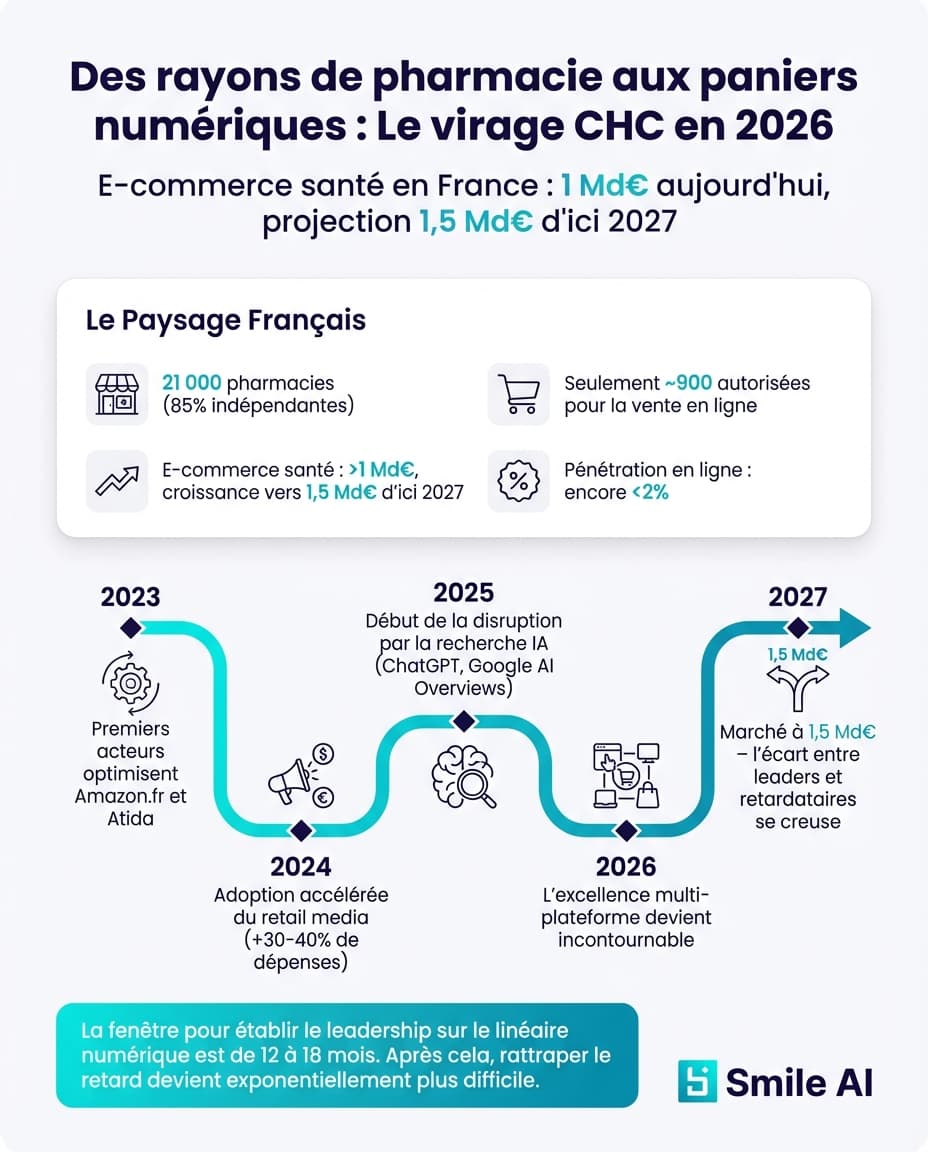
The essentials at a glance
Key takeaways from this article in one infographic.
© Smile AI 2026
Ready to dominate the Digital Shelf?
Discover how Smile Analytics helps Consumer Healthcare brands optimize their e-commerce performance across all platforms.